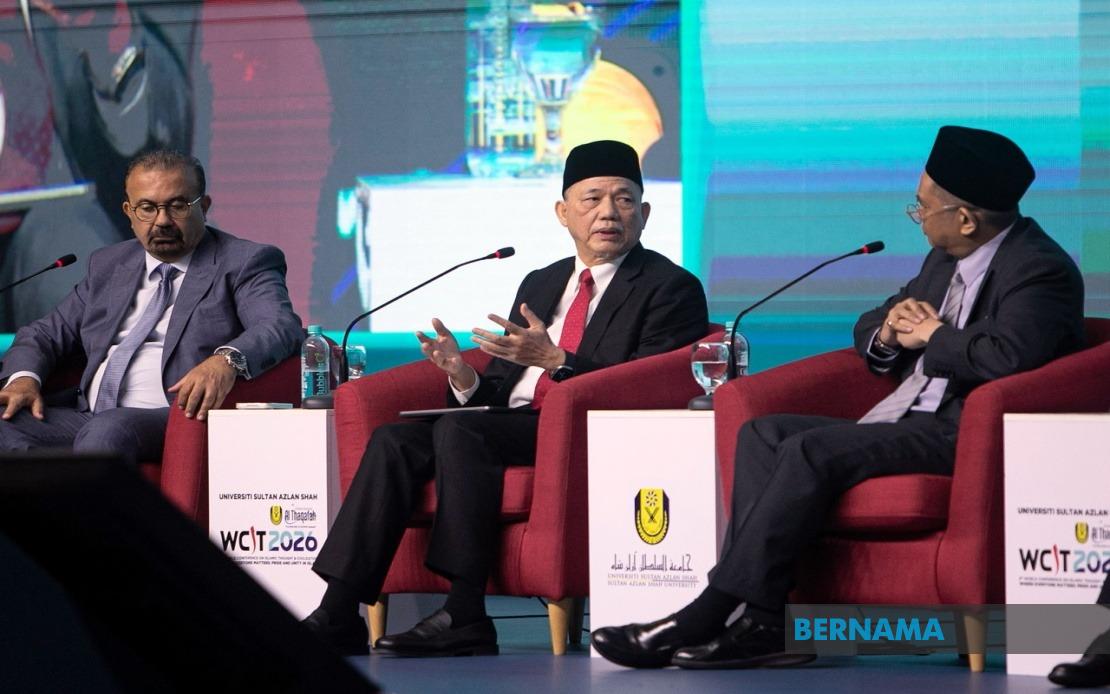
The line between energy security and maritime stability has blurred into irrelevance, according to Deputy Prime Minister Datuk Seri Fadillah Yusof, who drew attention to how contemporary geopolitical flashpoints are reshaping economic realities across the region. Speaking at the 8th World Conference on Islamic Thought and Civilisation in Ipoh, Fadillah, who also oversees the Energy Transition and Water Transformation portfolio, underscored that what unfolds in distant corners of the globe—particularly escalating tensions between the United States and Iran—now reverberates through Malaysia's economy with tangible consequences for ordinary households.
The minister's observations reflect a sobering reality that policymakers across Southeast Asia must grapple with: the traditional compartmentalisation of security threats no longer holds true. When confrontations flare in strategically vital waterways or petroleum-producing regions, the impact manifests almost instantaneously through multiple channels. Energy markets experience volatility, fuel supplies face disruption, international commerce slows, and ultimately the price Malaysians pay for electricity or petrol at the pump shifts accordingly. This cascade of effects demonstrates how interconnected modern economies truly are, with vulnerabilities extending far beyond conventional notions of national borders.
The Strait of Hormuz exemplifies this troubling convergence. This narrow passage, through which roughly one-fifth of global petroleum flows, has become a flashpoint that directly threatens Malaysia's economic interests. Recent developments there have reverberated through global supply chains with particular severity, affecting not merely energy markets but the entire architecture of international commerce. When tensions rise in Hormuz, shipping companies reassess routes, insurers demand higher premiums, and logistics costs escalate—burdens that ultimately pass through to consumers and businesses throughout Malaysia's economy.
Beyond the immediate energy implications lies a more subtle but equally significant impact on logistics and international trade flows. The insurance mechanisms that underpin global shipping have become increasingly expensive in response to heightened risks, a cost structure that manufacturers, retailers, and traders must absorb. Supply chains that rely on predictable routing and stable insurance frameworks suddenly face uncertainty. Malaysian exporters and importers who depend on efficient, affordable passage through contested waters find themselves absorbing these mounting expenses, eroding competitiveness and squeezing profit margins across multiple sectors.
Fadillah's comments at the Distinguished Royal Session alongside Sultan of Perak Sultan Nazrin Shah positioned Malaysia's diplomatic approach as fundamentally distinct from more confrontational strategies adopted by other nations. The government's commitment to pursuing calm, responsible engagement through diplomatic channels rather than military posturing reflects Malaysia's historical experience as a trading nation. For more than a century, Malaysia's prosperity has relied upon an open, stable, and rules-based international trading system—a foundation that crumbles when the global order devolves into conflict.
The minister's reference to Malaysia's geographic position along the Strait of Melaka adds another layer to this strategic calculus. As one of the world's most critical shipping corridors, the strait funnels a staggering volume of international commerce through Malaysian waters. Any disruption to regional stability, whether originating from tensions in the Middle East or elsewhere, reverberates directly through this chokepoint. Malaysia's national interest therefore extends beyond merely responding to crises in distant regions; instability anywhere in the global maritime system ultimately threatens prosperity within Malaysian territorial waters and ports.
This interconnectedness presents particular challenges for a middle-power nation such as Malaysia that lacks the military capacity to project force across oceanic distances yet depends entirely on functioning global trade for economic survival. Unlike larger powers that might seek to influence regional conflicts through military intervention or deterrence, Malaysia must rely on diplomatic acumen and commitment to multilateral frameworks that prioritise rules-based dispute resolution. The challenge lies in maintaining these commitments even when immediate interests might appear to favour other approaches.
The energy transition Malaysia is currently navigating adds further complexity to this equation. As the country moves toward renewable and diversified energy sources, short-term dependency on imported fuel remains substantial. Any supply disruption or price spike during this transition period creates acute vulnerabilities. Simultaneously, Malaysia's aspirations to develop itself as a renewable energy hub and become more self-sufficient in power generation mean that geopolitical instability in distant regions threatens both current supply security and the capital investments required to build alternative energy infrastructure.
Regional implications extend beyond Malaysia alone. Other Southeast Asian nations—particularly those sharing dependence on maritime trade routes and vulnerable to price shocks in global energy markets—face similar exposures. Thailand, Indonesia, Singapore, and Vietnam all rely heavily on stable passage through regional waters and access to reasonably priced petroleum. A regional conflagration centred on energy security could undermine prosperity across ASEAN, making collective diplomatic engagement increasingly important for the bloc's future stability.
Fadillah's emphasis on Malaysia approaching these challenges through friendship with all nations reflects a pragmatic recognition that isolation is impossible and sides must be chosen cautiously. Remaining on positive terms with both Western powers and regional actors, while maintaining neutrality in conflicts that do not directly threaten national survival, allows Malaysia to preserve both economic relationships and political autonomy. This balancing act becomes increasingly delicate as global tensions intensify.
The convergence of energy and maritime security also highlights the importance of resilience and diversification in supply chains. For Malaysia's government and private sector alike, vulnerability to distant geopolitical shocks demands strategic planning around alternative suppliers, renewable energy development, and regional economic integration that reduces dependence on contested waterways. Building such resilience requires long-term investment and coordination that extends beyond any single ministry's purview.
As Fadillah suggested, Malaysia's position at the intersection of global energy flows and maritime routes makes it both acutely exposed to international instability and potentially influential in shaping regional responses. How effectively the government navigates this reality—through diplomacy, strategic investment, and commitment to multilateral frameworks—will largely determine whether Malaysia prospers or falters amid the geopolitical turbulence that appears increasingly inevitable in coming years.

