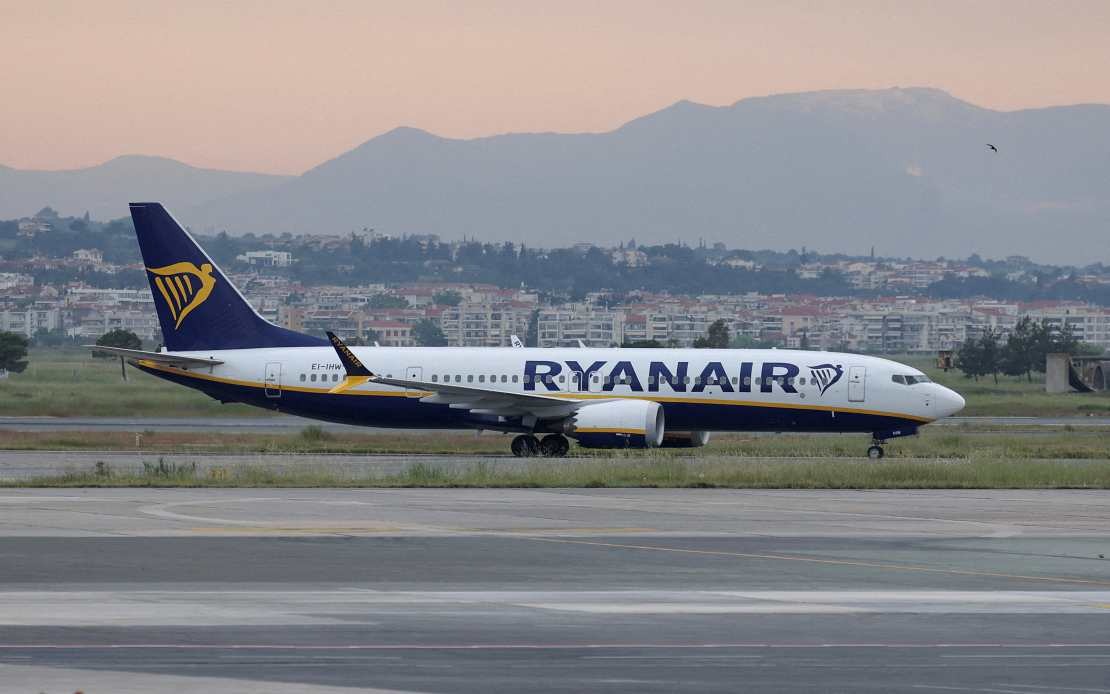
A catastrophic engine failure aboard a Ryanair flight operating from Thessaloniki to Munich last month exposed one of aviation's most harrowing scenarios: rapid decompression capable of pulling a person from their seat at cruising altitude. The US National Transportation Safety Board released its investigative findings this week, documenting how a fan blade separation in the aircraft's right engine created a chain of structural failures that culminated in the partial ejection of a passenger through the shattered cabin window.
The incident occurred shortly after the Malta Air-operated Ryanair service lifted off from Thessaloniki International Airport in Greece. During the climb phase of departure, as the aircraft was building altitude and gaining speed, the right engine experienced a critical mechanical failure. The separation of a turbine fan blade—a component designed to withstand extraordinary forces—triggered a cascade of destruction through the engine's core. Rather than containing the debris as modern engines are engineered to do, fragments escaped the engine casing with enough velocity and mass to breach the aircraft's fuselage.
The trajectory of engine debris created two distinct penetration points in the pressurised cabin structure. The primary impact occurred at row 11, where engine fragments smashed directly through a passenger window, explosively decompressing that section of the cabin. A second breach appeared in the lower lobe fuselage skin positioned aft of the right wing-to-body junction, further compromising the aircraft's structural integrity during the critical moments of rapid pressure equalisation. The violence of these breaches underscores the extreme forces generated when rotating turbine components fail at high speed.
The passenger seated in window seat 11F became caught in the decompression event, partially sucked toward the gaping window aperture as the cabin pressure differential created a powerful outward flow. Rather than becoming another aviation tragedy, fellow passengers demonstrated the capacity for immediate collective action under extreme duress. Multiple travellers physically restrained the passenger and prevented further displacement, essentially becoming an emergency response team in those chaotic seconds. Their intervention prevented what could have been a fatal outcome from unfolding at altitude.
According to the NTSB assessment, the entire window assembly was destroyed in the impact—not simply cracked or partially dislodged, but completely missing from the fuselage structure. This total window loss is particularly significant given that modern aircraft cabin windows incorporate multiple layers of acrylic and plastic designed to absorb impact energy. The force required to eliminate the window entirely suggests the engine fragments retained substantial kinetic energy across the span separating the engine inlet from the cabin wall.
Investigators discovered an unexpected contributing factor during their examination of engine components: bird remains were recovered from multiple sections of the powerplant, including feathers dispersed throughout the engine housing. This finding points toward a bird strike event as the precipitating cause of the fan blade failure. Wildlife encounters at takeoff represent an ongoing aviation hazard, particularly at regional airports in southern Europe where migratory patterns and wildlife activity fluctuate seasonally. The bird impact likely compromised the blade's structural integrity, creating a weakness that propagated into catastrophic failure as engine temperatures and rotational speeds increased during the climb.
The incident's resolution was comparatively fortunate given the severity of the structural damage. After the initial emergency, the pilots regained control of the aircraft and managed the asymmetrical thrust condition created by the dead right engine. The decision to return to Thessaloniki International Airport—rather than attempting to continue toward Munich—reflected appropriate aeronautical judgment. The aircraft landed safely despite operating on a single functioning engine, allowing emergency services to attend to the injured passenger and conduct a comprehensive damage assessment.
For regional aviation safety, this incident illustrates why engine containment design standards remain so rigorous and why regulatory authorities mandate such exacting certification requirements. The Ryanair aircraft's structure ultimately protected the overwhelming majority of passengers despite extreme circumstances. However, the incident also demonstrates the irreducible risks inherent in air travel, where the combination of wildlife, mechanical failure, and the extreme forces present at altitude can create dangerous situations within seconds. The passenger who was partially ejected sustained injuries but survived due to the quick thinking of those nearby, a factor that cannot be engineered into aircraft design.
Bird strikes have prompted aviation authorities worldwide to implement increasingly sophisticated wildlife management programs at airports, from radar systems that detect approaching flocks to habitat modification that discourages large bird populations near runways. Southeast Asian airports, which often operate in tropical environments with year-round wildlife activity, remain particularly attentive to these risks. The Ryanair incident serves as a sobering reminder that even modern aircraft with advanced safety systems remain vulnerable to incidents originating from sources beyond the aircraft itself.
The investigation's release comes as the global aviation industry continues recovering from operational disruptions and maintains elevated focus on maintenance protocols and pilot training. For low-cost carriers like Ryanair operating extensive networks across Europe and increasingly into Southeast Asia, the incident reinforces the importance of rigorous fleet maintenance and rapid response procedures. The crew's ability to manage a single-engine approach and landing, combined with the passenger interventions that prevented tragedy, exemplifies how human factors remain critical elements in aviation safety even in an era of advanced automation.

