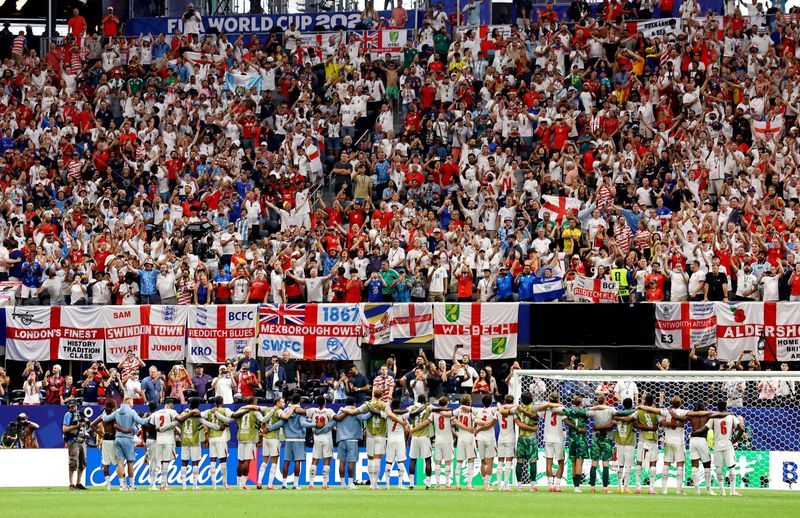
England's World Cup progression came under severe threat on Wednesday when an underdog DR Congo side pushed the tournament favorites to the brink in Atlanta, forcing a dramatic 2-1 reversal that exposed persistent defensive weaknesses and raised uncomfortable questions about Thomas Tuchel's team's overall readiness for the knockout phase.
The English camp had arrived at this juncture burdened by mounting anxiety. An opening 4-2 victory over Croatia had suggested ambitions of deep tournament advancement, yet subsequent performances against Ghana and Panama—producing a goalless stalemate and a labored 2-0 success respectively—cast doubt over whether the squad possessed the commanding quality observers anticipated. The defensive line in particular had appeared fragile throughout the group stage, a vulnerability compounded by ongoing injury concerns that limited Tuchel's selection options.
That brittleness became immediately apparent when Congolese forward Brian Cipenga capitalised on England's lack of concentration within the opening minutes, steering the ball past the goalkeeper to stun the Atlanta Stadium crowd. The moment registered as a watershed instant for England's tournament narrative. Never had they trailed at any point until that afternoon, and the historical record offered no precedent—they had never recovered to win a World Cup match after going behind at the interval. The sudden reversal transformed the stadium atmosphere from one of confident expectation into palpable unease.
What unfolded next was a masterclass in defending against a superior opponent. DR Congo, demonstrating the stubborn resilience characteristic of tournament underdogs, systematically shut down England's creative outlets whilst maintaining their own attacking threat. The Congolese defenders barely seemed to breathe in their commitment to denying space, while goalkeeper Lionel Mpasi displayed the kind of inspired shot-stopping that elevates players into folklore. England's supporters, many with national flags painted across their faces, fidgeted anxiously in their seats, sensing a tournament catastrophe unfolding. The tension proved almost suffocating as DR Congo's attackers repeatedly ventured forward with dangerous intent. Yoane Wissa struck the woodwork moments before the interval, and shortly afterward Harry Kane's vociferous penalty appeals were dismissed by the referee. England trudged into the dressing room trailing and facing genuine elimination prospects.
The critical shift emerged after the midfield hydration break when Tuchel's tactical adjustments and England's growing desperation finally began forcing openings. Jude Bellingham's powerful header extracted a brilliant reflex save, whilst Declan Rice's accurate wide deliveries created problems for the Congolese backline. Marcus Rashford saw his attempt blocked away from the goal-line, and Bellingham again found Mpasi performing miraculously in stoppage time. The goalkeeper's relentless excellence seemed to suggest that England's World Cup dream might genuinely perish in Atlanta. Tuchel displayed his mounting frustration along the technical area, at one point visibly upbraiding defender Djed Spence for a poorly-executed throw-in, before deploying tactical modifications that shifted Rice to right-back and introduced midfielder Eberechi Eze's attacking energy.
The breakthrough arrived in the 75th minute when Kane's delicately placed glancing header eluded Mpasi's desperate fingertips to equalize. The release of tension felt almost physical throughout the stadium, a collective exhalation after nearly an hour of suffocating anxiety. Kane struck again just beyond the 86-minute mark to secure England's passage and their first World Cup comeback victory since defeating Cameroon in the quarter-finals exactly 36 years prior. The magnitude of the escape could scarcely be overstated—had England failed to recover, an entire tournament narrative would have concluded in devastating anticlimax.
Tuchel's post-match commentary reflected the psychological ordeal his squad had endured. He emphasised the importance of maintaining belief during difficult phases and noted the extraordinary commitment his players had demonstrated. The manager recognised that his team's competitive character and unity had ultimately prevailed when technical excellence had temporarily abandoned them. Kane similarly acknowledged the contrasting challenges that knockout football presents, noting that whereas the DR Congo encounter tested England's capacity to break down defensive organisation, the impending Mexico showdown would present an entirely different examination—whether they could withstand determined attacking pressure from a team also desperate for progression.
Mexico presents complications extending beyond tactical considerations. The fixture will occur in Mexico City's Azteca Stadium, positioned at approximately 2,200 metres elevation. The altitude fundamentally alters football's dynamics—reduced oxygen availability impacts athlete endurance, whilst the thinner atmosphere causes the ball to travel faster and more unpredictably than players trained at sea level customarily experience. Following an exhausting psychological battle in Atlanta's oppressive humidity, England now confronts a physiological challenge that may prove equally demanding. Their lungs will face considerable strain whilst their muscle recovery compounds during the fixture itself. The geographical advantage provides Mexico considerable benefit, particularly given that Tuchel's squad demonstrated cardiovascular limitations during the prolonged second-half siege against DR Congo.
The escape against DR Congo, whilst extending England's tournament participation, has underscored that their previous defensive vulnerabilities remain unresolved. Tuchel possesses limited time to implement structural improvements before confronting a Mexican side motivated by home advantage and tournament ambitions. Whether England can sustain the psychological resilience demonstrated in Atlanta whilst simultaneously adapting to Mexico City's environmental challenges will determine whether this comeback represents a genuine turning point or merely a temporary reprieve in an ultimately disappointing campaign.

