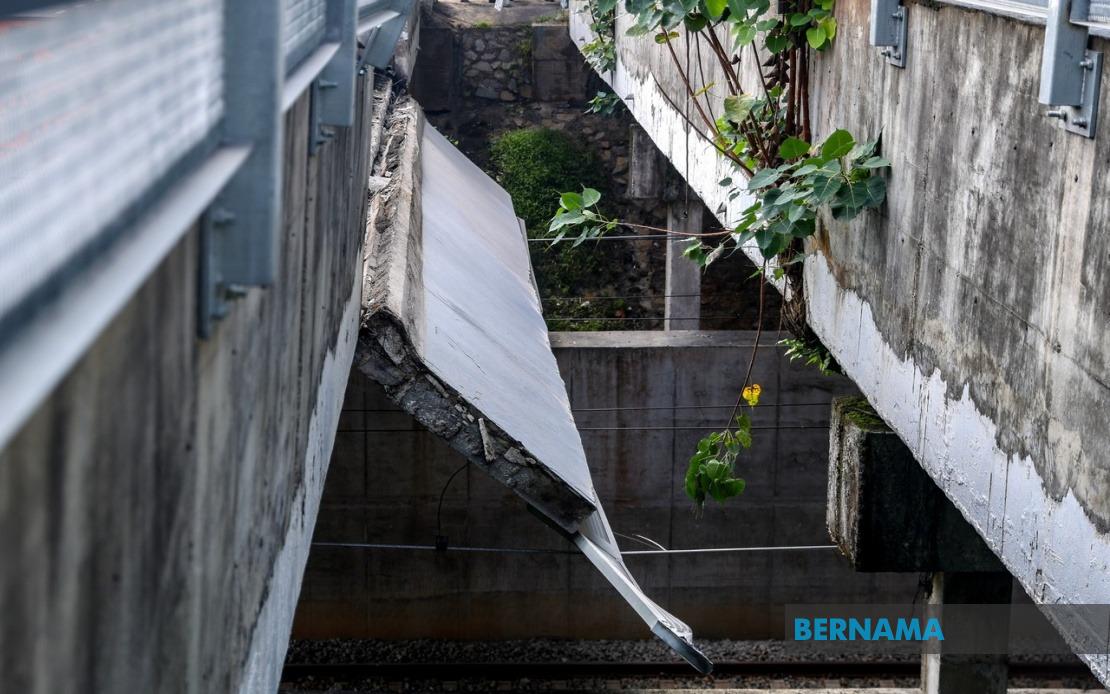
Commuters travelling on the Electric Train Service between Johor Bahru and northern Malaysia faced significant disruptions on Wednesday after a crane-carrying lorry collided with railway infrastructure along the Kulai-Kempas Baru line, prompting operator Keretapi Tanah Melayu Berhad to activate contingency transport arrangements to minimise passenger inconvenience.
Three major ETS services departing from JB Sentral Station were directly affected by the incident. The affected trains were ETS 9442 running to Padang Besar, ETS 9524 heading to Kuala Lumpur Sentral, and ETS 9326 bound for Butterworth. KTMB implemented a shuttle bus bridging service to transport stranded passengers from both JB Sentral and Kempas Baru stations directly to Kulai Station, where they could board replacement trains to continue their journeys to their final destinations. This arrangement allowed the operator to maintain a partial service capability despite the infrastructure damage.
The root cause of the disruption was a lorry operated by Transmare-Chemie (M) Sdn Bhd that crashed into the rail corridor, causing a concrete parapet structure to fall and contact the overhead line system on both tracks. The impact resulted in a power supply failure affecting train operations in the area. KTMB was notified at 3 am on Wednesday that the specialist equipment required for recovery—a 120-tonne crane—had not yet been located, creating uncertainty about the timeline for restoration work.
The operational impact extended beyond the immediate ETS network. The Shuttle Selatan service, which provides local connections between Pasir Gudang, JB Sentral, and Kempas Baru, maintained normal operations on those routes. However, the crucial Kulai-Kempas Baru-Kulai service on the same Shuttle Selatan network was entirely suspended, eliminating an alternative travel option for passengers in that corridor and further constraining transportation choices during the crisis period.
This incident represents the latest in a series of rail infrastructure challenges affecting southern Malaysian transport corridors. The previous day had already witnessed service disruptions when a different lorry carrying flammable liquid skidded near the rail line, again causing power supply problems and compelling both Shuttle Selatan and ETS services to operate under delay conditions. The frequency of vehicle-to-rail incidents raises questions about safety barriers and road management alongside the railway line.
RESTORATION efforts were expected to accelerate once the 120-tonne crane arrived at the site. KTMB indicated that lifting and removal operations were anticipated to commence around 10 am, targeting the extraction of the damaged concrete parapet that had breached the overhead line infrastructure. Nevertheless, KTMB cautioned that the exact timeline for reopening the line remained uncertain, contingent upon the efficiency of the removal work and subsequent technical inspections.
Passengers who opted not to wait for replacement train services were entitled to full refunds of their fares, with KTMB staff positioned at affected stations to process such requests and provide additional assistance. This policy acknowledged the significant inconvenience imposed by the disruption and offered an exit option for time-sensitive travellers who could adjust their plans or pursue alternative transport modes.
The restoration process involves multiple validation stages beyond the physical removal of the obstacle. KTMB emphasized that train operations would only resume after the damaged track had undergone comprehensive inspection and the overhead line system had received technical certification confirming its safety for normal operation. This multi-step clearance procedure, while potentially extending the disruption period, reflects international railway safety standards and the critical importance of overhead electrification systems to ETS functionality.
For Malaysian commuters, this incident underscores the vulnerability of major rail corridors to external disruptions originating from road transport incidents. The Kulai-Kempas Baru section represents a critical junction in the southern railway network connecting the Port Klang-Kuala Lumpur core to Johor and international services to Thailand. Extended closures on this line create cascading delays throughout the peninsula's rail network and increase pressure on alternative transport modes.
The coordination between KTMB and the responsible transport company, Transmare-Chemie (M) Sdn Bhd, will likely face scrutiny regarding liability and recovery mechanisms. Such incidents typically trigger insurance claims, root cause investigations, and potential regulatory reviews of road-rail interface safety protocols. The involvement of a large crane-carrying vehicle suggests industrial transport activity in the vicinity of the railway line, raising broader planning questions about infrastructure separation in densely developed Johor areas.
From a passenger perspective, the shuttle bus arrangement demonstrates KTMB's capacity to implement rapid contingency responses despite the logistical complexity. Coordinating multiple shuttle services from two separate stations to funnel passengers through a single processing point at Kulai Station requires real-time traffic management and clear communication—capabilities that proved essential during Wednesday's crisis. However, such arrangements, while valuable, remain far inferior to direct rail service in terms of travel time, comfort, and capacity.
Longer-term implications of this disruption extend beyond immediate passenger compensation. Repeated incidents of this nature may prompt infrastructure upgrades, including enhanced barriers between roads and railway lines, improved early warning systems for approaching vehicles, or height restrictions on vehicles using adjacent roadways. Such preventive measures would benefit the overall reliability of Malaysia's rail network and reduce vulnerability to external shocks that increasingly characterise transport operations in developed and developing regions alike.

