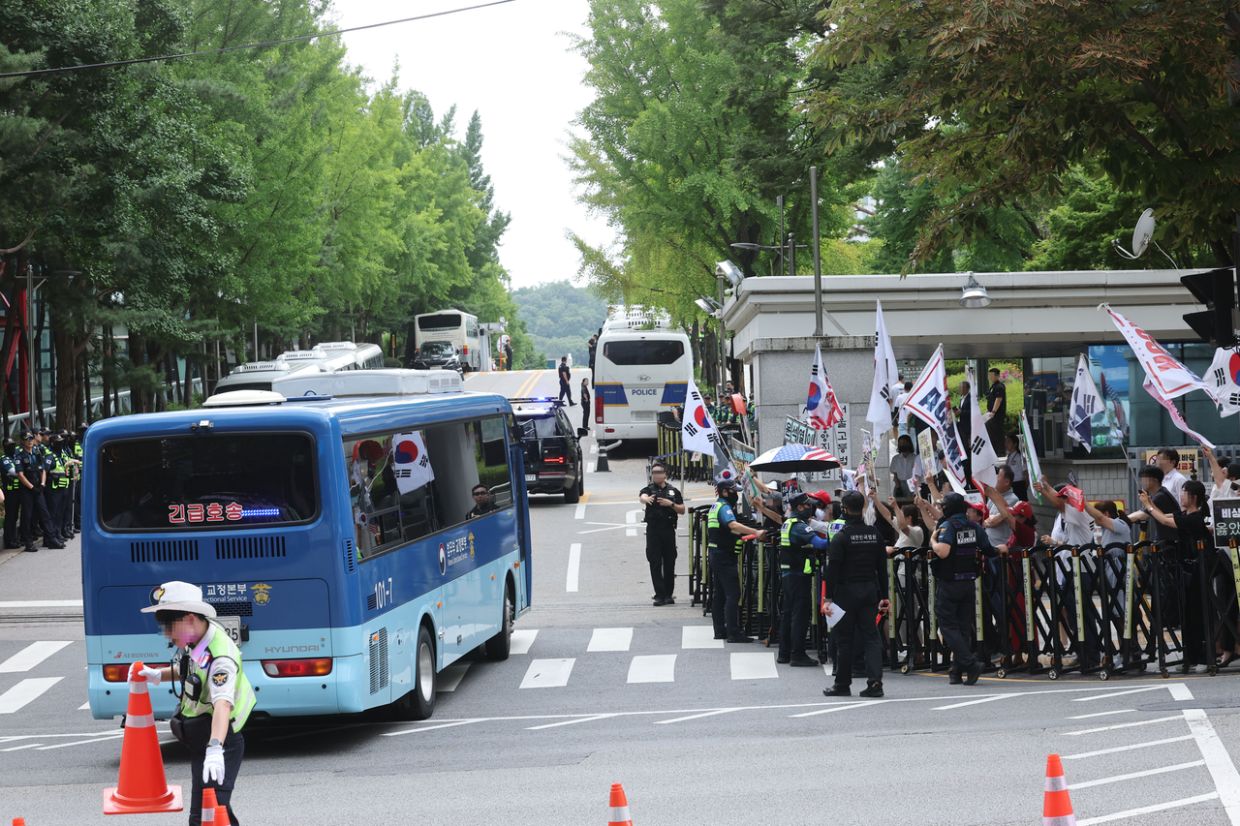
Former President Yoon Suk Yeol received a two-year prison sentence on Monday after Seoul Central District Court found him guilty of accepting undisclosed polling services during his successful presidential campaign. The conviction centres on his receipt of 14 opinion surveys valued at 27.92 million won—approximately $18,600—provided at no cost by political broker Myung Tae-kyun, a violation of South Korea's Political Funds Act which strictly regulates campaign contributions and in-kind support for candidates.
The court's judgment reveals the complex mechanics of how the polling arrangement functioned. Former first lady Kim Keon Hee, Yoon's wife, had authorised Myung to control crucial aspects of the surveys including their timing, content, methodology, and whether results would be made public. The arrangement represented a successive and tacit agreement among Yoon, his wife, and Myung, with Yoon informed of and implicitly consenting to the setup. This structure allowed the campaign to obtain substantial research value while maintaining a veneer of separation that prosecutors and the court ultimately rejected.
Presiding Judge Lee Jin-gwan emphasised the democratic significance of the violation, articulating concerns that resonate across all democracies struggling with campaign finance integrity. Opinion polls fundamentally shape voter perception and decision-making, the judge noted, serving as a cornerstone of fair electoral competition. When political operatives circumvent established funding regulations to access paid services without transparent documentation, they create conditions for public opinion manipulation and unfair electoral advantage. The court found that this arrangement specifically risked distorting the democratic process by giving Yoon's campaign access to professional polling data that competitors had to pay for through legitimate channels.
Beyond the polling services themselves, the court identified an underlying quid pro quo arrangement that deepened the misconduct. Yoon had promised Myung that former lawmaker Kim Young-sun would receive the People Power Party's presidential nomination in return for the surveys. Subsequently, Yoon exerted influence over the party's nomination process through Chang Je-won, then chief of staff to the president-elect, to fulfil this commitment. Though the court ultimately determined that proving the explicit quid pro quo was unnecessary to establish a Political Funds Act violation, the presence of this reciprocal arrangement illustrated how campaign finance violations often intertwine with broader patterns of political favouritism and behind-the-scenes dealmaking.
The case against Yoon proved more complex than the original prosecution narrative suggested. Prosecutors had initially charged him with conspiring alongside his wife to receive 58 free surveys worth more than 270 million won from Myung between June 2021 and March 2022. However, the court found sufficient evidence only for 14 of the disputed surveys, calculating the actual financial benefit at 27.92 million won rather than accepting the prosecution's broader estimation. This distinction matters significantly: it demonstrates that courts applied rigorous evidentiary standards even in high-profile cases involving former heads of state, resisting pressure to inflate charges.
Myung Tae-kyun, the political broker who facilitated the polling arrangement, received an 18-month prison sentence and was taken into custody immediately following the court's pronouncement. His conviction and incarceration underscore that culpability extends beyond the politician who benefits from illicit arrangements to include the service providers who knowingly participate in circumventing campaign finance regulations. In South Korea's political ecosystem, fixers and intermediaries like Myung occupy crucial positions in backroom arrangements, making their prosecution essential to dismantling the informal networks that undermine legal campaign finance frameworks.
The conviction of Yoon stands in stark contrast to the treatment of his wife in a related proceeding. Kim Keon Hee was acquitted at both trial and appellate levels on charges involving the same polling services, a divergence that Judge Lee explained by noting that the allegations in the two cases could not be regarded as identical. In Kim's case, lower courts found that prosecutors failed to establish either that she received a measurable financial benefit equivalent to the surveys' cost or that the polling services were provided in return for securing Kim Young-sun's nomination. This distinction illustrates how campaign finance jurisprudence can produce apparently inconsistent outcomes depending on the specific evidentiary chains prosecutors establish for different defendants.
For Malaysia and other Southeast Asian democracies grappling with campaign finance regulation, the Yoon case offers instructive lessons about both the possibilities and limitations of legal accountability in high-profile political corruption. South Korea's courts demonstrated willingness to prosecute and convict a sitting president's successor, suggesting institutional resilience against political interference. Yet the case also reveals how campaign finance violations often prove difficult to prosecute comprehensively. The court's inability to convict Yoon on most of the 58 surveys prosecutors alleged indicates that establishing clear chains of evidence for unpaid in-kind contributions remains challenging, even with dedicated prosecution resources and public attention.
The ruling carries broader implications for South Korea's political future. Yoon currently faces multiple other investigations and prosecutions, including allegations related to his controversial declaration of martial law in December 2024. This conviction on campaign finance charges represents one component of a larger legal reckoning with his presidency. The two-year sentence falls short of the maximum possible punishment but signals serious judicial rebuke of his campaign conduct. His ability to appeal to the Supreme Court preserves procedural protections, yet the conviction establishes a significant legal precedent that even former heads of state remain subject to campaign finance laws.
For the broader Southeast Asian context, Yoon's conviction demonstrates that entrenched political figures can face accountability through judicial processes, though often only after they have left office. The case illustrates how campaign finance violations frequently operate through informal networks and tacit arrangements rather than explicit written agreements, making detection and prosecution dependent on investigative sophistication and prosecutorial persistence. South Korea's experience suggests that democracies must develop institutional capacity to follow money and favours through complex webs of intermediaries, a challenge that resource-constrained anticorruption agencies across the region continue to struggle with.
The Supreme Court's upcoming decision on Kim Keon Hee's case, scheduled for Thursday, may provide additional clarity about where courts draw boundaries in campaign finance accountability. If the Supreme Court affirms her acquittal, it will reinforce the principle that financial benefit to the defendant must be clearly established. Conversely, if it reverses and convicts, it would signal stricter standards for what constitutes complicity in campaign finance violations. Either outcome will reshape how South Korean political operatives calculate risk in future campaign cycles, and may influence how prosecutors in other democracies approach similar cases involving high-level officials and in-kind campaign contributions.

