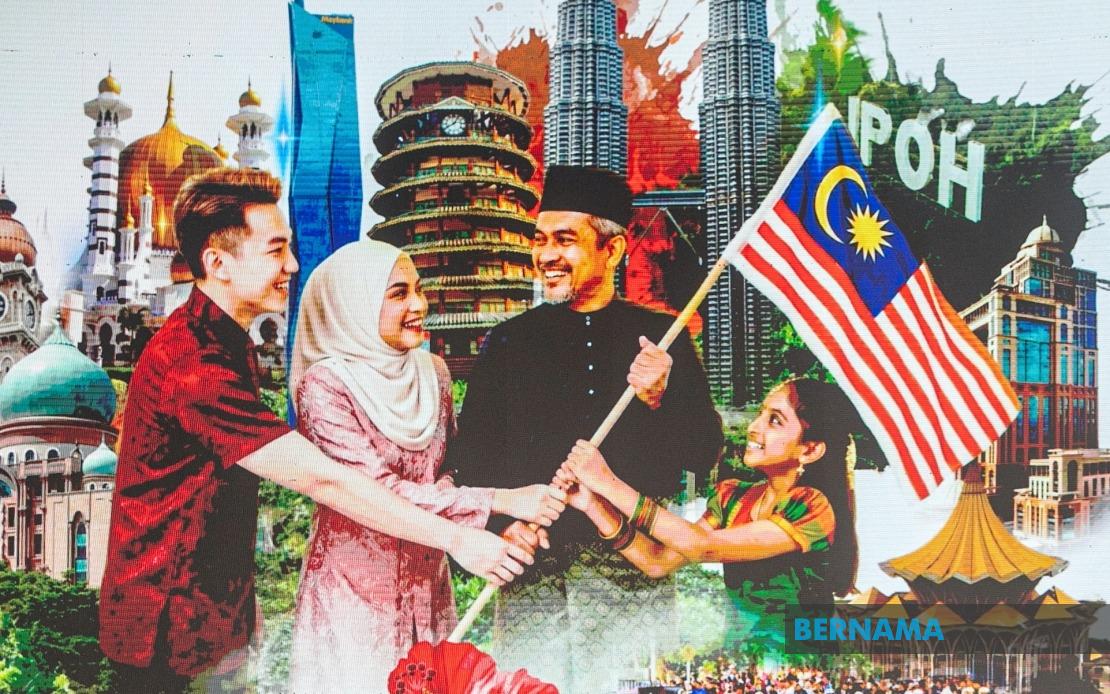
Communications Minister Datuk Seri Fahmi Fadzil has issued a timely advisory for content creators to exercise heightened vigilance when deploying artificial intelligence tools to generate material featuring the Jalur Gemilang, Malaysia's national flag. The warning, made during the launch of the 2026 National Month and Fly the Jalur Gemilang campaign in Ipoh, underscores growing concerns about how algorithmic systems may inadvertently distort critical national symbols in the digital age. The initiative was officially inaugurated by Prime Minister Datuk Seri Anwar Ibrahim and attended by National Unity Minister Datuk Aaron Ago Dagang and Perak Menteri Besar Datuk Seri Saarani Mohamad at the Sultan Azlan Shah Ministry of Health Training Institute in Tanjung Rambutan.
The crux of Fahmi's concern centres on a specific vulnerability in AI-generated imagery: the consistent and accurate rendering of the flag's 14 stripes, a defining characteristic of the Jalur Gemilang. While artificial intelligence has revolutionized content creation, enabling rapid production of graphics and multimedia materials, these systems occasionally produce imperfect representations of national symbols. The minister stressed that any omission or misrepresentation of these stripes constitutes a significant error, one that could inadvertently disrespect a symbol central to Malaysian national identity. As AI tools become increasingly accessible to the general public and professional content creators alike, the potential for such mistakes multiplies, making preventive guidance essential.
Fahmi's statement reflects a broader recognition within government that the intersection of technology and national iconography requires careful management. The Fly the Jalur Gemilang campaign, which encourages Malaysians to display the national flag from the announcement date through at least September 16, represents a coordinated effort to elevate patriotic sentiment across residential areas, villages, and government facilities. Yet in an era where much of this content may be AI-assisted or AI-generated, inconsistency in flag representation could undermine the campaign's symbolic power. The ministry has therefore positioned itself not as a rigorous enforcer but as an educator, attempting to build awareness among creators about the technical requirements for accurate flag imagery.
To institutionalize these standards, Fahmi announced collaborative arrangements with the Malaysian Press Institute and the Malaysian Media Council, positioning these organizations as partners in ensuring accurate flag representation throughout National Month. These bodies will be tasked with engaging media organizations to establish and maintain quality controls on flag imagery, particularly those produced through artificial intelligence. This approach recognizes that media organizations, as repeat producers of national imagery, require clear guidance and institutional support to maintain consistency. By enlisting established media bodies as gatekeepers, the government seeks to create a distributed enforcement mechanism that operates largely through professional standards rather than legal coercion.
The question of legal consequences for inaccurate flag depiction prompted Fahmi to clarify the ministry's enforcement philosophy. While acknowledging that specific laws govern the proper display and representation of the Jalur Gemilang, the minister indicated that the initial response would prioritize persuasion over punishment. The government intends first to contact parties responsible for errors in AI-generated content or flag display and request voluntary correction. This measured approach reflects pragmatism about enforcement challenges in the digital realm, where identifying content creators and determining intentionality can prove complex. Only if parties fail to rectify mistakes after being advised would the ministry consider pursuing formal legal action, though Fahmi did not specify which statutes might apply.
This advisory stance carries implications for both content creators and technology companies developing AI systems. Individual creators and small media operations now bear responsibility for verifying AI outputs before publication, a task requiring either technical expertise or careful visual inspection. Technology companies, meanwhile, face subtle pressure to improve their models' accuracy in rendering national symbols, even as Fahmi stops short of imposing mandatory compliance. The approach suggests that the ministry recognizes the impracticality of strict enforcement while attempting to establish a normative framework through which digital communities will self-regulate.
The timing of this guidance, coming ahead of the 2026 National Month and Malaysia Day celebrations, carries particular significance for Malaysian-Southeast Asian relations and soft power. National Month represents a critical period for articulating national identity both domestically and to international audiences. Inaccurate flag representation, especially when amplified through social media and digital platforms, could create an impression of carelessness about national symbols. For a country that values the integrity of its institutions and emblems, such errors carry reputational implications. Moreover, as Southeast Asian nations increasingly compete for digital influence and cultural presence, the accuracy and dignity with which they present their symbols through AI-generated content becomes a subtle but meaningful dimension of national brand management.
Fahmi's emphasis on public education and learning proper flag etiquette extends beyond mere technical accuracy. The minister encouraged Malaysians to invest time in understanding the protocols governing flag display, suggesting that this knowledge itself constitutes an important aspect of contemporary patriotism. In an environment where AI tools democratize content creation, ensuring that millions of potential creators possess baseline knowledge about flag standards becomes an exercise in collective national responsibility. This framing transforms the issue from a specialized concern of broadcasters and publishers into a civic obligation for all digitally active citizens.
The distinction between the planned venue locations for the dual celebrations also reflects geographic inclusivity and constitutional recognition within Malaysia's framework. National Day festivities will be centered in Putrajaya, the administrative capital, while Malaysia Day will be observed in Sarawak, acknowledging the significance of this East Malaysian state in the federation's formation. These location choices ensure that both observances receive equivalent ceremonial prominence while celebrating different but complementary aspects of Malaysian nationhood. The decision underscores that National Month encompasses not merely flag-waving nostalgia but substantive engagements with historical and constitutional meaning.
For media organizations and digital platforms operating within Malaysia, the advisory creates a new layer of editorial responsibility. News outlets, social media moderators, and content distribution networks must now consider not only the political or commercial aspects of flag-related content but also its technical accuracy when generated through AI. This requirement, while seemingly modest, represents a meaningful expansion of quality control standards in the digital age. The collaboration between government and media institutions signals recognition that maintaining national symbol integrity requires partnership rather than unilateral government action.
The broader context for this initiative reflects Malaysia's ongoing navigation of technological change and cultural preservation. As artificial intelligence becomes embedded in content production workflows across sectors from journalism to corporate communications to entertainment, ensuring that symbolic integrity is maintained requires proactive standard-setting. Fahmi's approach, balancing flexibility with principle, suggests a government attempting to harness technology while protecting institutions from degradation through algorithmic error. Whether voluntary compliance mechanisms will prove sufficient to prevent widespread inaccuracies remains an open question, but the articulation of standards represents an important first step in an increasingly complex digital landscape.

