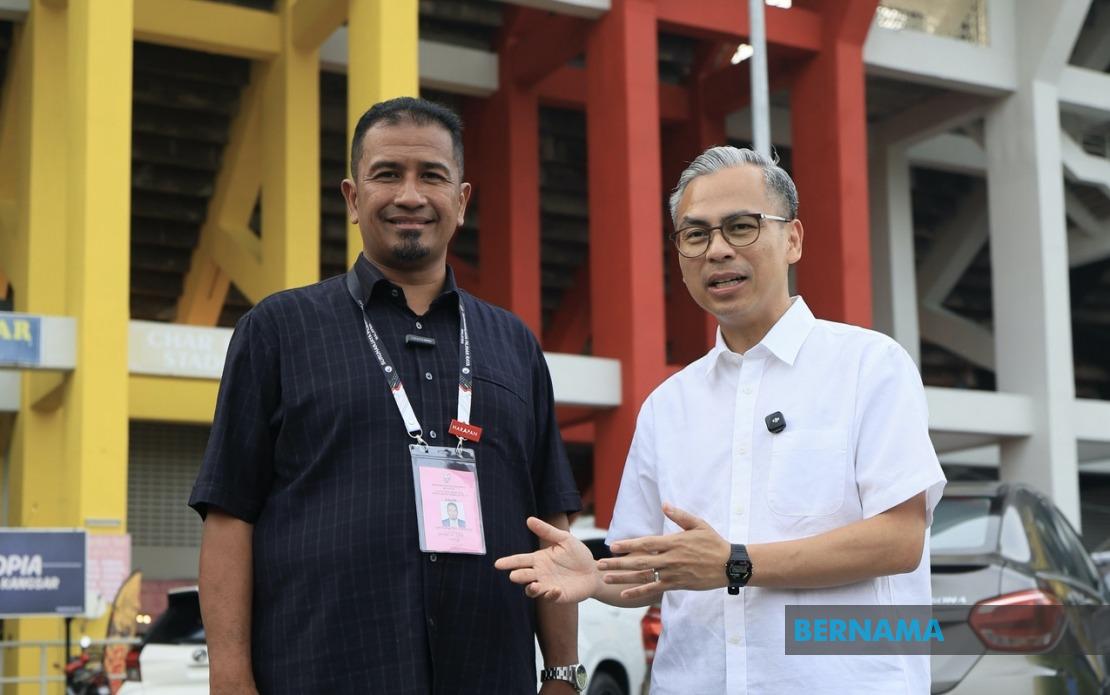
Communications Minister Datuk Seri Fahmi Fadzil has demanded that all political contenders maintain campaign decorum during the Negeri Sembilan State Election, emphasising that electoral contests should centre on substantive policy discussion and factual argument rather than personal attacks or destructive behaviour. His appeal comes after billboards belonging to Pakatan Harapan candidate Dr Azizul Hakim Mahdi for the Rantau state constituency were subjected to vandalism, an incident that has drawn attention to the standard of political conduct during the current campaign period.
The vandalism incidents have been documented not only through physical evidence but also through social media channels, where videos and photographs purporting to show the destruction of campaign materials have circulated online. Fahmi addressed this directly, acknowledging the gravity of such actions whilst maintaining that law enforcement authorities should investigate and prosecute any individuals found responsible, as vandalism constitutes a criminal offence under Malaysian law. This approach reflects the government's determination to distinguish between legitimate political competition and unlawful interference with candidates' campaign activities.
During a campaign event at Paroi Stadium in Seremban City Council, where he accompanied PH candidate for Sikamat state seat Nur Azman Mohamad, Fahmi reiterated that political campaigns must demonstrate maturity and sophistication by prioritising the exchange of ideas and factual evidence. He contrasted this ideal against the alternative of campaigns marred by slanderous rhetoric or sabotage, warning that such approaches not only undermine democratic principles but risk escalating tensions within communities already engaged in electoral competition. His comments reflect growing concern within government circles about maintaining social cohesion during what promises to be a closely contested state election.
The Negeri Sembilan state election represents a significant political test for Pakatan Harapan, with polling day scheduled for August 1 and early voting set for July 28. The relatively compressed campaign timeline heightens the importance of maintaining standards of conduct, as the intensity of political activity will accelerate significantly in the final stretch. Fahmi's intervention at this early stage of the campaign, approximately one week before polling day, suggests that concerned about the tone and direction of electioneering already warranted high-level political guidance.
Fahmi assessed that the campaign was progressing satisfactorily at its outset, though he anticipated substantial intensification as voting day approached. He employed the metaphor of automotive acceleration to illustrate this anticipated trajectory, suggesting that participants were still in the early stages of mobilisation and would soon shift into higher gear. This assessment aligns with typical patterns in Malaysian electoral campaigns, where initial activities focus on voter outreach and message dissemination before accelerating into a final week of concentrated canvassing and public events.
Prime Minister Datuk Seri Anwar Ibrahim has already committed to an extensive ground campaign, conducting stops at multiple locations to directly engage voters and reinforce party messaging. Fahmi indicated that additional senior leadership would join campaign activities in the coming days, signalling that Pakatan Harapan regards the Negeri Sembilan contest as sufficiently important to warrant senior-level participation. This deployment of political resources underscores the party's determination to secure or maintain influence within the state assembly.
The context of billboard vandalism must be understood against the backdrop of how campaign materials function in Malaysian electoral politics. Billboards serve as highly visible expressions of candidate presence and party commitment to constituencies, making their destruction a symbolic act with psychological dimensions beyond the material loss. The targeting of PH materials specifically suggests either partisan motivation or opportunistic disruption, either of which undermines the democratic principle that all registered candidates should have equal capacity to communicate their messages to voters.
Fahmi's intervention represents the government's attempt to establish and enforce norms of acceptable political behaviour through public statements and moral suasion. Rather than relying solely on law enforcement responses to specific incidents, he sought to establish a broader framework emphasising that healthy democracy requires voluntary adherence to standards of conduct that transcend legal minima. This approach acknowledges that not all destructive or corrosive political behaviour necessarily violates criminal law, yet still damages the quality of electoral discourse.
The call for idea-based rather than personal campaigning reflects a broader concern about the trajectory of Malaysian politics, where the competition between political coalitions can sometimes overshadow substantive policy debate. By explicitly privileging factual argument and policy discussion, Fahmi attempted to elevate the standard of political discourse and redirect campaign energy toward matters directly affecting voter welfare. This framing implicitly criticises campaigns that rely on character assassination, conspiracy theories, or inflammatory rhetoric rather than substantive engagement with governance questions.
For Malaysian voters in Negeri Sembilan, Fahmi's intervention signals that government leadership regards respectful and factual campaigning as sufficiently important to warrant public emphasis. It also indicates that authorities will take vandalism and other forms of campaign sabotage seriously, potentially deterring further incidents. The message is calibrated to reassure voters that the electoral process will be managed professionally whilst warning participants that destructive behaviour will invite legal consequences.
The Negeri Sembilan election occurs at a time when Malaysian politics remains characterised by significant competition between Pakatan Harapan and opposition coalitions, with state-level contests serving as important indicators of public sentiment between general elections. The conduct of this campaign will therefore carry implications extending beyond the immediate state outcome, potentially influencing voter perception of which coalitions can be trusted to govern responsibly and ethically. Fahmi's emphasis on campaign maturity should therefore be understood as serving both immediate practical purposes and longer-term political reputational interests.

