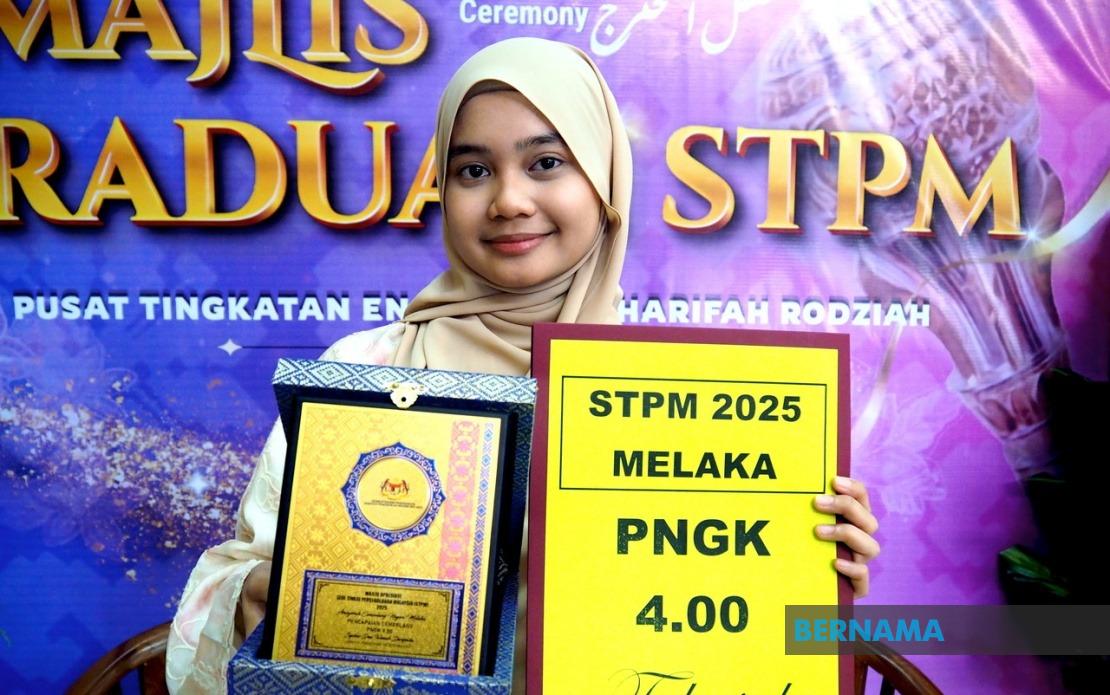
Nurfariesya Nasywa Hamedee's path to academic excellence was neither straightforward nor free from tragedy. The 21-year-old student from Sekolah Menengah Kebangsaan Agama Sharifah Rodziah in Melaka has just been announced as among the highest performers in the 2025 Sijil Tinggi Persekolahan Malaysia (STPM) examination, securing an impressive Cumulative Grade Point Average of 4.00. Yet behind this stellar achievement lies a deeply personal story of loss, resilience, and a son's unfulfilled legacy transformed into a daughter's driving force. When her father Hamedee Asri, then aged 43, suffered a fatal heart attack just a week before her SPM trial examination, Nurfariesya faced a crossroads that would test far more than her academic commitment.
The death occurred at a particularly vulnerable moment in her educational journey. Hamedee Asri's final piece of advice—urging his daughter not to squander her potential—reached Nurfariesya through her mother Yusnita Ruslan after his passing. For a grieving teenager contemplating dropping out of school to work and support her family, this last message from her father became an anchor. Rather than surrendering to despair or financial pressure, she channelled her grief into determination, resolving to honour his memory by pursuing excellence in her studies. This decision, made in the immediate aftermath of bereavement, proved foundational to everything that followed.
When the results of the 2025 STPM examination were announced at the Melaka State Results Ceremony, officiated by Datuk Rosli Abdullah, State Deputy Exco for Education, Higher Education, and Religious Affairs, Nurfariesya's 4.00 CGPA represented something far more significant than a statistical achievement. By her own admission, she had not anticipated perfecting her results. Based on her trial examination performance and preliminary calculations, she had conservatively projected a CGPA around 3.92. Exceeding even her own optimistic expectations speaks to the depth of her commitment and the quality of her preparation across all subjects taken during the pre-university programme.
The breadth of Nurfariesya's academic engagement reveals a student with diverse intellectual interests rather than one narrowly focused on maximising a single score. She undertook challenging subject combinations including General Studies, Arabic, Usuluddin, History, and Shariah—a cohesive cluster that suggests purposeful preparation for further study in religious jurisprudence. Her earlier success in securing seven A grades at SPM level had already demonstrated solid foundational competency, but the STPM results showcase genuine mastery across these more advanced disciplines. This intellectual range distinguishes her profile from students who might achieve similar overall grades through concentration in narrower subject areas.
Nurfariesya's motivation extends well beyond academic competition or parental pressure. Since her father's death, she has harboured a specific vocational aspiration: becoming a Shariah lawyer. This professional ambition has provided focus and meaning to her studies that transcends grades on a transcript. The subjects she selected at STPM level were deliberately chosen to support this trajectory, and her deep interest in Shariah law has functioned as intrinsic motivation throughout her pre-university studies. She has recently completed an interview session for a Bachelor's Degree programme at Universiti Malaya, the logical institutional progression for someone with her academic credentials and professional goals.
When discussing her formula for success, Nurfariesya articulated principles that, while unglamorous, reflect the reality of sustained academic performance at the highest level. She emphasised hard work, persistence in the face of setbacks, and faith—a spiritual dimension that appears particularly significant given her specialisation in Islamic theology and jurisprudence. Notably absent from her explanation was any reference to intensive commercial tutoring, sophisticated study hacks, or privileged access to resources beyond her school's standard provision. Her message to other students appears to be that excellence, particularly in the context of pre-university examination systems in Malaysia, remains achievable through consistent effort and sustained commitment, even—or perhaps especially—when motivation originates from profound personal loss.
Nurfariesya's achievement comes within the same examination cycle as another notable Melaka performer: Ng Zhen Hong from Kolej Tingkatan Enam Tun Fatimah, who was named the recipient of the National-Level Best Student Award for the Science Stream in the 2025 STPM examination. Ng's distinction as the national-level top performer in the science stream adds broader context to Melaka's strong examination performance in 2025. Having scored ten A grades at SPM level, Ng similarly exceeded his own expectations in securing the national honour. His planned trajectory toward Chemical Engineering or Electrical Engineering at Universiti Malaya reflects the increasingly specialised pathways that top-performing STPM students can access through Malaysia's higher education institutions.
Ng's account of his daily revision routine—dedicating one to two hours each day to consolidating his learning—mirrors the disciplined approach described by Nurfariesya. Both students emphasised the importance of parental and teacher support, suggesting that institutional excellence in education systems does not emerge solely from individual effort but requires functional support ecosystems. For Ng, his passion for science subjects, particularly those involving calculations and problem-solving, provided the motivational scaffold that made sustained daily effort sustainable rather than burdensome. This distinction between genuine interest and external obligation appears significant in understanding why students maintain consistency across the extended STPM examination period.
For Malaysian education observers and parents of pre-university students, Nurfariesya's journey offers several instructive elements. First, it demonstrates that personal tragedy need not derail educational progress; indeed, meaningful personal narratives can serve as motivation stronger than external incentives. Second, it illustrates that perfecting an examination score remains achievable through Malaysia's established pre-university pathway without reliance on extensive private tuition or exceptional socioeconomic advantage. The students celebrated in the 2025 STPM results represent diverse institutional backgrounds—government schools and government colleges—rather than exclusively elite private institutions. Third, both Nurfariesya and Ng's preference for STPM over other pre-university alternatives (such as A-Levels or International Baccalaureate) highlights the continued viability and accessibility of the Malaysian examination system for students with university aspirations.
Looking forward, Nurfariesya's achievement carries implications beyond her individual trajectory. As she contemplates her Bachelor's programme at Universiti Malaya and an eventual career as a Shariah lawyer, she joins a cohort of high-achieving students channelling excellence toward professional fields that address substantive societal needs. The legal profession, particularly in specialised areas like Shariah jurisprudence, benefits from practitioners educated to the highest intellectual standards. Nurfariesya's combination of perfect STPM results and demonstrated commitment to Islamic legal principles suggests she may ultimately contribute to Malaysia's professional landscape in meaningful ways. Her example also serves quieter but important functions: it demonstrates to other students facing grief, adversity, or limited resources that excellence remains within reach through perseverance, strategic subject selection, and unwavering focus on a meaningful long-term goal.
The broader narrative emerging from the 2025 STPM announcement is one of institutional continuity and meritocratic function. Thousands of Malaysian students sat for these examinations; among them, individuals like Nurfariesya and Ng achieved exceptional results through a combination of personal effort, institutional support, and often, meaningful motivation rooted in circumstances particular to their lives. Nurfariesya's perfect score represents not merely intellectual capability but the successful navigation of grief, financial anxiety, and the ordinary challenges of adolescence alongside academic demands. Her father's final advice—not to waste her potential—has been honoured through achievement that opens pathways to professional contribution and personal fulfilment. This outcome, multiplied across thousands of successful STPM students entering Malaysia's higher education system annually, suggests that the examination remains a functional and fair mechanism for identifying and nurturing talent from diverse backgrounds.

