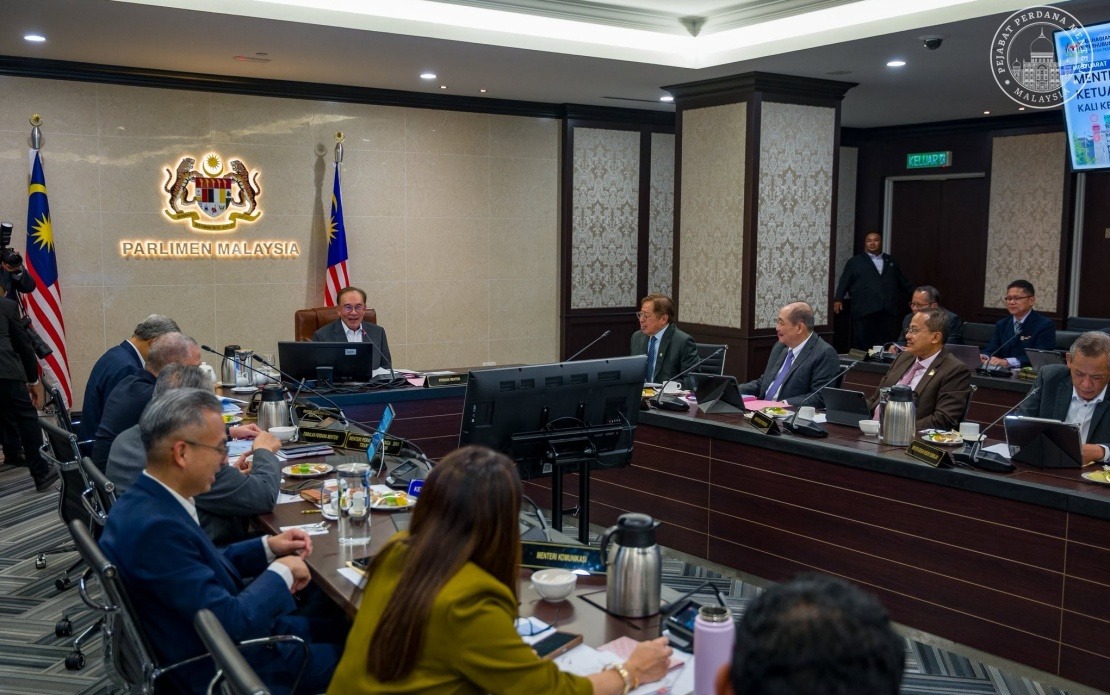
Prime Minister Datuk Seri Anwar Ibrahim convened the 149th Meeting of Menteris Besar and Chief Ministers at the Parliament Building in Kuala Lumpur on June 23, bringing together Malaysia's top federal and state leaders to chart a unified course for the nation's economic recovery. The gathering, which represents one of the key coordination mechanisms between Putrajaya and state capitals, centred on developing comprehensive strategies to shield Malaysia's economy from the cascading effects of global instability, particularly the escalating tensions in West Asia that have destabilised international markets and disrupted trade flows.
The confluence of regional geopolitical turmoil has created a particularly precarious environment for Malaysia's open economy, which depends heavily on global trade and investment flows. As a nation positioned strategically along critical shipping lanes and deeply integrated into regional supply chains, Malaysia faces heightened vulnerability to any prolonged disruption stemming from Middle Eastern conflicts. The challenge before the assembled leaders was therefore substantial: how to maintain economic momentum and investor confidence while external conditions remain volatile and unpredictable. Anwar's emphasis on this dimension underscores the seriousness with which the federal government views the potential fallout from West Asian instability on domestic economic performance.
Beyond geopolitical considerations, the meeting addressed an equally pressing environmental challenge that threatens Malaysia's agricultural productivity and food security. The El Niño phenomenon, which meteorologists have flagged as an approaching concern, presents a multifaceted threat to the nation's economic and social wellbeing. Prolonged dry spells associated with this weather pattern could critically constrain water supply to urban and rural populations, compromise agricultural yields at a time when food inflation already pressures household budgets, and elevate the incidence of haze events that damage public health and economic activity. The convergence of these environmental pressures with existing economic vulnerabilities creates a complex policy challenge requiring coordinated action across multiple government tiers and economic sectors.
According to Anwar's account of the deliberations, the assembled Menteris Besar and Chief Ministers examined how comprehensively prepared Malaysia's institutions and infrastructure are to absorb the shock of El Niño. This assessment would necessarily encompass water resource management systems, irrigation infrastructure in agricultural regions, disaster preparedness frameworks, and public health protocols for managing extreme heat and air quality crises. The fact that this discussion featured prominently in the agenda suggests federal planners recognise that state governments, which administer much of Malaysia's agricultural land and local water systems, must be equipped and coordinated to respond effectively.
A significant dimension of the meeting's focus involved reorienting how government operates at both federal and state levels. Rather than pursuing policies in silos or allowing jurisdictional boundaries to impede coordination, Anwar advocated for what he characterised as more integrated, efficient, and people-centric implementation of government initiatives. This phraseology suggests frustration with previous modes of operation where federal programmes sometimes clashed with state priorities or where coordination failures diluted policy effectiveness. In the Malaysian context, where concurrent federal and state powers coexist and occasionally create tensions, such calls for integration carry considerable weight and represent an attempt to streamline governance despite constitutional divisions of authority.
The prime minister further emphasised that this integrated approach must simultaneously strengthen Malaysia's economic competitiveness in global markets. In an era of intensifying competition for foreign investment and export markets, Malaysia cannot afford to appear internally fractured or administratively dysfunctional. Multinational corporations contemplating regional investment decisions require assurance that government policy is coherent, predictable, and implemented consistently across state boundaries. By publicly underscoring the commitment to unified, efficient governance, Anwar seeks to project stability and seriousness to potential investors evaluating Malaysia against regional alternatives.
Attraction of quality foreign investment emerged as another explicit priority in the meeting's deliberations. Quality matters as much as quantity here; the goal is not merely to boost foreign investment inflows but to secure capital that brings technological transfer, skills development, and sustainable employment rather than footloose operations seeking only tax breaks or labour cost advantages. Given Malaysia's positioning as a middle-income economy facing pressure from lower-cost competitors and technological disruption, the emphasis on quality signals a strategic pivot towards more sophisticated economic activities. This approach aligns with the nation's longstanding ambition to transition towards higher-value manufacturing and services.
Central to Anwar's framing of these economic imperatives was an overarching commitment to safeguarding the welfare and prosperity of all Malaysians. This language, while perhaps appearing formulaic, carries substantive implications for policy design. It signals that economic growth strategies will be evaluated partly by their distributional consequences—whether gains are broadly shared across regions, income groups, and demographics or concentrated among narrow beneficiaries. For a multiethnic, multiregional nation like Malaysia, ensuring that development benefits reach all communities and states remains politically essential and socially necessary for maintaining cohesion.
Anwar portrayed the meeting as reflecting a spirit of togetherness and consensus between federal and state administrations. This characterisation is noteworthy because federal-state relations in Malaysia have historically been contentious, particularly when different political coalitions control the centre and individual states. If such consensus genuinely prevails, it would represent a significant achievement in aligning what are sometimes competing governance interests. However, the sustainability of such consensus will ultimately depend on whether the agreed-upon strategies translate into tangible improvements in economic performance and public welfare.
The implications for regional stability and Malaysia's role in Southeast Asia are also worth considering. As ASEAN's third-largest economy, Malaysia's policy choices and economic health influence broader regional dynamics. Economic stagnation or internal policy incoherence in Kuala Lumpur reverberates throughout the region's investment climate and integration processes. Conversely, a Malaysia that successfully navigates current global uncertainties while maintaining internal coordination could emerge as a more resilient regional actor, potentially influencing the broader ASEAN economic architecture.
Moving forward, the concrete test of the meeting's outcomes will lie in implementation. High-level consensus statements, while necessary, prove insufficient without sustained follow-through by federal agencies, state governments, and private sector partners. The coordination mechanisms established during such meetings require ongoing reinforcement and adjustment as conditions evolve. Malaysia's ability to weather the combination of geopolitical turbulence, environmental stress, and economic competition will depend on how effectively the federal and state apparatus translates these stated commitments into coherent, coordinated action.

