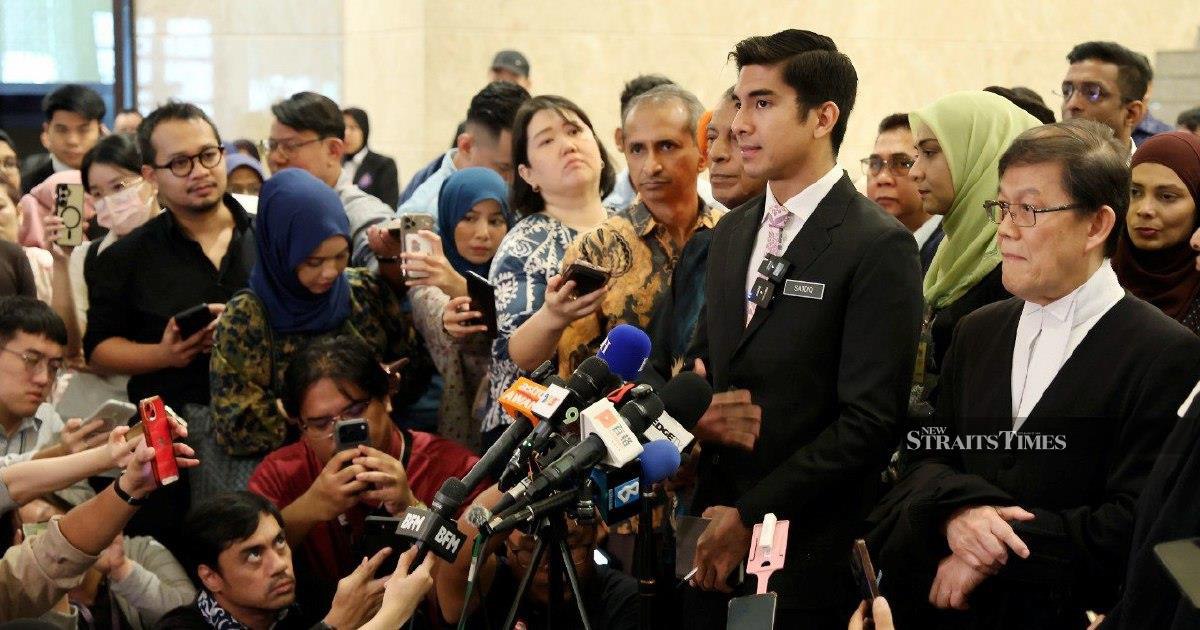
The prosecution has appealed for public patience following the Federal Court's decision to postpone its judgment in the landmark appeal involving Muar Member of Parliament Syed Saddiq Syed Abdul Rahman. The adjournment came after a member of the judicial panel was unable to sit due to medical reasons, prompting the court to defer its ruling on what remains one of the most closely watched legal proceedings involving a prominent young politician in Malaysia.
The case represents a significant juncture in Malaysian political and legal discourse. Syed Saddiq, who gained prominence as a younger generation politician and former Bersatu Youth Chief, has faced considerable legal scrutiny over financial matters related to his political activities. The protracted nature of these proceedings reflects both the complexity of the underlying allegations and the meticulous approach taken by the courts in handling cases of substantial public interest.
When the Federal Court eventually reconvenes to deliver its judgment, the decision will carry implications extending far beyond the immediate parties involved. The court's interpretation of relevant statutes and legal principles could establish precedents affecting how similar financial allegations involving politicians are prosecuted and adjudicated in future cases. The outcome may also influence broader perceptions about judicial independence and the rule of law during a period when Malaysia's legal institutions have faced heightened public scrutiny.
The postponement underscores an inherent tension within the Malaysian judicial system: the need to maintain schedules and public confidence versus the practical realities of judicial administration. Medical emergencies affecting judges, while unavoidable, inevitably create delays that test the patience of interested parties, including the accused, prosecutors, legal representatives, and the broader public following the matter. The prosecution's measured appeal for understanding acknowledges this reality while attempting to maintain confidence in the process itself.
For Syed Saddiq personally, the extended timeline represents continued legal uncertainty during a period when his political future and public reputation remain significantly affected by the pending verdict. The delay provides neither resolution nor closure, instead perpetuating a liminal state where conclusive judgment has been repeatedly deferred. Such protracted proceedings can take considerable psychological and professional toll on accused individuals regardless of eventual outcomes.
The broader Malaysian public has demonstrated substantial interest in how senior courts handle high-profile cases involving political figures. The various adjournments and scheduled hearings generate significant media coverage and public commentary, reflecting citizen concern about accountability mechanisms and their consistent application across different sectors of society. The prosecution's call for patience implicitly recognizes this public attention while requesting restraint in drawing premature conclusions during the ongoing judicial process.
From a systemic perspective, the incident highlights ongoing challenges within Malaysia's judicial administration regarding resource allocation and scheduling. While judges' health concerns must necessarily take precedence over case schedules, such occurrences point to potential vulnerabilities in judicial capacity planning. As Malaysia faces an expanding caseload across different court levels, such logistical complications may become increasingly frequent unless corresponding investments in judicial infrastructure and personnel are prioritized.
The specific allegations underlying this case involve purported financial irregularities related to political funding and party management. Such matters occupy a particularly sensitive space within Malaysian jurisprudence, where questions about proper governance of political party finances have long generated controversy. The Federal Court's eventual determination will likely influence how prosecutors and investigators approach similar allegations involving other political organizations and their office-bearers in coming years.
For legal observers and practitioners following Malaysian jurisprudence, this case remains instructive regardless of its ultimate verdict. The appellate processes employed and the procedural issues encountered throughout the litigation contribute valuable examples of how Malaysia's highest court navigates complex disputes involving public figures. The case also demonstrates the extended timeframe that even final appeals can consume within Malaysia's judicial hierarchy, a reality that has prompted occasional calls for procedural reforms to accelerate resolution of such matters.
The prosecution's request for patience reflects standard institutional practice when high-profile cases experience delays. Such appeals serve multiple functions: they discourage public speculation that could prejudice fair proceedings, they acknowledge legitimate concerns about timeline extensions, and they attempt to preserve confidence in judicial processes that occasionally frustrate expectations regarding timeliness. Whether such appeals prove effective in shaping public discourse remains uncertain, particularly in an era of rapid social media commentary on significant legal developments.
As Malaysia's legal system continues processing this significant case, the eventual verdict will represent not merely a judgment on specific allegations but also an occasion to observe how Malaysia's courts approach questions of political accountability and financial propriety. The Federal Court's eventual decision will likely attract considerable analysis regarding both its substantive conclusions and its procedural reasoning, contributing to broader discussions about the appropriate scope and application of laws governing political funding and organization in Malaysia.

