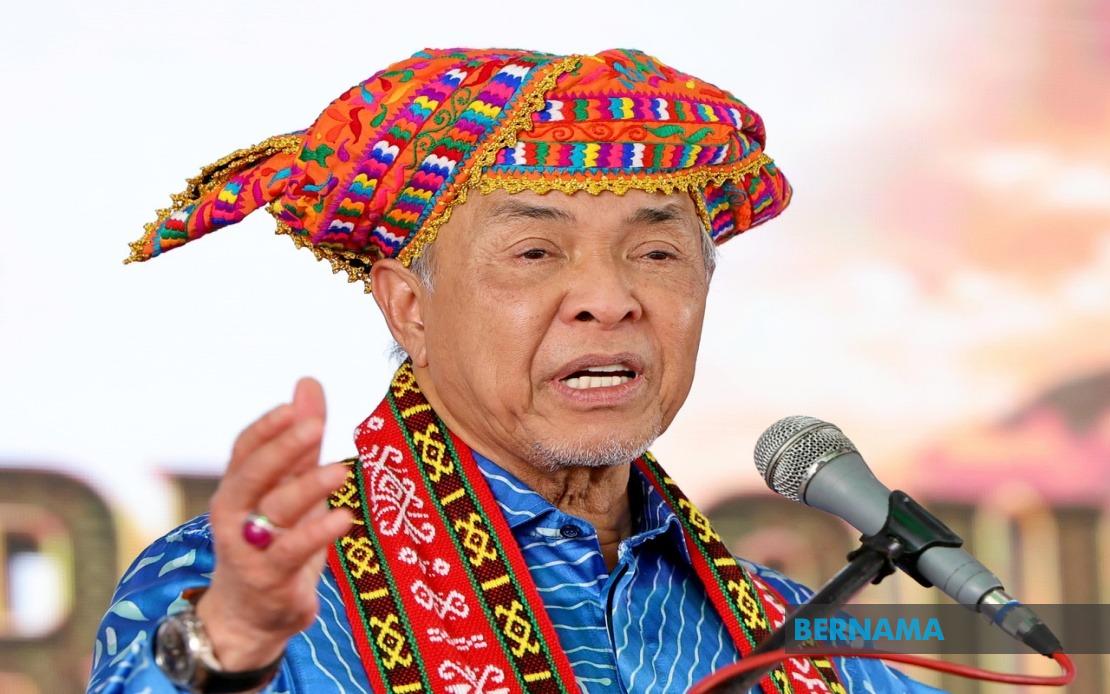
Deputy Prime Minister Datuk Seri Dr Ahmad Zahid Hamidi has unveiled a RM4.06 billion federal allocation destined for Sabah's Rural Water Supply programme, marking a substantial commitment to addressing infrastructure deficits in the state's remote communities. The announcement, made during the opening of the Rungus Cultural Festival in Matunggong, signals the federal government's recognition that water access remains a fundamental challenge in Sabah's rural and outlying settlements, where traditional development has lagged significantly behind urban centres.
The Rural and Regional Development Ministry (KKDW), under Ahmad Zahid's stewardship, will channel these funds directly to the Sabah state government for project execution and implementation. This arrangement reflects the federal structure of Malaysian governance, whereby infrastructure development in states often requires coordinated funding flows between Putrajaya and state administrations. Ahmad Zahid framed the investment as essential to fulfilling a constitutional promise—that development benefits ought to reach all Malaysians equally, whether they reside in Sabah, Sarawak, or Peninsular Malaysia, a principle that has proven challenging to implement consistently across the federation.
The districts identified as primary beneficiaries—Kudat, Kota Marudu, and Pitas—rank among Malaysia's poorest by official metrics, meaning the allocation aligns with the government's stated poverty-eradication objectives. These three constituencies have historically struggled with inadequate basic services, including reliable electricity supply alongside water infrastructure. Ahmad Zahid acknowledged that water scarcity and energy deficiency represent the principal developmental obstacles confronting Sabah's rural populations, a reality he positioned as falling squarely within his ministerial responsibilities.
Beyond capital allocation, the KKDW has committed to sustained technical oversight and monitoring to ensure projects progress on schedule and meet specified standards. This supervisory role addresses historical concerns about project completion rates and quality in remote areas, where geographical isolation and logistical complexity frequently compound implementation challenges. The ministry's involvement thus extends beyond financial transfer to encompassing active project governance, a mechanism that Malaysian observers will recognise as standard practice where federal infrastructure funds enter state jurisdiction.
The broader policy context underscores that rural water and electricity deficits remain persistent development issues in East Malaysian states despite decades of federal-state cooperation. Ahmad Zahid's announcement suggests the federal government intends treating these basic services as priority items rather than ancillary amenities, a reframing that carries implications for budgetary prioritisation across the coming budget cycles. The emphasis on hardcore poverty zones signals that targeting will concentrate resources where deprivation metrics prove most acute, though this approach also raises questions about equity between marginal communities in different states vying for limited federal resources.
Socioeconomic initiatives complementing the water infrastructure investment are reportedly under development, aimed at lifting household incomes and living standards among Sabah's B40 demographic groups in rural areas. These programmes presumably extend beyond hardware—pipes, pumps, treatment facilities—to encompassing broader livelihood enhancement, recognising that infrastructure alone cannot sustainably improve community welfare without accompanying economic opportunity. The integration of infrastructure, poverty alleviation, and income-generation strategies represents an increasingly common approach in Malaysian development policy, though implementation coordination remains challenging across multiple federal ministries.
Ahmad Zahid additionally pledged federal support for elevating Matunggong sub-district to full district status, a proposal he undertook to discuss with Sabah Chief Minister Datuk Seri Hajiji Noor and the federal Cabinet. Administrative reorganisation of this type carries material consequences for resource allocation, as gazetted districts typically receive dedicated development budgets unavailable to sub-districts. This commitment illustrates how infrastructure announcements often accompany broader administrative interventions designed to enhance governance capacity and resource access in peripheral areas.
The Deputy Prime Minister further directed relevant agencies, particularly those operating under KKDW, to begin repairs on Matunggong's Community Hall within three months, a directive that translates political announcement into concrete administrative action with specified timelines. Such targeted interventions, whilst symbolically significant, demonstrate the manner in which federal ministers exercise direct influence over local infrastructure maintenance and improvements through ministry channels.
For Malaysian observers, particularly those in Sabah and Sarawak monitoring federal commitment to East Malaysian development, this allocation signals continued priority given to basic service provision. However, the RM4.06 billion figure requires contextualisation within national budgetary frameworks and historical spending patterns to assess whether this represents genuine enhancement or merely continuation of established investment trajectories. The announcement also arrives amid broader political dynamics in Sabah, where securing federal resources remains contested among competing state-level political factions, potentially influencing both the credibility and ultimate implementation effectiveness of this allocation.

