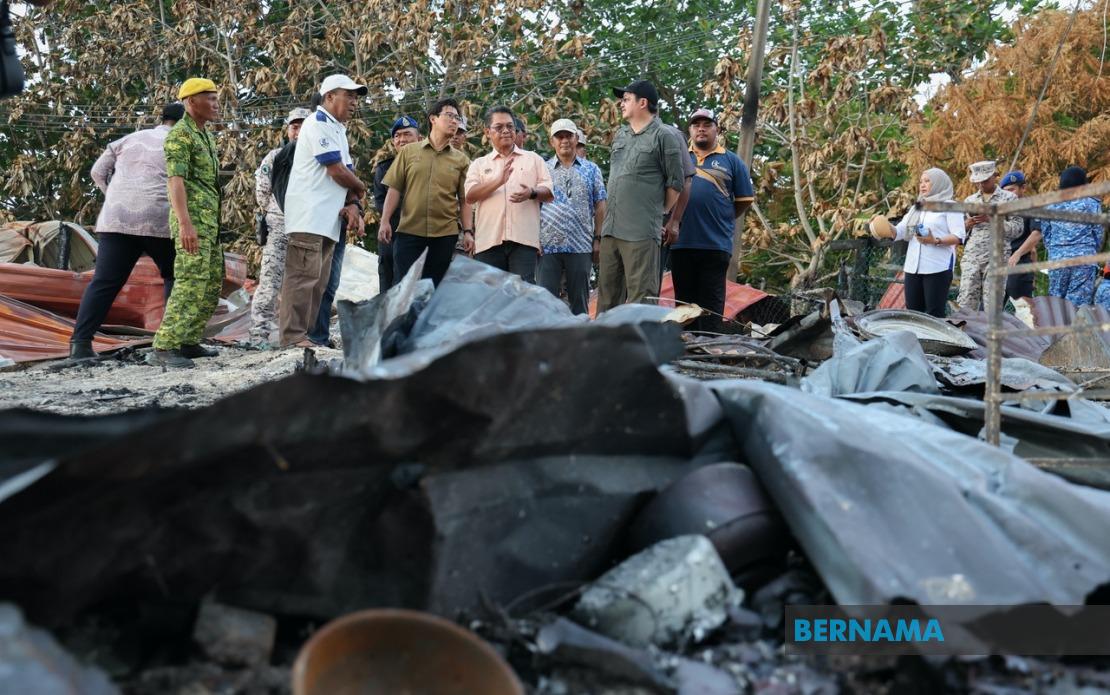
A massive fire at Pulau Nunuyan Laut in Sandakan has prompted swift federal intervention, with the Prime Minister's Department distributing emergency relief to 29 household heads affected by the blaze that swept through the coastal settlement early yesterday morning. The disaster, which ignited around 3 am at Kampung Nunuyan Laut, consumed 28 residential structures and displaced more than 100 residents from their homes. Federal authorities have signalled their commitment to comprehensive recovery efforts that extend beyond immediate aid distribution to encompass long-term rehabilitation of the affected community.
Datak Mustapha Sakmud, who serves as Minister in the Prime Minister's Department with responsibility for Sabah and Sarawak affairs, visited the fire site to assess conditions firsthand. He announced that the Implementation Coordination Unit within his department had initiated rapid-response measures designed to alleviate the most pressing hardships facing survivors. These initial interventions include the distribution of mobility aids such as wheelchairs to elderly residents who have been rendered vulnerable by the sudden loss of their homes and belongings. The minister's presence and hands-on approach signal federal recognition of the severity of this incident within the rural East Malaysian context, where island communities often face isolation and limited access to support systems during emergencies.
Beyond immediate humanitarian relief, Mustapha outlined a structured framework for assessing the full scope of victims' requirements. He has directed the Sandakan Municipal Council and related government agencies to conduct comprehensive needs evaluations that will inform the scope and nature of ongoing assistance. This coordinated approach reflects an understanding that disasters of this magnitude typically create cascading needs that extend well beyond emergency shelter and food provision. Victims frequently require documentation assistance, health services, and psychological support in the aftermath of losing their entire homes and accumulated possessions.
A critical concern highlighted by Mustapha involves infrastructure damage sustained during the fire. The disaster has compromised essential public facilities, including a jetty that serves as the primary transportation corridor for schoolchildren commuting daily to educational institutions. The minister emphasized that restoring such vital infrastructure must occur urgently to prevent the tragedy from compounding educational disruptions. He has requested that the Sandakan Municipal Council expedite documentation of all damaged infrastructure requiring immediate repair and submit these assessments to the Implementation Coordination Unit for prioritized action. This focus on maintaining educational continuity demonstrates sensitivity to long-term community wellbeing beyond immediate crisis response.
Sandakan Municipal Council president Datuk Walter Kenson provided additional details regarding the relocation strategy being formulated for displaced residents. The Rural Development Department has been tasked with determining optimal locations for resettlement, with consideration being given to available village reserve land as potential sites for reconstructing the community. This measured approach to relocation reflects the complexity inherent in resettling island-based populations who depend heavily on maritime livelihoods and established social networks. Simply relocating residents to inland areas without careful consultation could undermine their economic viability and community cohesion.
A particularly intricate aspect of the recovery process involves land ownership complications. Walter disclosed that the fire victims have been residing on privately owned land, with at least two separate property titles involved in the affected area. This dual ownership structure necessitates negotiation and agreement with both private landowners before any permanent relocation or reconstruction can proceed. Such negotiations require sensitivity to property rights while simultaneously addressing humanitarian imperatives, making this dimension of recovery potentially protracted. The council president indicated willingness to engage these landowners in discussions aimed at finding mutually acceptable solutions.
The comprehensive rehabilitation vision extends beyond simply moving families to alternative locations. Municipal authorities have committed to ensuring that any new settlement area will be equipped with fundamental modern amenities including reliable electrical supply, clean water infrastructure, and maritime transport facilities. This commitment to providing adequate utilities acknowledges that inadequate infrastructure in the original settlement may have contributed to fire risk conditions or impeded emergency response. By incorporating these improvements into relocation planning, authorities can potentially enhance community resilience against future disasters while improving overall living standards for residents.
The fire at Pulau Nunuyan Laut underscores the particular vulnerabilities of remote island communities in Malaysia's federal territories. Such settlements often operate with minimal regulatory oversight regarding building standards, fire safety measures, and emergency preparedness. The dense residential clusters typical of such communities, combined with limited access to fire-fighting equipment and emergency services, create conditions where fires can spread with devastating rapidity. This incident provides an opportunity for authorities to assess broader systemic vulnerabilities affecting island communities throughout Sabah and Sarawak, potentially informing policy improvements applicable across the region.
For Malaysian observers, this response demonstrates the federal government's commitment to extending welfare assistance across its territorial expanse, including to remote populations. The systematic approach involving multiple agencies—the Prime Minister's Department, municipal councils, and the Rural Development Department—reflects institutional capacity for coordinated disaster response. However, the structural complications involving private land ownership and the need for intensive needs assessment also illustrate the practical complexities that often delay recovery in disaster situations, particularly in less urbanized areas where administrative frameworks may be less developed than in peninsular Malaysia.
The relocation and reconstruction process ahead will likely extend over several months, with success dependent on effective cooperation between federal authorities, local councils, private property owners, and the affected community itself. The experience will provide valuable lessons regarding disaster response procedures in Malaysia's maritime settlements, potentially informing future preparedness initiatives. For residents of Pulau Nunuyan Laut, the commitment to restore community infrastructure and provide modern amenities alongside relocation offers prospect for reconstructing not merely homes, but improved living conditions.

