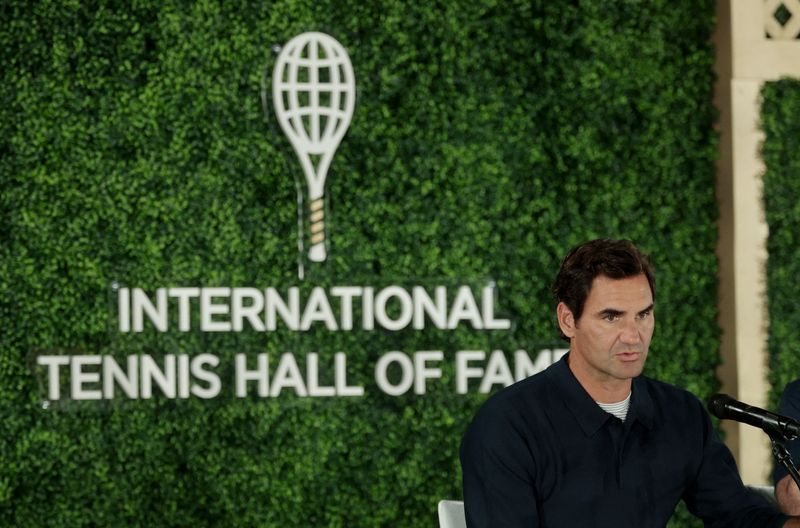
Roger Federer's induction into the International Tennis Hall of Fame this weekend marks a pivotal moment for the 45-year-old Swiss legend, one that transcends the tangible achievements that defined his 24-year professional career. Speaking at a press conference on Friday ahead of his Saturday ceremony in Newport alongside broadcaster Mary Carillo, Federer described the honour as offering something fundamentally different from the trophies and world rankings that dominated his playing years. The recognition arrives nearly three years after his retirement in 2022, allowing him distance and perspective to assess not merely what he won, but what his presence meant for tennis as a sport and profession.
Federer's competitive accomplishments remain staggering by any measure. His 20 Grand Slam titles placed him at the apex of men's tennis for years, including eight Wimbledon crowns—a record he still holds—alongside six Australian Open victories, five U.S. Open triumphs, and the 2009 French Open that completed his career Grand Slam. Beyond the major championships, his résumé encompasses 103 ATP Tour titles, 310 weeks as world number one, Olympic doubles gold with Stan Wawrinka in 2008, and crucial contributions to Switzerland's 2014 Davis Cup victory. Yet during Friday's remarks moderated by Hall of Fame president Patrick McEnroe, Federer deliberately shifted the conversation away from silverware, suggesting that his true influence extends into territories rarely captured by tournament draws or statistical compilations.
The Swiss champion's philosophy about measuring sporting legacies resonates particularly in Southeast Asia, where younger players and administrators are increasingly questioning whether traditional success metrics adequately reflect an athlete's contribution to their sport's ecosystem. Federer explicitly stated his hope that history would evaluate him through a broader lens, encompassing his collaborative efforts with tennis leaders, ATP officials, Grand Slam organisers, and player councils where he donated considerable time and influence. This perspective challenges the region's sometimes narrow focus on individual achievement and ranking points, suggesting that thoughtful stewardship of a sport's infrastructure carries equivalent weight to personal glory.
When discussing his concrete contributions, Federer pointed to material improvements in professional tennis conditions that directly affect thousands of players globally. Prize money expansion represented his first example, though notably he emphasised growth not merely at the championship level but trickling down through first and second-round payouts—the rounds where the majority of touring professionals compete and where financial stability remains precarious. For Malaysian and Southeast Asian players aspiring to sustain careers on the international circuit, such structural changes determine whether professional tennis remains feasible or becomes a luxury only the wealthy can pursue. Federer's involvement in advancing these conversations reflects an understanding that a sport's health depends on viable pathways for its broader player base, not merely its champions.
Beyond financial considerations, Federer highlighted improvements in tournament conditions encompassing player amenities, medical support infrastructure, media facilities, and stadium quality. These seemingly peripheral elements fundamentally shape the professional experience and safety standards across the tennis calendar. For developing tennis nations in Southeast Asia investing in hosting international tournaments, Federer's emphasis on comprehensive facility standards and player welfare offers a template for tournament organisers seeking to establish credible, player-friendly competitions that attract quality fields. His involvement in advancing these standards helped normalise expectations that have now become baseline requirements for major events.
Federer's reflection on his own psychological relationship with expectations and pressure offers unexpected depth for an athlete of his stature. He described early recognition of his competitive instincts, acknowledging that he gravitated toward prestigious stages and championship moments rather than early-round obscurity. Rather than viewing this as mere ambition, he framed it as conscious embrace of pressure—a deliberate choice to thrive within demanding circumstances rather than avoid them. However, he balanced this revelation with candid acknowledgment that the external commentary surrounding elite sport can become psychologically overwhelming, particularly when players encounter relentless judgment based solely on tournament victories. The tension between channelling pressure productively and maintaining enjoyment represents an underexamined psychological dimension for young athletes in Malaysia and across the region pursuing competitive tennis careers.
Federer's observation that players can lose enjoyment amid constant scrutiny deserves particular attention in contemporary sports culture, where social media amplifies criticism and external noise reaches unprecedented levels. His claim that he largely managed to maintain happiness despite these pressures suggests resilience developed through conscious effort rather than natural immunity. For younger Malaysian and Southeast Asian players navigating career pressures while managing intense public and parental expectations, Federer's candid discussion of this psychological battleground validates the legitimacy of mental health considerations within elite sport preparation.
Looking forward, Federer suggested several possible roles in his post-playing career that would allow continued engagement with tennis. These include potentially captaining the Laver Cup, mentoring emerging players, and working as a commentator—all roles that align with his expressed desire to give back to the sport. He indicated that attending multiple tournaments annually helps maintain the connection necessary for identifying meaningful opportunities. This gradual approach to retirement contrasts sharply with abrupt exits some athletes make from their sports, instead positioning Federer as someone who views his career as fundamentally evolving rather than conclusively ending.
Federer's Hall of Fame induction ultimately represents more than ceremonial recognition of past excellence. It provides a platform for articulating a philosophy of sporting legacy that extends beyond personal achievement into systemic contribution. For Malaysian and Southeast Asian sports administrators, tournament organisers, and aspiring professional players, his emphasis on collective advancement of the sport's infrastructure, financial viability, and player welfare standards offers valuable lessons. The example suggests that true sporting greatness encompasses not merely what individual athletes accomplish within competition but how they influence the conditions, standards, and opportunities available to all participants in their sport. This broader understanding of legacy—one focused on leaving a sport more robust, more equitable, and more sustainable than inherited—may ultimately define Federer's influence on tennis far more permanently than his 20 championship titles.

