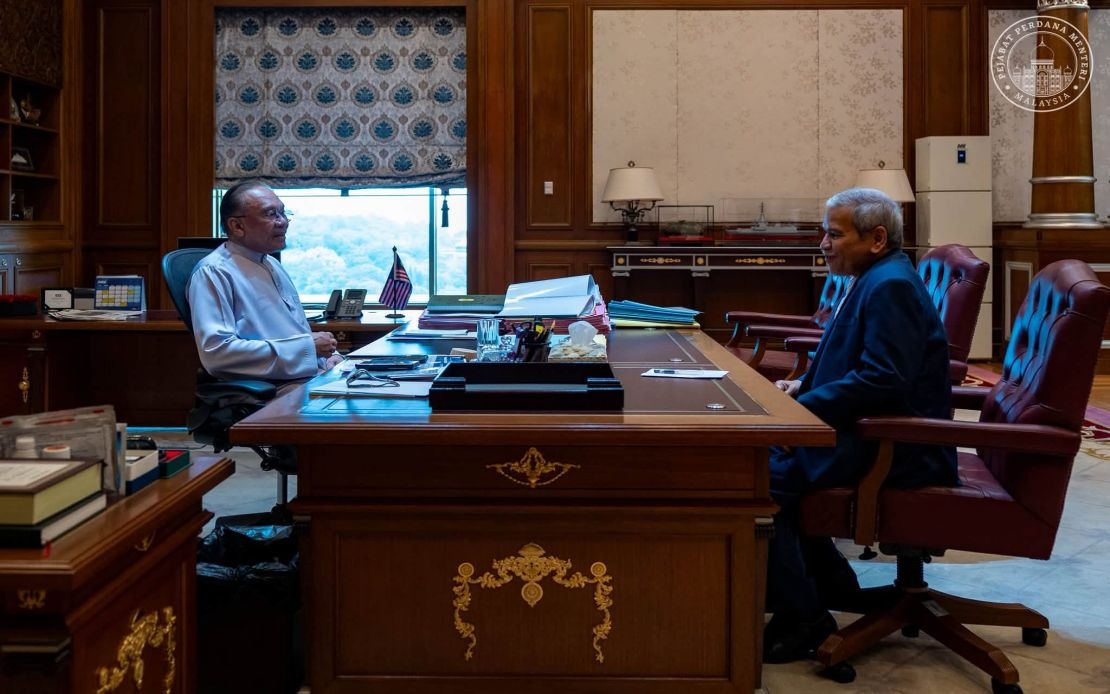
Prime Minister Datuk Seri Anwar Ibrahim has reiterated the government's commitment to reinforcing the Federal Land Development Authority (FELDA) as a cornerstone institution dedicated to enhancing the lives and dignity of settler communities and their families. The statement came during a courtesy visit by the newly appointed FELDA chairman Tan Sri Ahmad Badri Mohd Zahir to the Prime Minister's office in Putrajaya, where the two officials discussed the organization's strategic direction and priorities.
Anwar, who holds the dual portfolios of Prime Minister and Finance Minister, emphasized that strengthening FELDA's institutional capacity must proceed in tandem with broader efforts to bolster the organization's economic performance and long-term viability. This dual-track approach reflects recognition that settler welfare cannot be sustained on good intentions alone; FELDA must operate as a competitive and economically resilient enterprise capable of generating returns that directly benefit its constituents across multiple generations.
A significant dimension of the government's strategy involves addressing the distinctive challenges facing younger-generation settlers who have inherited land holdings or recently entered the scheme. Unlike their predecessors, who benefited from pioneering development phases, younger settlers contend with volatile commodity markets, climate pressures, and evolving agricultural practices that demand updated support systems and targeted interventions. The Prime Minister's emphasis on this demographic underscores awareness that FELDA's relevance depends on its ability to adapt to contemporary realities rather than rely solely on historical models of assistance.
Anwar expressed confidence in Ahmad Badri's capacity to drive the restoration and consolidation of FELDA's institutional strength, characterizing the appointment as strategically aligned with the government's broader development vision. The new chairman, who commenced his duties on July 15, assumes responsibility for an organization that has undergone significant transitions in recent years. His predecessor, Datuk Seri Ahmad Shabery Cheek, concluded his tenure on June 30 after a substantial period overseeing the organization during a period of considerable economic and social change affecting settler communities.
The timing of this leadership transition carries particular significance given Malaysia's broader economic environment. Commodity prices, particularly for palm oil and rubber—traditional FELDA crops—remain subject to international market fluctuations that directly impact settler income and livelihoods. The new administration's mandate encompasses not merely managing existing operations but reimagining FELDA's role within a modernizing agricultural sector that increasingly emphasizes sustainability, value addition, and diversification away from monoculture dependency.
Government support constitutes another pillar of the revitalization strategy. Anwar pledged that the MADANI Government would maintain robust backing for FELDA's operational and development objectives, ensuring the institution remains positioned to serve its constituency effectively and remain germane to future generations of settlers. Such governmental commitment, backed by ministerial engagement at the highest levels, signals that FELDA's challenges are recognized as deserving priority attention rather than peripheral concern within national development frameworks.
For Malaysian settlers and their communities, the renewed institutional focus carries practical implications. Many FELDA schemes face aging infrastructure, declining productivity on certain plots, and limited access to modern agricultural technologies and training. Strengthening the institution should translate into tangible improvements: better maintenance of estate roads and facilities, enhanced extension services, improved market linkages, and investment in skills development that prepare settlers to compete effectively in contemporary agricultural markets.
The appointment of Ahmad Badri also reflects broader considerations about institutional governance and the caliber of leadership directing crucial development agencies. The selection process and his background suggest deliberate positioning to navigate complex stakeholder dynamics involving settler interests, government policy objectives, commercial sustainability requirements, and environmental stewardship considerations. These competing demands require leadership capable of synthesizing diverse perspectives while maintaining focus on FELDA's foundational mission.
Regionally, FELDA's trajectory carries significance extending beyond Malaysia's borders. Across Southeast Asia, land-settlement schemes and smallholder agricultural development represent enduring policy instruments for poverty alleviation and rural development. FELDA's experience—including both successes and challenges—offers instructive lessons for neighboring countries managing similar schemes. A strengthened FELDA could serve as a model demonstrating how institutional commitment and continuous adaptation enable land-development authorities to remain relevant amid changing agricultural, economic, and social landscapes.
Looking ahead, the crystallization of institutional priorities under new leadership will prove instructive. The coming months and years will reveal whether the rhetorical commitment to strengthening FELDA translates into resource allocation, policy reforms, and operational changes capable of addressing settler aspirations comprehensively. Success will require sustained attention across multiple fronts: financial performance, settler income security, intergenerational opportunity, environmental sustainability, and organizational modernization. The acknowledgment that all these dimensions must advance simultaneously demonstrates sophisticated understanding of the complex challenges confronting agricultural development institutions in contemporary Malaysia.

