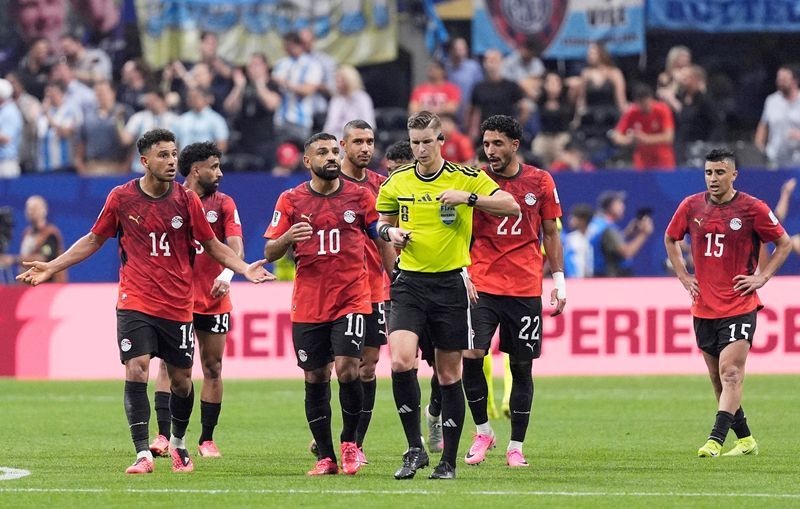
FIFA's chief of refereeing, Pierluigi Collina, has mounted a robust defence of the match officials who oversaw Argentina's dramatic 3-2 victory against Egypt in the World Cup knockout stage, categorically denying suggestions that the contest was decided unfairly or that external pressure influenced the outcome. Speaking through an official FIFA channel, Collina rejected what he characterized as unfounded allegations against the referees, drawing a firm distinction between legitimate discussion of controversial decisions and baseless accusations that undermine the credibility of international football's governing body.
The confrontation centres on Egypt's exit from the tournament following a match that saw Argentina mount a remarkable comeback from two goals down to secure victory through a stoppage-time strike by Enzo Fernandez. The Egyptian Football Association and the team's coaching staff have since questioned the consistency and impartiality of several key decisions that they argue materially influenced the match's trajectory. These grievances have created diplomatic tension within world football, particularly given the high stakes involved and the broader regional significance of the two nations' footballing rivalry.
Collina's statement establishes a clear position: while disagreement about refereeing decisions forms an inevitable and even healthy part of football discourse, allegations questioning officials' integrity cross a line that FIFA considers unacceptable. The distinction he draws is meaningful for the global sport's governance—it attempts to preserve space for technical debate while establishing a protective boundary around the principle of referee independence. This framing proves especially relevant in a context where coaching staff and national associations wield considerable influence over public narratives surrounding disputed matches.
The specific incidents at the heart of Egypt's complaint involve two critical moments. First, Egypt contends that Mostafa Zico's second-half goal was incorrectly disallowed after the Video Assistant Referee (VAR) identified a foul by Marwan Attia on Argentine defender Lisandro Martinez. Second, the Egyptian Football Association argues that a challenge on star player Mohamed Salah moments before Argentina's winning goal should have resulted in a penalty but went unpunalized. These decisions collectively shifted momentum decisively in Argentina's favour at crucial junctures.
Collina addresses the Zico goal controversy by clarifying FIFA's VAR protocols. According to the refereeing chief, the system correctly recommended overturning the goal upon identifying Attia's foul during Egypt's attacking possession, irrespective of whether the original referee had observed the infringement. This represents an important principle in modern football administration: VAR exists precisely to identify contact and infractions that occur outside the match official's direct line of sight. The interpretation suggests that the standard for identifying fouls remains consistent whether detected in real time or through video review, a position that Collina argues maintains the integrity of the rules themselves.
Regarding the controversial moment involving Salah's challenge, Collina explains that both the on-field referee and the VAR operator determined the contact between the Egyptian winger and Argentine defender Julián Alvarez constituted normal football contact rather than a punishable offence. The refereeing chief makes a technical distinction: stepping on an opponent's foot represents a clear foul, whereas a defender who makes initial contact with the ball and then engages in typical football contact has not committed an infraction. This differentiation reflects football's inherently physical nature and the tolerance levels built into the rules for competitive play.
Collina's defence carries broader implications for how FIFA manages controversy in a sport where decisions determine continental qualification, financial reward, and national pride. By speaking publicly through official channels, the refereeing chief sends a message that the organization stands behind its officials and the systems they employ. However, this approach also risks appearing defensive and potentially dismissive of genuine concerns about consistency in application of the rules, particularly when different standards appear to govern similar incidents across different matches.
The controversy highlights an enduring tension in international football: the exponential increase in stakes at the World Cup level creates intense pressure on decision-makers, yet the sport's governing structures resist the notion that such external factors influence outcomes. Collina's explicit statement that "nobody can claim that FIFA refereeing can be influenced by anyone, not even by the FIFA president" attempts to establish an unambiguous position on this question, though reasonable observers might question whether such categorical assurances can ever be definitively proven.
For Malaysian and Southeast Asian football followers, this dispute carries instructive value. The incident demonstrates how top-level professional football navigates between the demands of competitive integrity and the realities of human judgment in real-time decision-making. It also illustrates the growing role of technology in attempting to standardize and depersonalize controversial moments, though VAR itself introduces new layers of interpretation that can prove equally contentious. As regional football develops its own professional infrastructure and ambitions, understanding how elite competitions manage such disputes becomes increasingly relevant.
Collina also acknowledges that some refereeing decisions inherently involve subjective judgment, yet maintains that FIFA remains satisfied with the overall application of VAR principles throughout the tournament. This concession to subjectivity while asserting confidence in systemic fairness represents the delicate balance that FIFA attempts to strike: recognizing that perfect objectivity remains impossible while insisting that the mechanisms for oversight operate as designed. The statement effectively closes the door on further investigation into the specific match while reaffirming faith in the broader institutional framework.
The refereeing chief's warning that unfounded allegations can provoke threats against match officials and their families introduces a separate but connected concern about the discourse surrounding controversial decisions. This observation shifts the conversation from pure technical analysis to the safety and wellbeing of those who implement the rules, a dimension that often receives insufficient attention in post-match recriminations. Whether this strategic inclusion strengthens or weakens Collina's overall argument likely depends on observers' willingness to distinguish between legitimate criticism of specific decisions and personal attacks on the officials themselves.

