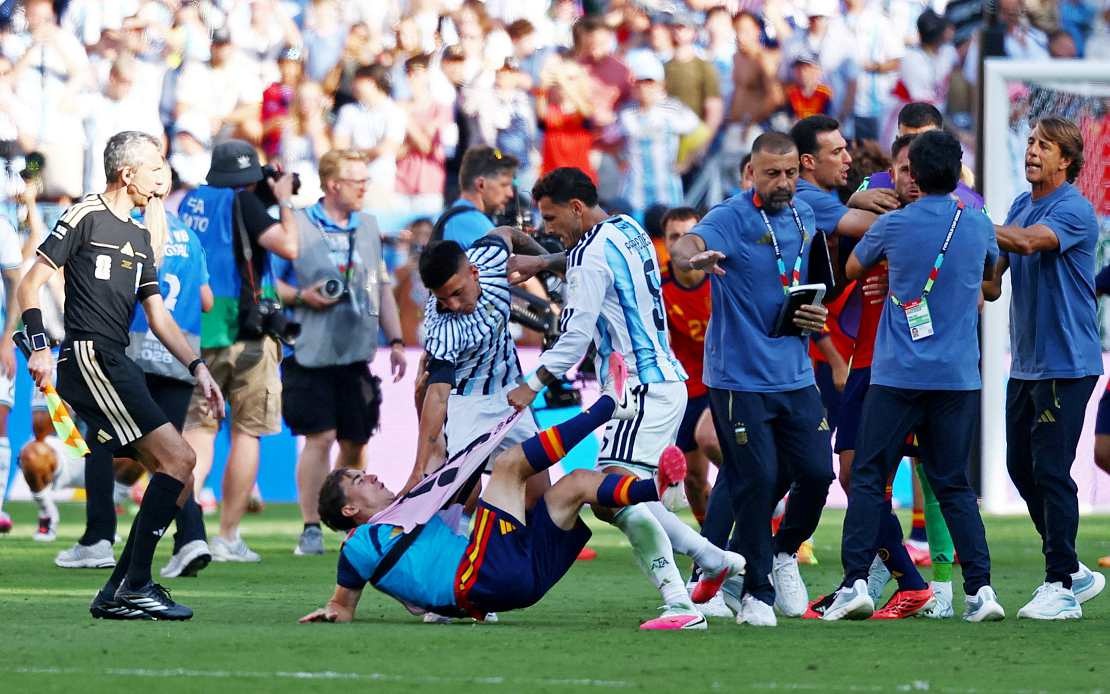
FIFA has formally opened an investigation into disciplinary violations allegedly committed by Argentina during the World Cup final against Spain in New Jersey, marking the latest development in what has been an increasingly scrutinised tournament regarding player conduct and national team behaviour. The football federation appointed a Disciplinary and Ethics Prosecutor to examine the incident and determine whether violations of the FIFA Disciplinary Code occurred, with further details expected once the investigation concludes.
The flashpoint that triggered the probe centred on midfielder Leandro Paredes, who appeared to exchange blows with Spanish players immediately after the final whistle as celebrations erupted on the pitch. The incident was captured in the match commissioner's report, which subsequently underwent review by FIFA's governing bodies before the decision was made to escalate the matter through formal disciplinary channels.
Argentina's physical approach to the tournament has drawn repeated criticism from match officials and international observers throughout their World Cup campaign. During the semi-final encounter with England, the South American side faced accusations of excessive physicality, with midfielder Enzo Fernandez ultimately receiving a red card for accumulating two yellow card offences. This pattern of aggressive play raises questions about team discipline and coaching philosophy, particularly when contrasted with the tournament's broader expectations regarding fair play and sportsmanship.
The investigation also raises the possibility that FIFA may examine other post-match conduct beyond the Paredes incident. Uncertainty remains about whether Argentina faces scrutiny for displaying a banner asserting Argentine claims to the Falkland Islands following their victory over England, an act that potentially breaches Article 34.3 of the tournament regulations. The Argentinian Football Association (AFA) previously faced financial penalties for an identical gesture during a 2014 friendly match against Slovenia, demonstrating FIFA's prior awareness of such incidents.
FIFA's approach to political gestures and nationalist displays has remained inconsistent across different competitions and circumstances. The Union of European Football Associations (UEFA) demonstrated a stricter enforcement standard by imposing one-match suspensions on Spain's Rodri and Alvaro Morata following Euro 2024, sanctioning them for chanting related to Spain's territorial claims regarding Gibraltar. This disparity in enforcement between FIFA and continental confederations suggests potential inconsistency in how international football bodies address similar nationalist expressions.
The broader context of FIFA's disciplinary philosophy extends beyond the current investigation. During the 2022 World Cup in Qatar, FIFA explicitly warned the English Football Association that captain Harry Kane would face sporting consequences, beginning with a yellow card, if he wore the 'OneLove' rainbow-armband in support of LGBTQ+ rights—a stance taken despite Qatar's criminalisation of homosexuality. This demonstrated FIFA's willingness to suppress certain forms of expression while potentially allowing others, raising complex questions about consistency and the organisation's values.
For Malaysian and Southeast Asian observers, the Argentina investigation offers important lessons about international sports governance and the application of disciplinary standards across different nations and circumstances. The situation highlights how major football confederations navigate the tension between permitting national pride and maintaining competitive integrity, a balance that Asian football bodies must similarly address as the region's clubs and national teams increase their presence in global competitions.
The investigation's outcome carries implications beyond Argentina's immediate competitive standing. A substantial penalty could affect squad morale and international player availability for upcoming fixtures, while a lenient conclusion might suggest FIFA prioritises competitive fairness over conduct enforcement. Regional football associations across Asia will likely monitor the decision closely when determining their own approach to player discipline and post-match conduct standards.
Argentina's situation also reflects broader tensions within modern international football regarding what constitutes acceptable expression of national identity and patriotism within competitive contexts. As football globalises and becomes increasingly embedded in diplomatic relations and geopolitical claims, governing bodies face mounting pressure to define clear boundaries between legitimate sporting competition and inappropriate political messaging.
The appointment of a dedicated prosecutor signals FIFA's intention to conduct thorough examination rather than issuing swift judgement. This methodical approach contrasts with social media criticism and immediate public condemnation, suggesting the federation recognises the necessity for careful investigation when addressing allegations of this magnitude. The investigation's conclusion will likely establish precedents that shape disciplinary enforcement in future international tournaments.

