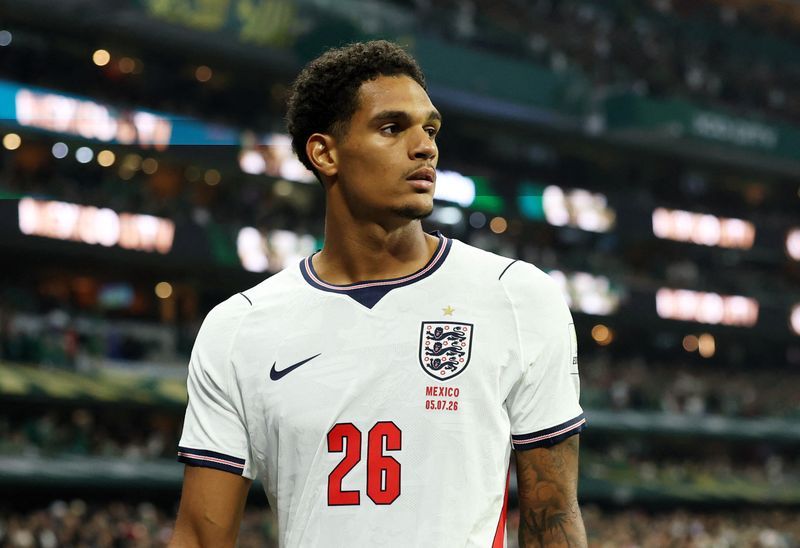
The FIFA disciplinary saga surrounding striker Folarin Balogun has exploded into a broader international incident, with British politicians now intervening to challenge what they view as an inconsistent application of soccer's rulebook. Labour MPs Noah Law and Melanie Onn have written directly to FIFA President Gianni Infantino requesting that defender Jarell Quansah receive identical treatment to Balogun—specifically, a deferral of his automatic one-match suspension until after the World Cup concludes. The pair cited Balogun's reprieve as a direct precedent, turning what FIFA has characterized as an isolated judicial decision into a test case for whether the sport's governing body will apply its own rules uniformly.
The controversy deepened dramatically when U.S. President Donald Trump publicly disclosed that he had personally contacted Infantino regarding Balogun's original suspension. While the FIFA chief maintained that his judicial bodies operate independently and would reach their own determination, the presidential intervention immediately triggered accusations from European football authorities and political figures that political pressure may have compromised FIFA's integrity. For a World Cup already scrutinized for its complex host-nation politics and commercial considerations, the suggestion of high-level political interference in match discipline represents a new crisis entirely.
Quansah received his red card during England's thrilling 3-2 victory against Mexico at the Azteca Stadium on Sunday, automatically triggering a one-match ban under FIFA's standard disciplinary protocols. The circumstances mirror Balogun's situation closely enough that Law and Onn argued deferring the ban would merely ensure fairness rather than grant preferential treatment. In his written statement, Law acknowledged that the red card itself was warranted but contended that consistency demanded Quansah receive the same consideration FIFA had extended to Balogun. Onn went further, suggesting it would be virtually impossible for FIFA to justify one player benefiting from a delayed suspension while another in materially similar circumstances faced immediate punishment.
The MPs framed their intervention as defending FIFA's credibility rather than merely advocating for England's interests. Both emphasized that failure to apply rules consistently across different nations and players would fundamentally undermine global confidence in FIFA's disciplinary system. This reasoning proved persuasive enough that Caroline Dinenage, Chair of the House of Commons Culture, Media and Sport Committee, escalated the pressure by demanding that FIFA urgently explain its Balogun decision and specifically address allegations of political interference. Dinenage's statement was notably measured in tone but pointed in substance: she positioned FIFA's ruling as potentially casting a shadow over an otherwise inspiring tournament.
The English FA has acknowledged considering appeal options, though sources indicate no formal decision has been reached. This measured approach contrasts sharply with the parliamentary intervention, suggesting the football body is navigating complex diplomatic waters. The FA's potential challenge would hinge partly on whether FIFA confirms that Article 27—the provision apparently applied to Balogun's case—is indeed available to other players facing similar suspension circumstances. FIFA has not publicly clarified whether Article 27 applies uniformly or was somehow specific to Balogun's situation, a silence that the parliamentary committee has explicitly called out as problematic.
For Malaysian and Southeast Asian observers, this episode illuminates how World Cup politics operate at levels far removed from tactical formations and match statistics. The intervention of a sitting U.S. president in soccer discipline, followed by coordinated parliamentary pressure from another nation, demonstrates that even FIFA—an organization that often resists political scrutiny—remains susceptible to state-level pressure when powerful nations' interests are at stake. The fact that these interventions are occurring openly and simultaneously suggests a structural vulnerability in FIFA's claimed independence that few had previously articulated so directly.
The timing compounds FIFA's difficulty. England faces Norway in the quarter-finals scheduled for Saturday in Miami, meaning the Quansah suspension issue will dominate pre-match discussions and potentially influence team selection and tactical planning. This institutional pressure to resolve the matter before a major knockout fixture creates exactly the conditions that undermine FIFA's insistence on independent judicial decision-making. Any ruling issued now will appear responsive to political pressure rather than principle, regardless of its actual merits.
Balogun's original suspension followed what FIFA characterized as a standard disciplinary review of his red card offense. Yet the subsequent reprieve, granted apparently at presidential request, has transformed the case from a routine matter of match discipline into a symbol of FIFA's vulnerability to great-power influence. The organization's repeated assertions that its judicial bodies operate independently ring increasingly hollow when those same bodies can be persuaded to reverse previous decisions through high-level political channels.
The broader implications extend beyond this single tournament. If FIFA establishes a precedent that suspension deferrals are available to players from nations willing to deploy sufficient political pressure, the organization has effectively created a two-tier disciplinary system. Smaller nations and less politically connected players would lack recourse to the same reprieve mechanisms, inverting the principle of universal rules application that supposedly underpins international sport. This scenario represents exactly what concerns British parliamentarians, who recognize that FIFA's integrity depends on genuine consistency rather than selective application of discretionary provisions.
The unfolding dispute also raises questions about FIFA's institutional decision-making processes. If Article 27 permits suspension deferrals, the provision should be transparent, its application criteria clearly defined, and its invocation documented with explicit reasoning. Instead, the Balogun reprieve emerged as something of a surprise reversal, explained only after the fact and never comprehensively justified. This opaqueness invites the precise suspicions FIFA's leaders are now struggling to dispel.
English football authorities must navigate between supporting their player's competitive interests and protecting FIFA's credibility as an impartial institution. Any appeal by the FA will inevitably be interpreted as responding to parliamentary pressure, further validating accusations of political interference. Conversely, accepting Quansah's suspension while Balogun remains available appears grossly unfair, creating internal resentment within the England squad and the broader football community.
FIFA faces a decision with no good outcomes. Granting Quansah's reprieve validates the parliamentary intervention and establishes a precedent that powerful nations can successfully lobby for disciplinary exceptions. Denying it exposes FIFA to accusations of bias toward the United States and confirms that political pressure produces results selectively. The organization's credibility now depends on providing a comprehensive, principled explanation of Article 27's scope and its application criteria—something it has conspicuously failed to do thus far.

