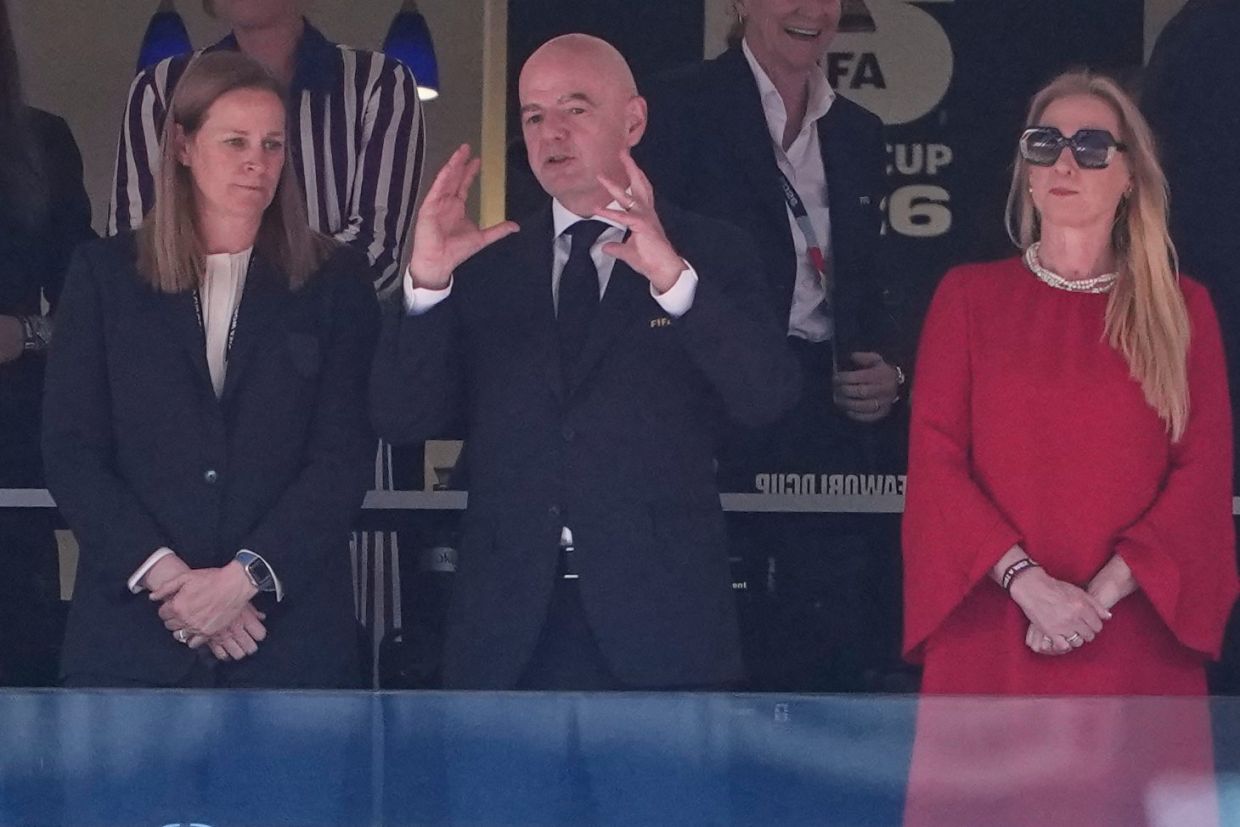
Gianni Infantino's grip on global football appears unshakeable despite mounting criticism over the 2026 World Cup, which has sparked controversy from multiple directions—inflated ticket pricing, the controversial sidelining of Iran's squad, the exclusion of a Somali referee, and even the bestowal of a peace award to President Donald Trump. Yet as competing scandals jostle for attention and public memory proves ephemeral, one inescapable reality dominates the post-tournament landscape: FIFA, under the Swiss administrator's stewardship, is richer than ever, and that financial muscle translates directly into political capital.
The flashpoint that crystallised concerns about FIFA's independence came when pressure from Trump's office allegedly influenced the governing body's decision to allow a suspended American player to compete, drawing scathing condemnation from footballing nations worldwide. The incident raised fundamental questions that extended beyond whether the original disciplinary action was warranted. UK-based sports lawyer Nick De Marco articulated the deeper anxiety: whether FIFA has fundamentally compromised the World Cup's competitive integrity and, more broadly, its credibility as football's global custodian. Yet as the dust settles and the tournament's narrative arc shifts towards celebration of athletic achievement, the structural advantage accruing to Infantino—now in his second full cycle of leadership—becomes ever more evident.
The 2026 World Cup is on track to generate approximately $9 billion in direct revenue for FIFA, nearly $2 billion above the 2022 Qatar edition, positioning Infantino as an extraordinarily effective fundraiser for an organization simultaneously tasked with upholding sporting ethics and governance standards. This inherent tension between profit maximisation and regulatory integrity has become the defining characteristic of his tenure. When Infantino assumed control in 2016, following Sepp Blatter's resignation amid a US Department of Justice corruption investigation, the organisation was synonymous with scandal. His mandate included implementing reforms and restoring credibility, objectives he has pursued alongside a parallel agenda of expanding tournaments and maximising commercial returns—two ambitions that have increasingly collided.
The financial architecture of this World Cup reveals how comprehensively FIFA has monetised every dimension of the competition. Food and beverage concessionaires operating within stadiums are capturing unprecedented margins, with per-capita spending reaching $100 per attendee during matches—nearly double the average NFL stadium spend. Advertisers have effectively reconfigured the sport's fundamental rhythm through mandated hydration breaks, introducing an American-inflected structure of four quarters that disrupts the traditional two-half format that has defined association football for over a century. These seemingly technical adjustments represent the deeper commodification of the sport itself.
Host cities, which mounted strident pre-tournament complaints about infrastructure costs, are already witnessing substantial economic returns. Data compiled by Bank of America covering mid-June demonstrated that credit and debit card spending in World Cup host cities increased 6.3 percent year-on-year, with non-local spending surging 16.7 percent—evidence that the tournament, despite its controversies, functions effectively as an economic stimulus for partner nations. This tangible benefit to local economies strengthens member association support for Infantino, whose tenure has proven extraordinarily lucrative for football bodies across multiple continents.
Structural expansion of the tournament—increasing from 32 to 48 participating nations—has created a redistribution mechanism that fundamentally binds smaller football associations to Infantino's vision. The prize purse has doubled to a record $871 million, with every participating nation guaranteed a minimum $12.5 million simply for entry. For Cape Verde, whose historic qualification to the knockout stage generated over $21 million—approximately 0.75 percent of the nation's annual GDP—this windfall represents transformative investment in football development. For the vast majority of footballing nations, particularly across Africa, Asia, and smaller South American federations, FIFA's enlarged financial distributions are essential to operational sustainability. This economic dependency creates a formidable political base.
Infantino's re-election appears predetermined. He faces no opposition for the FIFA Congress scheduled for early 2027 in Rabat, Morocco—a nation simultaneously hosting the next World Cup, a convenient scheduling that underscores the alignment between FIFA's administrative apparatus and host nation interests. Federations from Asia, South Africa, and Africa have already formally endorsed his candidacy. The vote counts overwhelmingly in his favour: 211 member associations, each possessing one ballot, represent a constituency directly enriched by his tournament expansion policies. His ascension to a third term would extend his control through 2031, consolidating nearly two decades of influence over the sport's highest office.
Criticism from high-profile figures has been severe but uncoordinated. Former Liverpool manager Jurgen Klopp articulated the anxiety animating many football purists: that allowing political interference—specifically Trump's intervention regarding the American player—represents an existential threat to the competition's foundational legitimacy. Politicians from Belgium and the United Kingdom have explicitly called for Infantino's resignation. Yet these objections emanate from established football nations accustomed to institutional authority; they lack the coercive leverage possessed by developing nations whose football associations depend upon FIFA revenue streams and tournament opportunities.
Conversely, support for Infantino among federations has proven remarkably resilient. The Asian Football Confederation president Sheikh Salman declared that FIFA occupies "its best position ever," while the Royal Moroccan Football Federation praised "the great work carried out by Mr. Gianni Infantino and his team to develop African and world football." These endorsements reflect the material reality that Infantino's tenure has channelled unprecedented resources towards traditionally marginalised footballing regions, whether through expanded tournament participation or increased prize distributions. For nations like South Africa and Kuwait, rhetoric defending Infantino against Western criticism carries the additional benefit of positioning themselves as champions of a more equitable, globally representative football governance structure.
The tournament itself, viewed through a purely competitive lens, has produced genuinely compelling football. Nine African nations advanced to the knockout stage—a historic achievement reflecting both the continent's rising football quality and the expanded format's accommodation of previously underrepresented regions. Stadiums have operated at capacity despite critics' concerns about ticket pricing, suggesting that core supporters remain willing to absorb inflated costs. The standout hospitality of host nations has generated positive sentiment that contrasts sharply with the austere conditions that characterised previous World Cups in Russia and Qatar.
However, distinguishing between legitimate sporting achievement and the institutional framework enabling that achievement proves increasingly difficult. The same structural mechanisms that permit nine African nations to compete deeper in the tournament simultaneously create financial dependencies that discourage member associations from scrutinising FIFA's governance practices or challenging Infantino's authority. Revenue distribution has become a substitute for democratic accountability, allowing FIFA to maintain institutional credibility among member states while Western football establishments, unaccustomed to institutional dissent from peripheral nations, find their appeals for governance reform effectively isolated.
As Malaysia and other Southeast Asian football federations contemplate their position within FIFA's evolving architecture, the trajectory appears unmistakable. Infantino's unopposed re-election next year will represent a mandate from the global footballing community, however uneasily obtained. Whether through genuine enthusiasm or pragmatic accommodation of financial incentives, the international federation's member states have effectively endorsed his tenure. For regional footballing bodies with limited financial resources and aspirations for greater tournament representation, opposing the sitting FIFA president carries prohibitive costs. The controversies that dominated headlines during the tournament—Trump's phone call, suspended players' reinstatement, questioned refereeing decisions—will recede into historical memory, superseded by the overwhelming reality that FIFA, under Infantino, generates wealth at unprecedented scale, and that capacity to generate revenue remains the paramount currency in modern sporting governance.

