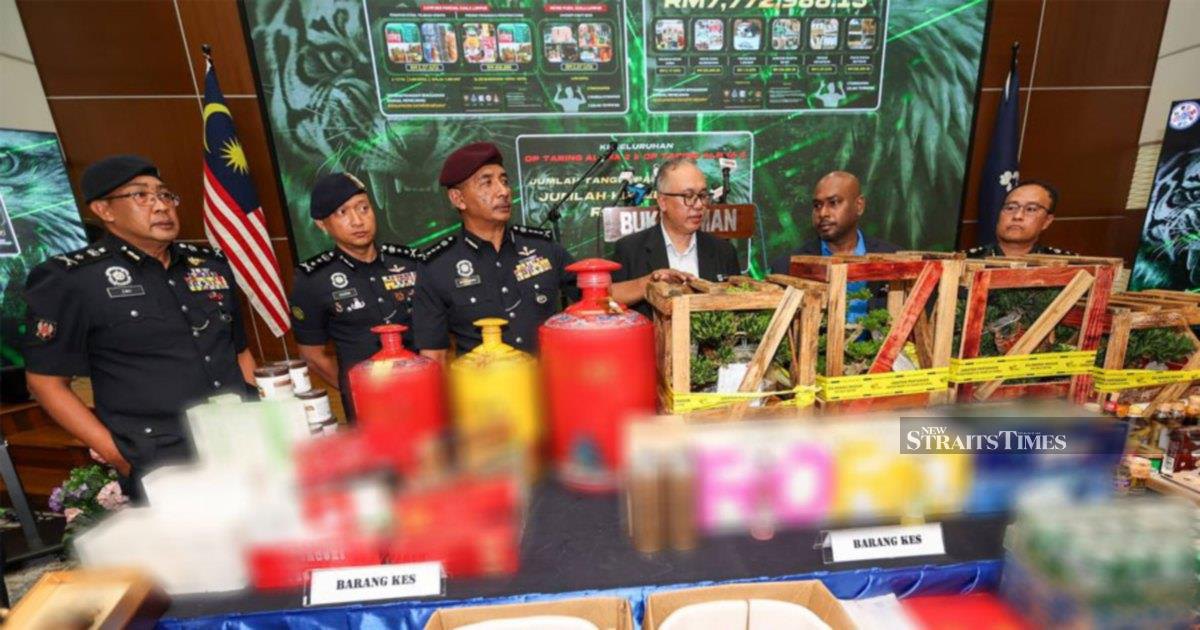
The Royal Malaysia Police have intensified their assault on illicit trade networks, apprehending five suspects and confiscating contraband and merchandise valued at RM12.8 million across dual operations launched in Kuala Lumpur and Klang. The coordinated raids represent a significant enforcement initiative aimed at disrupting smuggling activities that have long plagued Malaysia's major commercial hubs and posed challenges to legitimate commerce and revenue collection.
Smuggling operations centred around Kuala Lumpur and Klang have become increasingly sophisticated, exploiting the region's proximity to port facilities and established logistics corridors. These two areas serve as critical gateways for illicit goods flowing into Malaysia and across Southeast Asia, making them priority targets for law enforcement agencies. The concentration of economic activity, combined with high-volume legitimate trade, has historically provided cover for criminal syndicates moving contraband through conventional supply chains. Police efforts to penetrate these networks require sustained investigative work and coordinated enforcement across multiple jurisdictions.
The RM12.8 million valuation of seized items underscores the substantial scale of smuggling operations that persist despite ongoing regulatory and enforcement measures. Such seizures typically encompass goods subject to excise duties, import restrictions, or outright prohibition under Malaysian law. Common contraband categories include counterfeit merchandise, controlled substances, restricted electronics, and goods smuggled to evade customs duties. The monetary value attached to recovered items often exceeds their actual street worth, reflecting the calculation of unpaid taxes and duties that represent losses to the national revenue system.
Law enforcement agencies in Malaysia have progressively upgraded their capacity to detect and interdict smuggling networks, leveraging intelligence gathering, surveillance technology, and international cooperation. The Kuala Lumpur and Klang operations demonstrate tactical coordination between various police units, port authorities, and customs personnel. Such multi-agency approaches have proven more effective than isolated enforcement efforts, as smuggling networks frequently span multiple operational zones and require seamless information sharing across jurisdictional boundaries. The success of these raids reflects investment in investigative capabilities and personnel training.
Smuggling activities inflict measurable economic harm beyond direct tax and duty losses. Counterfeit goods undermine consumer safety and legitimate business interests, while illicit commerce erodes market competitiveness for compliant enterprises. Malaysian manufacturers and retailers face unfair competition from smuggled products entering at artificially depressed prices. The proliferation of counterfeit items, particularly in pharmaceuticals, automotive parts, and consumer electronics, poses public health and safety risks. Revenue foregone through smuggling could otherwise fund essential government services and infrastructure development.
The apprehension of five individuals in these operations reflects ongoing criminal investigation. Each suspect will be processed through Malaysia's legal framework, which provides comprehensive penalties for smuggling offences depending on contraband category and quantity. Prosecution success depends on evidence quality and investigative documentation. Intelligence gathered during these operations often yields leads for subsequent investigations, potentially exposing larger supply chains and identifying key trafficking nodes. The detention of lower-level operatives frequently facilitates higher-level intelligence through interrogation and cooperation agreements.
Regional smuggling networks frequently operate across Southeast Asian borders, with Malaysia representing both a transit point and final destination market. Goods originating from Cambodia, Thailand, and other regional sources transiting Malaysia demonstrate transnational dimensions of illicit trade. Coordinated enforcement through regional frameworks like the ASEAN Secretariat and bilateral arrangements with neighbouring governments has enhanced capacity to intercept contraband at source and transit points. Police cooperation with Thai, Indonesian, and Singaporean counterparts has yielded intelligence sharing on transnational smuggling organisations. These regional networks require responses transcending national borders and conventional enforcement mechanisms.
The timing of these operations reflects broader government priorities addressing underground economy activities and informal sector growth. Smuggling provides revenue for organised crime syndicates, terror financing networks, and money laundering operations. By disrupting smuggling infrastructure, police weaken financial streams supporting broader criminal enterprises. Intelligence from smuggling investigations frequently reveals connections to human trafficking, drug distribution, and other serious offences. The interconnected nature of organised crime means anti-smuggling operations generate intelligence valuable for other law enforcement objectives.
Port and border security enhancements continue reshaping smuggling methodologies, with traffickers adapting routes and concealment techniques as enforcement intensifies. Kuala Lumpur and Klang remain attractive smuggling destinations despite increased security measures, reflecting persistent demand for contraband within Malaysia and surrounding regions. Criminal organisations employ increasingly sophisticated methods—from body carries and compartmentalised shipping containers to exploitation of diplomatic channels and corruption networks. These adaptations require continuous law enforcement innovation, specialised training, and investment in detection technology.
The RM12.8 million seizure demonstrates material enforcement success but likely represents only a fraction of total smuggling throughput. Intelligence estimates suggest substantial quantities of contraband evade detection during transit. Sustainable reduction of smuggling requires addressing underlying factors—regulatory complexity that incentivises evasion, price differentials creating arbitrage opportunities, and corruption vulnerabilities within government agencies. Comprehensive strategies combining enforcement with regulatory reform, international cooperation, and institutional integrity initiatives offer more promising long-term outcomes than enforcement operations alone.
Government agencies have signalled commitment to sustained enforcement campaigns targeting smuggling networks operating within Malaysian territory. These operations demonstrate operational capability and resolve to disrupt illicit trade. Continued investments in intelligence infrastructure, personnel development, and technology upgrade will shape future enforcement effectiveness. Police leadership has emphasised coordinated approaches involving customs authorities, maritime agencies, and international partners. The five arrests and RM12.8 million seizure reflect current enforcement momentum, though transnational smuggling networks' resilience suggests sustained vigilance remains essential for protecting Malaysian commerce and public safety.

