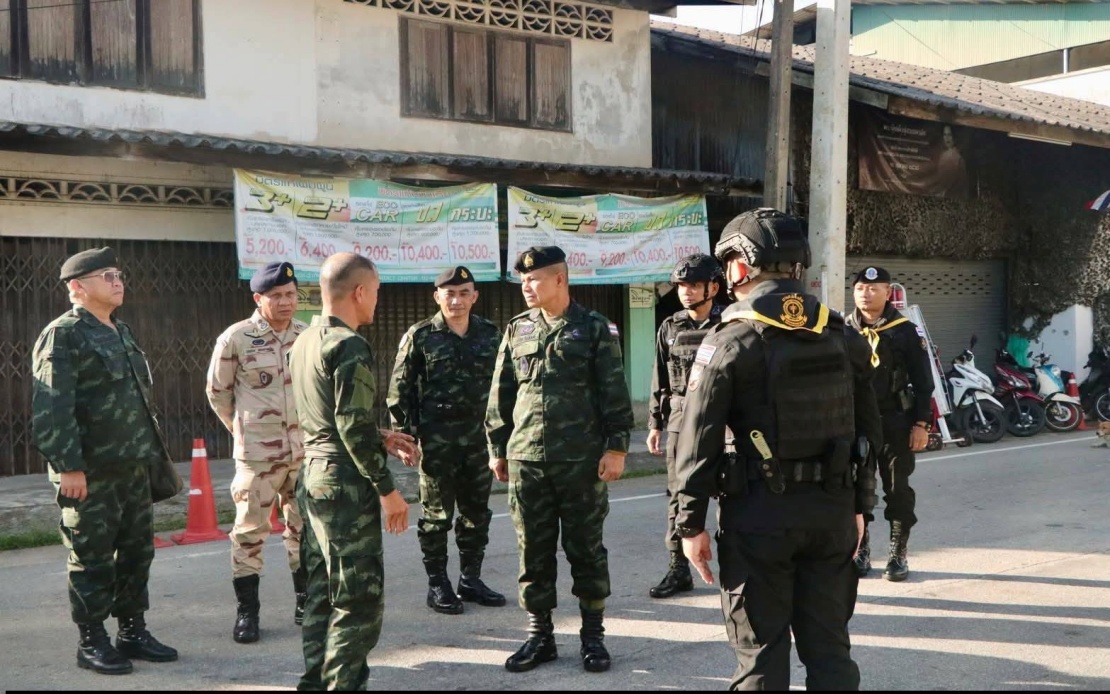
An armed assault on a military checkpoint in Thailand's restive southern province of Narathiwat has claimed the lives of five rangers, marking another escalation in violence that continues to plague the region bordering Malaysia. The attack unfolded on Wednesday evening at approximately 6.45 pm local time when assailants targeted the 4509 Ranger Company checkpoint positioned on Sami Hill in Rangae District, a strategically sensitive area within the conflict-prone southern border region.
Lieutenant General Norathip Phoyanok, who holds the dual position of Fourth Army Region Commander and Director of the Internal Security Operations Command Region 4, provided details of the incident following an inspection of the checkpoint on Thursday morning. According to his account, more than six masked attackers dressed entirely in dark clothing perpetrated the assault, employing both conventional firearms and improvised explosive devices in their coordinated strike against the security personnel stationed there.
The tactical nature of the assault—involving gunfire and pipe bomb detonations—suggests a level of planning and coordination consistent with established militant groups operating within Thailand's southern border provinces. The attackers managed to inflict significant casualties among the ranger contingent before withdrawing from the scene, reportedly using a black four-wheel-drive vehicle to escape. The rapid departure and apparent pre-planned extraction route indicate sophistication in operational execution, raising questions about intelligence networks and coordination capabilities among insurgent factions.
Beyond the military fatalities, six civilians suffered injuries during the crossfire and explosions. Among the wounded were a three-year-old girl and an elderly person, highlighting how such violence extends beyond security forces to affect ordinary residents in the locality. The presence of child casualties in attacks on security installations has become an increasingly troubling pattern in Thailand's southern provinces, underlining the indiscriminate nature of much of the violence plaguing the region and its toll on civilian populations.
For Malaysian observers, the incident carries particular significance given Narathiwat's position directly adjacent to the Malay Peninsula's northeast coast. The Malaysia-Thailand border, which runs through four southern Thai provinces including Narathiwat, has long been a porous boundary where insurgent movements, smuggling networks, and illegal weapon trafficking operate with relative impunity. Cross-border movement of militants and their support networks remains a persistent security concern for both governments, though cooperation mechanisms between Malaysian and Thai authorities have improved substantially in recent years.
In response to the checkpoint attack, Narathiwat Governor Boonchuai Hormyamyen announced heightened security measures across the affected province. These measures encompass fortified border surveillance and expanded protective operations spanning twelve districts within Narathiwat, reflecting official recognition that security threats have intensified across multiple locations rather than being confined to isolated incidents. The provincial administration's decision to mobilize police, military, and local administrative resources underscores the scale of the security challenge confronting authorities.
Forensic teams have secured the checkpoint site to conduct detailed crime scene investigations and evidence collection, with particular attention likely focused on identifying distinctive characteristics of the pipe bombs used and analyzing weapon ballistics to potentially match them against previous attacks. Such forensic data accumulates into an intelligence picture that assists authorities in tracking militant networks and their operational capabilities over time.
Investigations into identifying the masterminds orchestrating the attack remain in preliminary stages, though security analysts familiar with patterns of violence in Thailand's south point to established armed groups as likely perpetrators. The southern Thai insurgency comprises multiple factions with varying organizational structures, ideologies, and tactical approaches, complicating attribution even as broad patterns of violence remain consistent. Some groups maintain stronger territorial control and more centralized command structures, while others operate as loose networks of sympathizers conducting sporadic attacks.
The incident arrives amid a troubling trend of persistent violence in southern Thailand that has claimed thousands of lives over the past two decades. While international attention frequently focuses on terrorism in other regions, the ongoing conflict in Narathiwat, Pattani, and Yala provinces represents one of Asia's longest-running low-intensity armed conflicts. Civilian populations, security personnel, and economic development all suffer consequences from the instability that characterizes these provinces.
For Malaysia, which shares not only a physical border but also ethnic and cultural ties with southern Thailand's Muslim-majority population, developments in the Thai south warrant careful monitoring. Malaysian security agencies maintain intelligence partnerships with Thai counterparts to prevent spillover effects, though the porous frontier ensures complete isolation remains impossible. Cross-border militant movements and weapons smuggling networks have occasionally affected Malaysian security, justifying sustained attention to developments within Narathiwat and neighboring provinces.
The checkpoint attack also reflects broader challenges facing Thai security forces tasked with protecting installation and civilian infrastructure in hostile environments. Rangers operating in southern Thailand face persistently high risks, requiring continuous rotation, training refinement, and tactical adaptation to counter evolving militant methods. Recruitment and retention of quality personnel for such assignments remains difficult, particularly as the conflict's duration and apparent intractability become apparent to potential service members.
As investigations proceed, Thai authorities will likely examine whether this incident represents an isolated attack or signals renewed mobilization by particular militant factions. Such determinations prove critical for strategic response planning and resource allocation by the Interior Ministry and military leadership. Simultaneously, cross-border security consultations between Malaysian and Thai authorities will presumably intensify, ensuring both nations coordinate responses to any spillover risks or transnational aspects of the perpetrators' networks.

