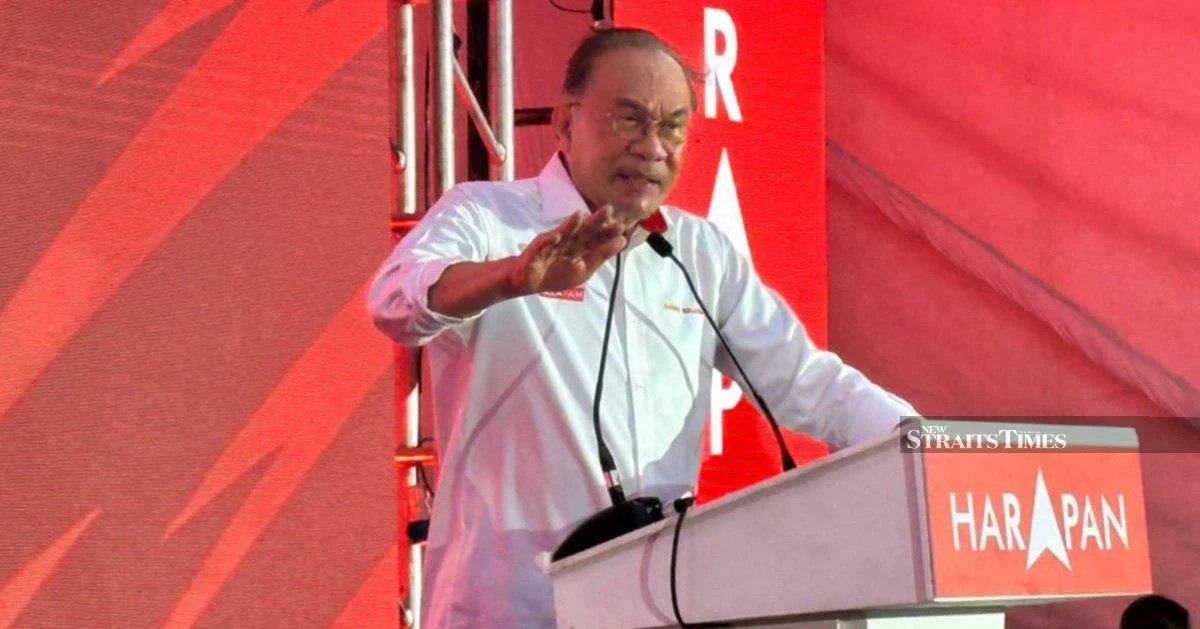
Addressing supporters gathered in Tangkak, Johor, Pakatan Harapan chairman Datuk Seri Anwar Ibrahim delivered a pointed message to the coalition's organisational structure and party leaders across the state: internal squabbles with federal allies must be shelved in favour of demonstrating tangible results that resonate with voters.
Anwar's remarks reflect a strategic pivot within the opposition coalition, which governs six states despite losing federal power in the 2022 general election. The message appears calculated to tighten party discipline ahead of potential electoral contests, while simultaneously signalling maturity in political management. By instructing subordinate structures to refrain from public confrontations with government coalition partners, the Pakatan Harapan leadership aims to project an image of stability and statecraft-like governance that might appeal to centrist voters.
Johor, Malaysia's second-largest state by population and a crucial swing constituency, represents contested political terrain. The state has seen complex power-sharing arrangements between different coalitions, with Barisan Nasional maintaining significant influence over local governance structures. Anwar's choice to deliver this message in Johor underscores the strategic importance the opposition places on improving its standing in the state, where organisational discipline and voter confidence remain pivotal to electoral prospects.
The directive against "bickering" carries multiple implications for PH's internal cohesion and external positioning. Publicly quarrelling with federal government coalition members—whether Barisan Nasional components or other federal partners—creates an impression of perpetual conflict and prevents the opposition from building a credible narrative of alternative governance. When opposition machinery spends resources on scoring political points against allies rather than constructively engaging constituents, it cedes the advantage in setting public discourse around substantive issues like cost of living, service delivery, and infrastructure development.
Anwar's emphasis on "hard work" signals a return to ground-level organising principles that have historically served opposition movements well in Malaysian politics. Building voter databases, conducting neighbourhood engagement, training campaign volunteers, and maintaining consistent communication with constituents form the unglamorous but essential foundation of electoral success. Many experienced political observers note that campaign victories in Malaysia are frequently won or lost at the grassroots level, where persistent and organised parties outperform those relying primarily on media coverage or top-leadership visibility.
The current political environment makes such discipline particularly valuable for Pakatan Harapan. With the federal government comprising multiple coalition partners with sometimes divergent interests, the opposition faces an electorate that may feel increasingly fatigue with political bickering generally. Voters fatigued by constant conflict tend to reward whoever appears most focused on resolving practical problems—roads, schools, healthcare, economic opportunity—rather than perpetuating partisan warfare. By instructing its machinery to maintain this focus, Anwar positions PH as the pragmatic alternative.
For Johor specifically, the directive carries practical significance given the state's complex political history. The state has experienced multiple transitions in governance, including periods of Barisan Nasional dominance interrupted by spells of opposition influence or power-sharing arrangements. Voters in Johor have demonstrated willingness to switch allegiances based on perceived performance and competence rather than blind partisan loyalty. A PH machinery focused on demonstrating good governance in the six states it controls, rather than engaging in unproductive conflict, can leverage those records as evidence of capability.
The timing of Anwar's message also merits consideration within Malaysia's broader political calendar. While no general election date has been announced, political observers widely expect electoral competition to intensify across multiple levels—parliamentary, state assemblies, and local government—within the coming years. Parties utilising the interim period to strengthen organisational capacity, refine messaging, and build voter relationships typically enter electoral contests from positions of greater strength than those consumed by internal disputes or external recriminations.
Anwar's leadership approach reflects lessons learned from PH's experience in federal government between 2018 and 2022, when internal coalition tensions contributed to the government's fragility and eventual collapse. By establishing clear expectations that party machinery should prioritise unity and delivery over public disputes, the coalition's leadership attempts to insulate itself from similar vulnerabilities. The message essentially tells mid-level party organisers that their performance will be measured by their ability to serve constituents and win voter confidence, not by their aggressive rhetoric against political opponents.
The instruction to avoid bickering also represents a subtle acknowledgment that relentless oppositional rhetoric, while emotionally satisfying to partisan activists, often fails to persuade swing voters or convince undecided constituencies to support a party. Malaysian electoral contests are frequently decided by voters who hold flexible political allegiances and make decisions based on perceived competence, personal economic circumstances, and assessments of which party or coalition can better address their concerns. These voters typically punish excessive negativity and reward constructive engagement with community issues.
Moving forward, implementation of Anwar's guidance will serve as a measure of PH's organisational maturity and internal discipline. How effectively the coalition's state structures, local party branches, and campaign machinery adhere to his directive—maintaining professional engagement while resisting provocative engagement with federal coalition partners—will significantly influence the coalition's electoral trajectory. Success in Johor, where this message was specifically emphasised, could catalyse broader momentum toward rebuilding PH's federal competitiveness ahead of the next general election.

