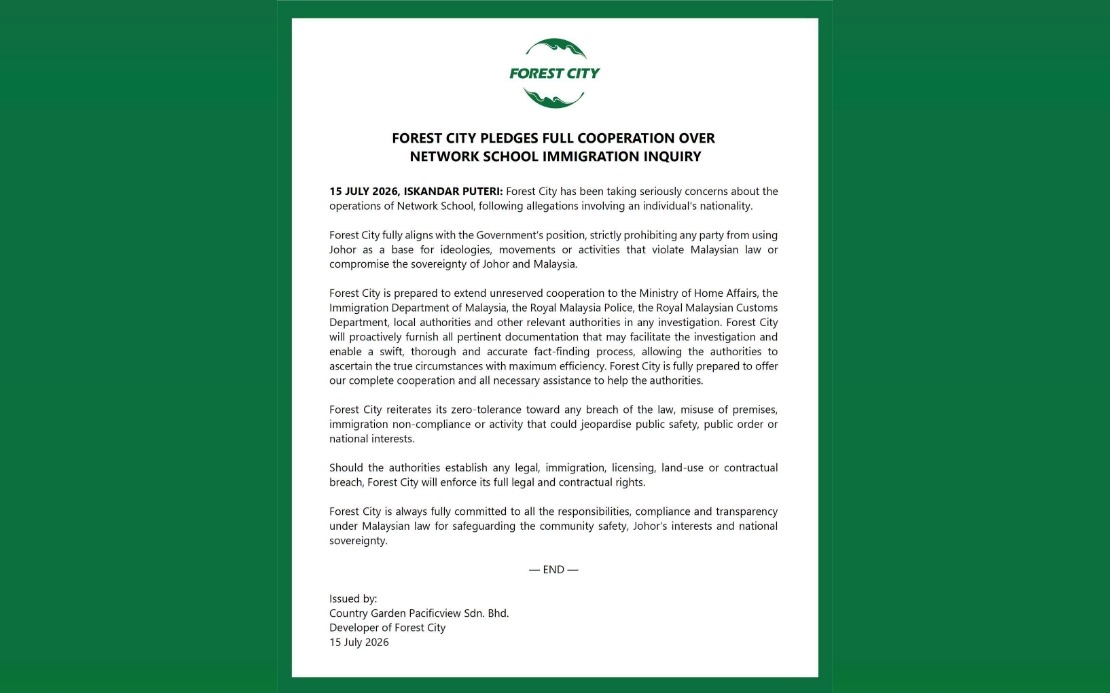
Country Garden Pacificview Sdn Bhd, the developer behind Forest City in Johor Bahru, has committed to providing authorities with unrestricted access and assistance as investigations continue into the Network School operation, which allegedly involved Israeli nationals. The developer's formal undertaking comes amid heightened scrutiny following the Johor Menteri Besar's call for a comprehensive probe into whether the facility was being used to circumvent Malaysia's diplomatic stance on Israel and contravene immigration protocols.
The developer issued a statement affirming its alignment with the federal government's position that Johor must not become a conduit for activities that breach national laws or compromise Malaysia's sovereignty. This positioning is strategically significant, as it distances Country Garden Pacificview from any potential liability while demonstrating corporate responsibility to Malaysian authorities. For foreign developers operating major mixed-use developments in Malaysia, such public declarations serve both as protective measures and as affirmations of commitment to the nation's legal frameworks and foreign policy objectives.
Country Garden Pacificview indicated its readiness to furnish all documentation and records that investigators require, with the explicit aim of accelerating the fact-finding process. The developer's emphasis on transparency suggests either a genuine lack of prior knowledge regarding the Network School's operations or a calculated effort to preempt further regulatory scrutiny of Forest City's tenant vetting procedures. This cooperation extends across multiple enforcement agencies, including the Home Ministry, Immigration Department, Royal Malaysia Police, Customs Department, and municipal authorities, underscoring the multi-agency nature of the investigation.
The developer also restated a formal zero-tolerance position regarding any breach of law, misuse of facilities, non-compliance with immigration requirements, or actions that threaten public safety. Such declarations are standard in corporate communications following controversy, yet they carry weight given the reputational implications for a large-scale development project that has already faced criticism from various quarters since its inception. For Country Garden Pacificview, maintaining operational integrity and demonstrating adherence to Malaysian standards is essential to its long-term viability and profitability in the Malaysian market.
The investigation was triggered after Johor Menteri Besar Datuk Onn Hafiz Ghazi raised concerns that individuals attending the Network School may have employed secondary passports to gain entry to Malaysia, thereby circumventing standard border controls and potentially operating under false identities. This allegation carries significant implications for Malaysia's immigration enforcement and raises questions about how such an operation could have functioned within a high-profile residential and commercial development without immediate detection.
The Immigration Department's subsequent inspection of 266 foreign nationals residing across Forest City revealed that while all individuals possessed valid immigration documentation at the time of verification, authorities have signalled that their investigation remains active and ongoing. This finding suggests either that the alleged Israeli participants had already departed Malaysia prior to the inspection or that they were not among those interviewed. The scale of the inspection, covering nationals from 40 countries, indicates authorities were conducting a broad sweep rather than targeting specific individuals, a procedural approach that minimises potential accusations of selective enforcement.
For Malaysia, the incident touches on longstanding sensitivities regarding Israel and Palestinian sovereignty. Malaysia does not maintain diplomatic relations with Israel, and any indication that Israeli nationals are operating educational or business activities on Malaysian soil contravenes the nation's official stance. The alleged use of alternative passports adds a layer of deception that authorities view as particularly troubling, as it suggests deliberate circumvention of Malaysian entry restrictions and immigration screening protocols designed to uphold the country's foreign policy objectives.
Forest City itself has been a subject of debate since its conception, with various stakeholders questioning aspects of its development, governance, and commercial operations. The Network School controversy adds to this narrative of scrutiny. For investors and residents in Forest City, the investigation's outcome may influence perceptions of security, management oversight, and whether the development adequately screens tenants and operations. The developer's cooperative stance may help mitigate longer-term reputational damage, but the incident has exposed a potential gap in internal vetting procedures.
Regionally, the incident serves as a reminder of the complex intersection between commercial freedom and diplomatic considerations in Southeast Asia. Multinational developers operating across the region must navigate not only business and regulatory requirements but also the geopolitical sensibilities of host nations. For Malaysia, the case reinforces the importance of robust immigration checks and tenant oversight in large mixed-use developments that attract international operators and residents.
The investigation's trajectory will likely determine whether this becomes an isolated incident or signals systemic vulnerabilities in Forest City's management. Should authorities uncover evidence of deliberate facilitation or knowledge of unauthorised activity, consequences for Country Garden Pacificview could extend to operational restrictions or enhanced regulatory oversight. Conversely, if the investigation establishes that the Network School operated independently and deceived the developer, the cooperation pledged today may help insulate the company from deeper legal or administrative consequences.
This episode underscores broader questions about the responsibilities of major commercial developments in policing their own operations and the adequacy of current frameworks for monitoring foreign nationals and activities within large, mixed-use facilities. For Malaysia's regulatory agencies, strengthening coordination between immigration, local authorities, and private property management will be essential to preventing similar situations. The developer's stated commitment to cooperation provides an immediate pathway for authorities to investigate thoroughly, but longer-term reforms may be necessary to address structural vulnerabilities.

