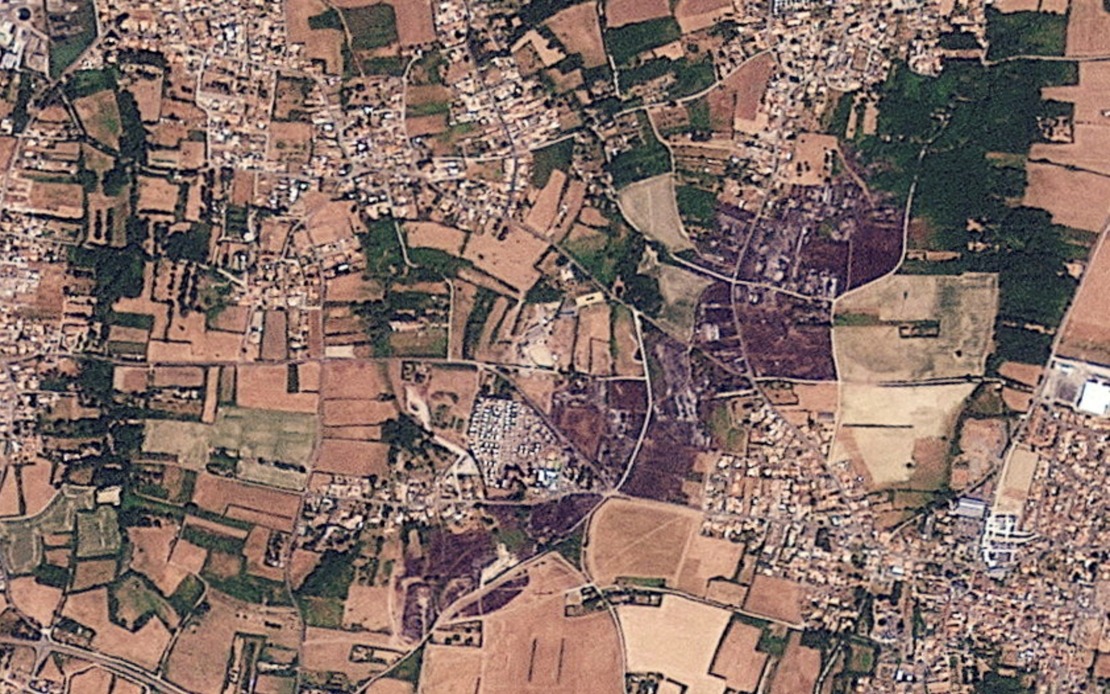
France is grappling with a serious wildfire crisis that has consumed vast stretches of forest and grassland across multiple regions, with the most severe destruction concentrated in the Fontainebleau forest near Paris. Two active fires in this iconic woodland have destroyed approximately 1,920 hectares of vegetation since the first outbreak began on Sunday, forcing authorities to maintain a substantial firefighting presence on the ground. The scale of the emergency underscores the mounting vulnerability of European forests to both natural conditions and human-caused ignitions, a concern that resonates across Southeast Asia where deforestation and fire management remain critical policy issues.
The situation deteriorated overnight as the twin blazes in Fontainebleau continued their destructive path despite intensive suppression efforts. The initial fire consumed roughly 1,500 hectares before a second fire emerged, eventually destroying between 300 and 400 additional hectares. With approximately 600 firefighters remaining stationed at the scene, French authorities have mounted a sustained operation to contain the flames and prevent further spread into surrounding communities. The deployment of such substantial manpower reflects the urgency officials attach to preventing additional losses and protecting residential areas and infrastructure in proximity to the affected zones.
A particularly troubling aspect of the disaster involves evidence that deliberate human action triggered at least the primary fire. French law enforcement arrested two individuals suspected of intentionally setting the initial blaze, prompting strong rhetoric from government officials about accountability and punishment. Transport Minister Philippe Tabarot called for exceptionally stringent sentences for those convicted of deliberately starting fires, distinguishing between deliberate arsonists who warrant harsh criminal penalties and individuals suffering from pyromania who require medical intervention and psychological treatment. This nuanced approach reflects broader debates within European justice systems about proportionality and rehabilitation versus punishment.
The broader context of arson-related fires has become increasingly alarming for French authorities tracking patterns across the country. Since the official commencement of the fire season, officials have arrested 59 individuals nationwide on suspicion of intentionally igniting wildfires, suggesting a troubling trend of deliberate fire-setting that extends well beyond the Fontainebleau incidents. Such numbers prompt consideration of underlying motivations—whether economic grievance, mental health crises, or other factors drive this behaviour—and raise questions about prevention strategies beyond purely reactive firefighting and criminal prosecution. For Malaysia and other developing nations wrestling with similar challenges, the French experience highlights the necessity of addressing root causes alongside enforcement mechanisms.
Beyond the Fontainebleau emergency, France confronts multiple simultaneous wildfire challenges scattered across its geography, stretching firefighting resources and complicating coordinated response efforts. The Trevillach wildfire in the Pyrenees-Orientales region, which ignited earlier in July, has inflicted sufficient damage to critical transportation infrastructure that railway operations remain severely compromised. The Perpignan-Villefranche-Vernet-les-Bains line, a significant transport corridor in southern France, sustained infrastructure damage that forced the national railway operator SNCF to suspend passenger services between Ille-sur-Tet and Villefranche-Vernet-les-Bains until at least July 20.
The disruption to rail services exemplifies how wildfire impacts cascade through civilian infrastructure and economies in ways extending far beyond immediate property destruction. Tourists, commuters, and commercial logistics networks face disruption as transport operators implement service suspensions and rerouting arrangements. This ripple effect underscores why wildfire management constitutes not merely an environmental concern but an economic and social policy priority. For Malaysia, where tourism and regional connectivity depend heavily on functioning transport networks, such disruptions carry obvious parallel implications.
Fires have also significantly impacted Brittany and Lozère regions, diversifying the geographic scope of the current emergency across northwestern and south-central France. In Brittany's Côtes-d'Armor department, a heath fire that erupted near Cap Fréhel forced authorities to evacuate more than 100 residents as a precautionary measure, while the blaze consumed approximately 38 hectares of landscape. Simultaneously, the Lozère region reported 107 hectares of burnt territory, indicating that even regions outside the primary Fontainebleau crisis face substantial damage. This geographic dispersal suggests widespread conditions favouring fire propagation rather than isolated incidents, potentially related to prolonged heat, drought stress, or seasonal wind patterns that elevate fire risk across broad territory.
The pattern of multiple simultaneous fires occurring across disparate regions raises important questions about underlying meteorological and climatic conditions that create elevated fire risk. Southern and central European regions have experienced increasingly volatile fire seasons in recent years, with scientists attributing intensification partly to climate-related factors including temperature elevation and shifting precipitation patterns. For a Southeast Asian readership, such dynamics parallel concerning trends in regional fire seasons, particularly across Indonesia and Malaysia where transboundary haze episodes create significant public health and diplomatic challenges. France's current struggle offers instructive lessons about the necessity of comprehensive fire prevention infrastructure, early warning systems, and coordinated regional response mechanisms.
The French government's explicit focus on prosecuting arsonists reflects a policy stance emphasizing that human accountability must accompany environmental management. By distinguishing arson requiring criminal punishment from pyromania demanding medical treatment, officials articulate a framework recognising that not all fire-setting behaviour stems from identical motivations or bears identical culpability. This differentiated approach potentially offers greater deterrent effect against deliberate criminals whilst ensuring that individuals with genuine compulsive behaviour receive appropriate care rather than purely punitive responses. Such frameworks merit consideration in Southeast Asian contexts where wildfire causation varies substantially between agricultural burning practices, industrial negligence, and deliberate arson.
The deployment of 600 firefighters and the coordination of response across multiple regions demonstrates the substantial resource commitment required to address wildfire emergencies at national scale. However, even such substantial deployments appear challenged by the scale and simultaneity of current fires, suggesting that prevention through intelligence gathering, public awareness campaigns, and elimination of fire sources may ultimately prove more cost-effective than purely suppressive measures. For Malaysia and neighbours, this observation reinforces arguments for investing upstream in fire prevention rather than concentrating resources solely on reactive firefighting once blazes ignite.
Looking ahead, French authorities face the dual challenge of containing immediate fires whilst investigating the criminal dimension of deliberate fire-setting. The arrest of two suspects in connection with Fontainebleau and the identification of 59 individuals across the country suggest that intelligence services and local authorities possess capacity to identify and apprehend fire-setters, though establishing criminal liability requires rigorous investigation. The broader implication involves recognising that wildfire management encompasses not merely technical firefighting capacity but also law enforcement, public education, and policy frameworks addressing underlying drivers of fire risk. As France navigates this crisis, neighbouring and distant nations including Malaysia can benefit from observing how such multifaceted approaches interact and contribute toward eventual resolution.

