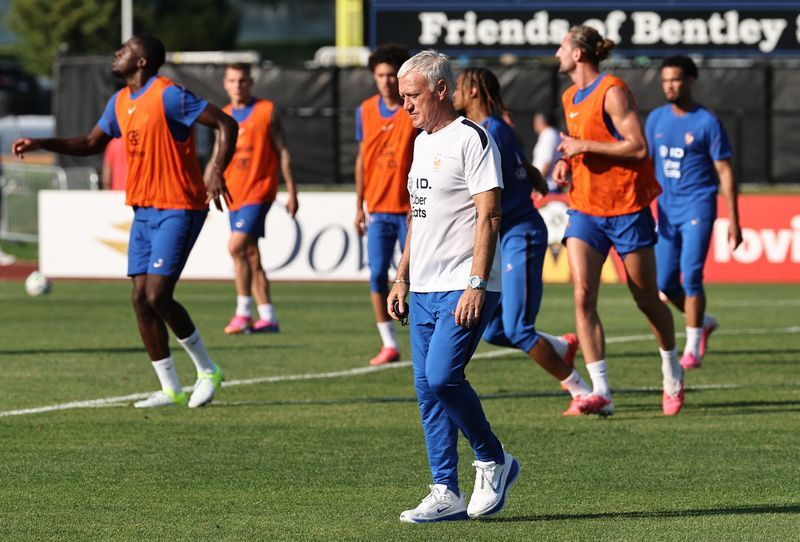
France's journey through the group stage has been defined by devastating attacking prowess, yet as they prepare for Tuesday's knockout encounter with Sweden, coach Didier Deschamps recognises that tactical refinements will be necessary to navigate the tournament's more demanding later rounds. The French squad finished atop Group I with an unblemished record, demonstrating their capacity to dismantle opponents through a combination of pace, creativity and clinical finishing that has left observers struggling to identify weaknesses in their offensive arsenal.
The numbers tell a compelling story of French dominance. Ten goals across victories over Senegal, Iraq and Norway showcase the depth of attacking talent available to Deschamps, with Kylian Mbappe, Ousmane Dembele and Michael Olise forming what many consider the tournament's most formidable forward line. The interplay between these three has been virtually impossible for group-stage opponents to contain, and their ability to create and convert chances in rapid succession has become the defining characteristic of France's campaign so far.
However, beneath the glittering offensive statistics lies a concern that occupies Deschamps' mind as he prepares his team for opponents no longer willing to absorb punishment passively. The left side of France's defensive structure has proven inconsistent, with left back Theo Hernandez unable to deliver the assured performances required at this level of competition. This vulnerability runs deeper than the performance of a single player, affecting the team's overall shape and their capacity to transition smoothly from defence to attack along the flanks.
To address this structural weakness, Deschamps has signalled his intention to introduce Lucas Digne at left back, a change that prioritises defensive solidity and more reliable distribution from wide areas. Digne's presence should provide France with improved cover against opponents capable of exploiting space in behind their defensive line, a concern that emerged even during group matches when the attacking focus sometimes left France exposed on the counter-attack. The decision reflects Deschamps' pragmatic understanding that knockout football rewards balanced teams over those reliant solely on offensive brilliance.
Further up the flank, Bradley Barcola is expected to replace Desire Doue on the left wing, a substitution driven by Deschamps' desire to inject more direct running and explosive pace into France's wide play. Barcola's profile differs from Doue's in crucial ways, offering the kind of ball-carrying threat and one-versus-one capability that could create more straightforward attacking opportunities. This adjustment maintains France's overall attacking philosophy whilst introducing greater coherence to a left-side unit that has appeared disjointed during the group stage.
Sweden present themselves as considerably more challenging opposition than France faced in their opening fixtures. Finishing second in Group F, the Swedes demonstrated both vulnerabilities and resilience throughout their group campaign. An emphatic 5-1 victory against Tunisia proved their capacity for offensive aggression, whilst their subsequent capitulation against the Netherlands, who inflicted an identical 5-1 defeat, exposed serious defensive frailties. Yet their disciplined 1-1 draw with Japan suggested that focused defensive organisation remains available to them when they prioritise compactness over ambition.
The Swedish approach will likely involve abandoning any pretence of competing for possession and instead constructing defensive barriers designed to minimise the space available to France's principal playmakers. Set pieces offer Sweden their most realistic avenue for threatening France's goalkeeper, and indeed, physical presence throughout the pitch may prove their best strategy for disrupting France's rhythm. Nevertheless, the gap in attacking quality between the two teams appears cavernous, with Alexander Isak, Viktor Gyokeres and Anthony Elanga providing Sweden respectable forward options that pale beside France's embarrassment of riches.
Former England captain Gary Lineker has articulated what many observers suspect: Sweden simply lacks the firepower to punish France sufficiently if given opportunities to counter-attack. Lineker's assessment, offered to French sports daily L'Equipe, acknowledges that whilst France demonstrated minor defensive lapses during their group campaign, their superior goal-scoring capability renders such moments inconsequential. The mathematics of knockout football strongly favour the side capable of converting chances most ruthlessly, and France's bench strength—featuring Rayan Cherki, Jean-Philippe Mateta and Marcus Thuram as reserve attacking options—suggests they possess superior finishing quality at every level of their squad.
The transition from group-stage football to knockout competition presents a categorical shift in tactical intensity and risk management. France's occasional defensive vulnerability, overlooked during matches where they simply overwhelmed less competent opposition, suddenly becomes more consequential when opponents arrive prepared to exploit every mistake. Yet France's recent knockout history provides considerable reassurance: aside from their loss to Argentina in the 2022 final, they have not faltered in knockout matches at World Cups since 2014, a record indicating both structural resilience and clutch mentality.
The return of William Saliba to France's central defensive positions offers additional insurance against Swedish counter-attacking ambitions. Saliba's ball-playing ability and positioning sense should strengthen the defensive platform upon which France's attack operates, creating clearer passing lines into midfield and reducing the long-term exposure that comes from playing excessively open football. His presence represents a meaningful upgrade to France's defensive architecture, offering Deschamps the stability required to unleash his attacking talents with minimal concern.
Looking beyond this fixture, victory would position France to face either Germany or Paraguay in the Round of 16, ensuring that the tournament's structure itself appears designed to propel them toward the later stages. The convergence of superior attacking depth, tactical flexibility, and proven knockout experience makes France overwhelming favourites, yet Deschamps' willingness to tinker with his left side demonstrates appropriate respect for tournament dynamics where complacency carries genuine consequences.

