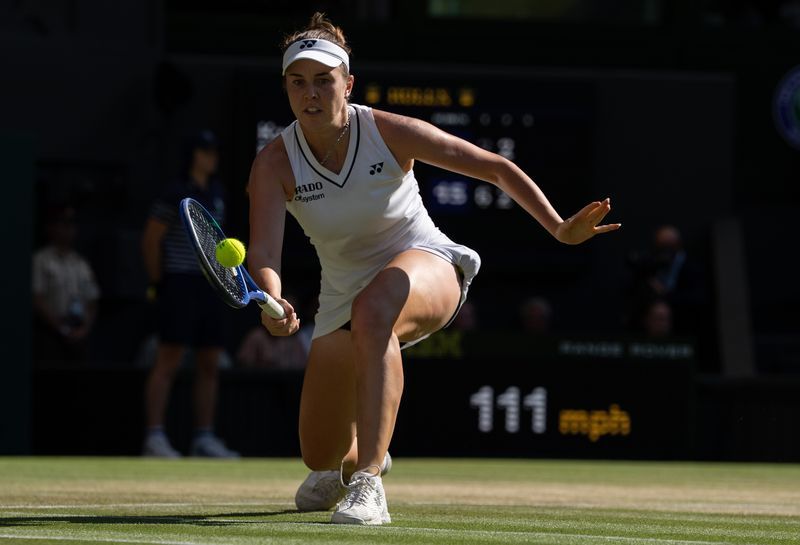
Linda Noskova's triumph at Wimbledon represented far more than a tennis achievement—it was a masterclass in psychological resilience under the most punishing circumstances imaginable. The 21-year-old Czech ninth seed faced a scenario that would ordinarily signal capitulation: leading 5-2 in the second set against fellow Czech and friend Karolina Muchova, she squandered five consecutive match points before her opponent clawed back to force a deciding set. By conventional logic, the mental damage should have been irreversible, yet Noskova returned to court transformed, ultimately claiming a 6-2 5-7 6-3 victory on a sun-drenched Centre Court at the All England Club.
The collapse itself was staggeringly comprehensive. With dominance within her grasp at 5-2 in the second set, Noskova watched helplessly as Muchova saved three match points while serving at 2-5. A double-fault that escaped from Noskova's own serve at 5-3 squandered another opportunity, before a fifth match point vanished in the ninth game. What followed was a complete reversal of momentum, with Muchova reeling off five consecutive games to level the match and send proceedings into a third set that had appeared virtually unthinkable mere minutes earlier. As Noskova walked towards her chair following this collapse, observers noted her shell-shocked demeanor—hands covering her ears as if trying to block out the enormity of what had just transpired.
What happened during that pivotal comfort break became the turning point of the match and arguably the defining moment of Noskova's young career. She described the almost spiritual experience of encountering the trophies as she made her way off court—a physical manifestation of her ambitions that jolted her consciousness back into present-moment awareness. "I was just telling myself that the match is starting over," she explained to reporters afterward. "I was in the bathroom. I just splashed some cold water on me, started over again. But what really helped me, like the first step I took off court, the trophies were there. I was like, I'm not going to take the small one, I'm taking the big one." This was not merely motivational rhetoric; it represented a genuine psychological reset, a deliberate choice to reject the narrative of defeat that threatened to overwhelm her.
The mental framework Noskova employed—compartmentalising the previous set as a separate entity and treating the third set as an entirely fresh contest—proved immediately efficacious. She held serve in the opening game of the final set, a holding that she would later acknowledge as crucially important for restoring her confidence and momentum. With that serve held, something shifted in her tennis as well. The timing on her groundstrokes, which had deserted her during the second-set collapse, gradually reasserted itself. Her footwork improved, her court positioning sharpened, and the aggressive rhythm that had characterised her first-set performance began to resurface. When she reached 5-3 in the third set more than an hour after her first match point, Noskova closed out the match decisively, finally converting the breakthrough that had eluded her so painfully.
Noskova's victory carries particular significance within the context of Czech women's tennis dominance. She became the third Czech woman to claim the Wimbledon singles title within four years, a remarkable concentration of success that places the small Central European nation among tennis's elite powers. Additionally, at 21 years old, she reclaimed the mantle of youngest women's champion since her compatriot Petra Kvitova won the first of her two Wimbledon titles in 2011. This achievement is not merely a sporting accomplishment but a cultural marker of Czech tennis's continued vitality and competitiveness at the sport's highest level.
What renders Noskova's victory even more compelling is the maturity and perspective she brings to competitive tennis—attributes that seem incongruous with her age but are rooted in genuine life experience and philosophical conviction. Two years prior to her Wimbledon triumph, Noskova's mother Ivana died from cancer, an experience that fundamentally reshaped her worldview and priorities. Rather than becoming consumed by the insular bubble of professional tennis, she has actively engaged with causes beyond the court, notably spending part of the previous off-season in Zanzibar volunteering at a school through a charitable organisation. That experience, she reflected, substantially increased her appreciation for life's fundamental blessings and shifted her perspective on tennis competition itself.
Growing up in a village within the Czech forests, Noskova has maintained a pronounced connection to environmental stewardship and natural systems that distinguishes her from many of her contemporaries. She has publicly articulated concerns about environmental degradation and has committed to pursuing volunteer work focused on nature conservation in the coming months and years. This commitment extends beyond abstract concern; she has demonstrated active participation in various humanitarian endeavours during times of crisis, displaying a civic consciousness that reflects maturity far beyond her years. Indeed, following her semi-final victory over Marta Kostyuk on Thursday, she reiterated her intention to dedicate time to environmental volunteering and expressed her commitment to remaining "very active during whatever crisis" emerged.
Noskova's distinctive personal presentation—she wears a nose ring—and her candid, thoughtful engagement with life's deeper questions suggest an athlete fundamentally at ease with her own identity and confident in her values. This internal coherence and psychological stability likely contributed substantially to her capacity to recover from the second-set meltdown. For players whose sense of self is entirely intertwined with competitive success, such a reversal might prove psychologically unmanageable. For Noskova, whose life encompasses concerns ranging from environmental conservation to family grief to international humanitarian work, a tennis match—however significant—exists within a broader context of meaning and purpose.
The immediate aftermath of her victory revealed an athlete still processing the magnitude of her achievement. "It was all worth it, so I will definitely never forget this week, these two weeks," she said, the cumulative weight of the championship fortnight evident in her words. She acknowledged that the third set would have unfolded entirely differently had she lost that opening game, suggesting a keen awareness of the psychological inflection points that separate victory from defeat in professional tennis. This capacity for analytical reflection on her own mental processes, combined with her demonstrated ability to execute meaningful resets under pressure, positions her as a player likely to contend for major titles throughout her career.
For Malaysian and Southeast Asian readers, Noskova's story offers compelling lessons about resilience, psychological maturity, and the importance of maintaining perspective beyond sport. Her emphasis on environmental stewardship and charitable work reflects broader generational values increasingly prominent among young athletes across Asia, where growing numbers of sports personalities are aligning their platforms with sustainability and social responsibility initiatives. Moreover, her experience overcoming substantial personal tragedy—her mother's death—while achieving elite athletic success resonates across cultures where family bonds and filial devotion remain central to identity and motivation.

