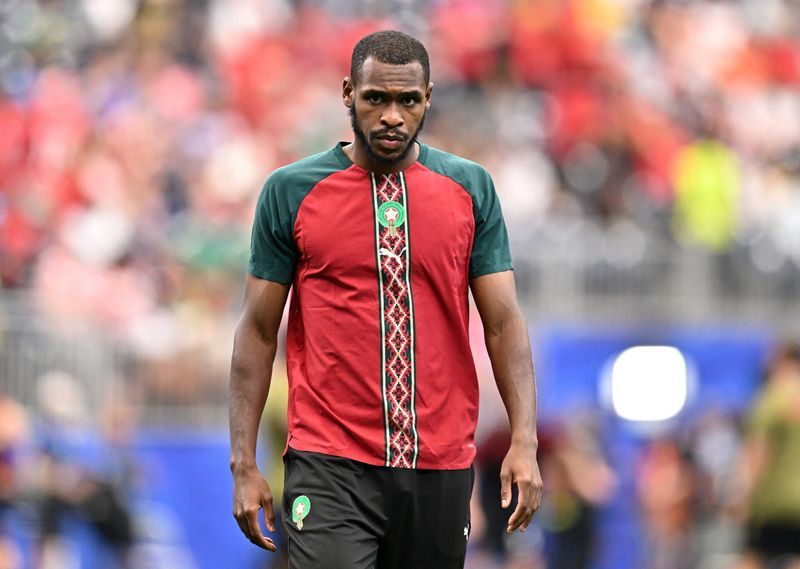
Issa Diop's World Cup journey has traced an improbable arc from ardent French patriot to committed Moroccan defender, a transformation that culminates in perhaps the tournament's most narratively rich assignment: shackling Kylian Mbappé in Thursday's quarter-final between Morocco and France. The 29-year-old centre-back, born in Toulouse to a Senegalese father and Moroccan mother, represents a sporting redemption story that transcends the usual calculus of international football selection, embodying instead the complex negotiations between identity, loyalty, and opportunity that define modern sport.
For most of his career, Diop appeared to have permanently closed the door on representing Morocco. Seven years ago, when still a junior international for France, he articulated his position with unequivocal clarity during a Canal Plus interview, declaring that his French birthright and the opportunities France had afforded him made switching allegiance unthinkable. His reasoning seemed almost patriotic in its conviction: abandoning France merely because selection remained elusive would amount to betrayal rather than pragmatism. That statement, articulated with the certainty of youth, set the parameters many believed would govern his international trajectory indefinitely.
Yet Morocco and Senegal, recognising the calibre of defender available to them through heritage, persisted in their courtship across the ensuing years. The African nations understood what Diop himself perhaps underestimated: that international football opportunities depend partly on circumstances beyond individual control. Morocco's approach finally succeeded when Diop agreed to commit to the North African nation in March, just months before the World Cup. The decision shocked many observers who remembered his earlier declarations; social media erupted with criticism that characterised his switch as opportunistic, a reversal born not from conviction but from exclusion by France.
Coach Mohamed Ouahbi, however, recognised in Diop something more substantial than mere ambition. The coach perceived a player genuinely connected to Moroccan culture, someone who visited the country regularly and inhabited a distinctly Moroccan lifestyle despite his French upbringing. This observation proved crucial in legitimising Diop's integration into a squad that required defensive solidity following significant personnel upheaval. Captain Romain Saiss's departure after January's Africa Cup of Nations and Nayef Aguerd's March injury had left Morocco vulnerable at centre-back precisely when World Cup preparation reached its critical phase. Diop's eight seasons in English football, split between West Ham United and Fulham, had equipped him with the defensive discipline and physical robustness that Premier League experience cultivates.
His debut for Morocco arrived relatively late in the international calendar, a March friendly against Ecuador that foreshadowed the decisive contribution he would make during the tournament proper. Ouahbi positioned him alongside Crystal Palace's Chadi Riad, forming a partnership that would require immediate cohesion given the limited time for partnership-building before the tournament. Remarkably, Diop stepped immediately into the first-choice centre-back berth, suggesting both his quality and the desperation created by Morocco's injury circumstances.
The moment that crystallised Diop's transformation from controversial recruit to emblematic figure arrived in the round of 32 encounter with the Netherlands. Deep into stoppage time, with Morocco facing elimination, Diop advanced into the Dutch penalty area—an unusual positioning for a centre-back that underscored both the desperation of the moment and his willingness to contribute across the pitch. When Chemsdine Talbi's cross arrived precisely one minute into added time, Diop's powerful header found the net with the precision of a striker. The equaliser forced extra time and ultimately decided the match in Morocco's favour via penalties, transforming what would have been a premature exit into a continuation of an improbable tournament run.
That goal possessed significance extending well beyond its immediate tactical consequences. For Moroccan supporters, it symbolised national commitment from a player whose earlier rejection of the nation had stung; for Diop himself, it represented vindication of a decision that many had questioned as opportunistic self-interest. The narrative shifted dramatically. Where critics had emphasised his reluctant patriotism, the sporting community increasingly acknowledged the sincerity of his integration into Moroccan football. Ouahbi's perspective—that past declarations mattered less than present attitude and future performance—gained credibility with each contribution.
Now Diop confronts his most demanding assignment yet, one that adds extraordinary layers of complexity to an already balanced quarter-final contest. France's Mbappé, the tournament's most dynamic attacking force and the player most capable of destabilising Morocco's defensive organisation, will represent an examination of Diop's commitment far more exacting than the Netherlands encounter. The symbolic weight of a Moroccan player of French birth containing a quintessentially French talent operates as subtext to the sporting narrative, investing the individual duel with significance beyond football statistics.
Diop's eight seasons in England's top flight have equipped him with the tactical intelligence and physical conditioning necessary for high-pressure defensive assignments. His experience against elite strikers, accumulated across 200 Premier League appearances, provides a foundation for confronting Mbappé's explosive acceleration and technical brilliance. Yet the psychological dimension extends beyond conventional preparation; Diop must navigate not merely Mbappé's exceptional talents but also the resonance of his own journey from rejected suitor to national representative.
For Morocco's aspirations of reaching the semi-finals for the second consecutive World Cup, Diop's performance encapsulates the broader challenge of defensive discipline against France's attacking potency. The quarter-final represents an inflection point in both the tournament trajectory and Diop's own international narrative. Success would crystallise his transformation from controversial selection to essential contributor; failure would resurrect questions about whether his integration remained incomplete and his commitment genuinely resolved.
The match transcends conventional football analysis because it embeds within its action the universal themes of belonging, redemption, and the capacity for revision that sport uniquely permits. Diop's presence in Morocco's defensive line against France condenses seven years of international football's philosophical debates into ninety minutes of competitive action. Whether his journey culminates in triumph or disappointment, the arc itself testifies to football's capacity to transform circumstance into opportunity and scepticism into commitment.

