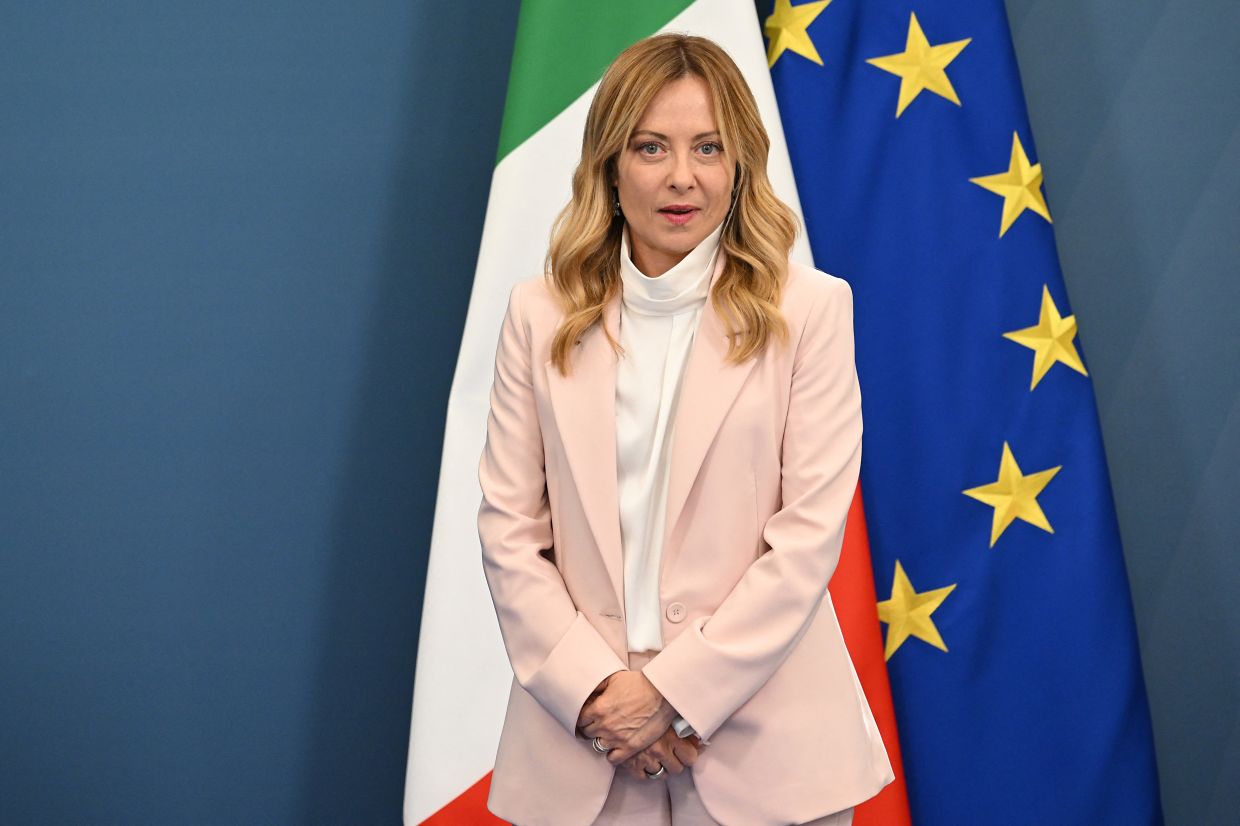
Italy's Prime Minister Giorgia Meloni has engineered a remarkable political metamorphosis since taking office in October 2022, and her wardrobe has evolved in tandem with her shifting persona. Where she once presented herself in austere dark suits and heavy black boots—visual markers of her radical outsider status—she now gravitates towards soft pastels, tailored silhouettes, and wide-legged trousers that conceal her heels. This sartorial recalibration represents far more than a superficial aesthetic adjustment; according to fashion and politics experts, it constitutes a deliberate communication strategy designed to project authority without the confrontational edge that characterised her emergence onto Italy's political stage.
When Meloni assumed the premiership nearly two years ago, few expected her governing approach to diverge so substantially from the extremist rhetoric that had long defined her political identity. Her party, the Brothers of Italy, inherited ideological DNA from Italy's post-fascist movement, and observers anticipated she would pursue antagonistic policies toward the European Union while adopting an uncompromising stance on foreign policy. The trajectory of her tenure has instead confounded these predictions. While maintaining conservative domestic positions, particularly regarding migration, Meloni has demonstrated pragmatism in her dealings with Brussels and emerged as one of Europe's most stalwart supporters of Ukraine's resistance against Russian invasion. She has additionally demonstrated a willingness to challenge American pressure, actions that have paradoxically strengthened her standing among European allies who value her independent judgment.
The shift in Meloni's political positioning—from the margins toward the mainstream—finds its clearest expression in her daily appearance choices. Antonio Mancinelli, who teaches at Rome's Costume And Fashion Academy, observes that Meloni possesses an acute understanding of how non-verbal communication through clothing functions within the political sphere. Shortly after her appointment as premier, she began adopting tailored suits rendered in muted tones, a transition that fashion commentators read as conveying both seriousness and accessibility. These garments replaced the starkly monochromatic ensembles that had become her trademark during her years as a minority party leader. The change accelerated as she became an increasingly visible figure on the international stage, requiring an appearance that would resonate with global counterparts and stakeholders.
The psychological and cultural associations embedded in Meloni's colour palette merit particular attention. Fashion educator Michela Bonafoni, who lectures at Unicollege in Florence, notes that lighter and neutral tones communicate loyalty, tenderness, and approachability—qualities that stand in sharp contrast to the severity projected by her earlier all-black aesthetic. Within the Italian context, this distinction carries heightened significance. While black represents sophistication and style throughout European fashion, Italy's historical trauma has imbued black garments, particularly when worn as complete outfits, with associations to fascism and authoritarianism. Meloni's departure from this visual vocabulary signals a deliberate disassociation from the extremist currents that have periodically troubled her political career.
The contrast between Meloni's current professional appearance and her younger self illuminates the extent of her transformation. In 1996, at nineteen years old, a French television crew documented the nascent activist—garbed almost entirely in black—as she coordinated members of a right-wing youth movement. During that same interview, she offered remarks defending Benito Mussolini that would subsequently become recurring obstacles to her political advancement and international acceptance. That particular moment crystallises the distance she has travelled. Two decades later, as a prospective leader of a major European democracy, such pronouncements had become politically untenable, necessitating a comprehensive repositioning.
Meloni's sartorial evolution gathered momentum during her 2008 appointment as youth minister under Silvio Berlusconi. In that governmental role, she began gravitating toward more serious professional attire, typically dark suits paired with crisp white shirts. This shift reflected her own recognition that advancement within established power structures required the visual markers of institutional legitimacy. By the time she mounted her successful campaign for the premiership in 2022, she had already begun expanding her appeal beyond her traditional base. Her campaign speeches, in which she described herself passionately as "a woman, a mother, a Christian," resonated with conservative centrists who might otherwise have viewed her with suspicion. These words subsequently spawned viral remixes and functioned as effective bridges toward a broader electoral coalition.
Fashion designer Stella Jean, herself of Italian-Haitian heritage, emphasises the particular weight that Meloni's wardrobe choices carry. Italy's global prominence in fashion design and the sector's substantial economic contribution to the nation's prosperity means that how a female prime minister presents herself acquires dimensions beyond the merely personal or even narrowly political. When the representative of a nation synonymous with sartorial excellence makes wardrobe decisions, those choices inevitably invite scrutiny and interpretation. Meloni's office has declined to comment on her fashion choices or the identity of advisers who might guide her decisions, maintaining an official silence on a matter that observers clearly regard as strategically significant.
Riccardo Alcaro, political analyst at Italy's Institute For International Affairs, contextualises Meloni's evolving presentation within the demands of her expanded political position. When leading a minor right-wing party, her primary obligation was maintaining coherence with a narrowly defined electorate accustomed to her confrontational rhetoric and aesthetic. Her elevation to premiership of a major EU economy fundamentally recalibrated those requirements. She must now project an image of credibility and seriousness to domestic parliamentarians, international counterparts, financial markets, and the broader European constituency that views Italy as a consequential actor within collective EU affairs. Her wardrobe has adapted accordingly, functioning as a visual affirmation of her ability to govern with responsibility and pragmatism.
Meloni's fashion choices position her within a broader pattern of world leaders leveraging sartorial decisions to reinforce political messaging. Ukrainian President Volodymyr Zelenskyy has maintained military-adjacent clothing since Russia's February 2022 invasion, a visual assertion of national solidarity and wartime resolve. Andy Burnham, the United Kingdom's new Prime Minister, wears jeans and casual t-shirts to reinforce his stated commitment to bringing government closer to working-class constituencies. Mexican President Claudia Sheinbaum deliberately wears garments embroidered by Indigenous artisans, thereby honouring and promoting Mexico's textile heritage and Indigenous communities. Yet Meloni's case contains particular complexity, as her fashion evolution must simultaneously accomplish the feat of distancing her from her party's problematic historical associations while establishing her credibility within elite international circles.
As Meloni enters the final year of her mandate as premier, her political environment has grown more turbulent. A rising right-wing challenger has begun contesting her authority within the broader conservative political ecosystem, rivalry that will inevitably highlight the moderating trajectory she has undertaken on multiple policy fronts. No amount of careful wardrobe curation will entirely eliminate the tension between her party's origins and her current governing approach. Nevertheless, her visual self-presentation has undoubtedly facilitated her transition from outsider to establishment custodian. The evolution from black boots and severe tailoring to pastel suits and concealed heels represents a strategic adaptation to changed circumstances—proof that in contemporary politics, how leaders present themselves through dress functions as an essential language for communicating competence, trustworthiness, and evolved perspective. For Meloni, these carefully chosen garments have become instruments through which she translates her political repositioning into forms that international audiences can readily comprehend and evaluate.

