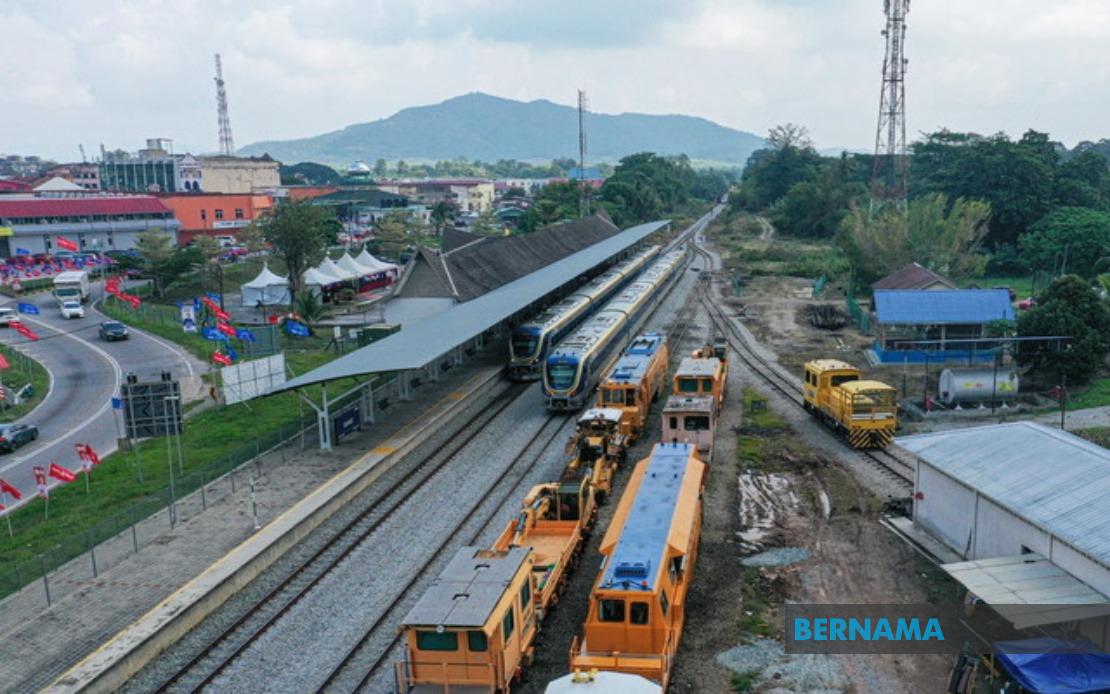
The long-delayed restoration of the railway corridor linking Gemas, Negeri Sembilan, to Mentakab, Pahang, has finally reached completion, with work concluded on June 19 at a final expenditure of RM41.7 million. Transport Minister Anthony Loke announced the milestone at KTMB Bahau station, marking the end of a project that began in 2016 but faced significant setbacks that pushed its delivery far beyond the original 2019 target date.
The extended timeline reflected multiple challenges that tested Malaysia's infrastructure management capacity. Severe flooding on the East Coast caused catastrophic damage to sections of the track, while the original contractor proved unable to maintain the pace required to meet project milestones. These compounding difficulties meant that what was envisioned as a three-year undertaking stretched to nearly double that duration, illustrating the practical difficulties of maintaining construction schedules in regions vulnerable to climate-related disruptions.
The significance of this route lies in its strategic positioning within Malaysia's broader rail architecture. Gemas functions as a crucial interchange point where the East Coast and West Coast railway networks converge, creating an essential artery that knits together Negeri Sembilan, Pahang, and Kelantan. By restoring this link, authorities have reinforced connectivity between Malaysia's peninsula-wide rail infrastructure, enabling smoother passenger transitions and more efficient freight movement across the country.
A notable operational advancement comes from the upgraded track's capacity to support loads of up to 20 tonnes per carriage. This capability enhancement aligns with the government's broader road-to-rail strategy, designed to shift cargo transportation away from highways and onto rail networks. Such modal shift offers environmental benefits through reduced carbon emissions while potentially easing congestion on major road arteries that have borne increasing strain from commercial vehicle traffic.
Progress across the project's various sections has been uneven. Package B, covering the Mentakab to Gua Musang stretch, surpassed its scheduled completion date, demonstrating that some segments encountered fewer obstacles. However, Package C, running from Gua Musang through to Tumpat in Kelantan, continues facing implementation delays. This section presents formidable engineering challenges, having sustained the most severe flood-related destruction and spanning terrain characterised by dense forest, remote interior regions, and slopes susceptible to landslides—factors that complicate construction methodology and extend timelines considerably.
The immediate operational impact focuses on enhancing passenger convenience along the restored route. Currently, the Gemas-Kuala Lipis service operates three return trips daily, a frequency that Loke acknowledged requires examination. His directive to Keretapi Tanah Melayu Berhad (KTMB) seeks to increase service frequency while synchronising schedules with the Electric Train Service (ETS) network, reducing passenger waiting intervals at interchange points. The minister specifically highlighted the Gemas node, where travellers transferring from regional services to high-speed ETS connections to Johor Bahru Sentral would benefit from optimised changeover times around 10 to 15 minutes.
For Southeast Asian context, this project exemplifies the regional infrastructure challenges that emerging economies face when balancing cost control with service quality improvement across geographically dispersed networks. Malaysia's experience demonstrates both the vulnerability of transport infrastructure to climate shocks and the institutional capacity required to absorb delays and cost overruns while maintaining strategic focus on connectivity objectives.
The completion also signals strengthening integration with the broader ETS network expansion, including the recent extension to Johor Bahru Sentral. These initiatives collectively represent Malaysia's commitment to modernising rail services as an alternative to road transport, particularly for medium and longer-distance travel. Such investments carry implications for urban planning, land-use patterns, and commercial distribution strategies across the peninsula.
Look suggests the upgraded corridor should catalyse wider transport improvements. Enhanced connectivity between the East and West Coasts creates opportunities for communities along the route, potentially unlocking economic development potential in regions traditionally disadvantaged by limited transport infrastructure. Better rail access can facilitate commerce, education access, and labour mobility in areas that have historically relied on road-dependent connectivity.
The project's completion arrives at a moment when Malaysia faces pressures to modernise transport infrastructure amid rising urban congestion and environmental concerns. The Gemas-Mentakab upgrade contributes incrementally to these objectives, though the persistent delays on the Gua Musang-Tumpat section underscore ongoing challenges in managing complex infrastructure projects in geographically challenging terrain. These implementation issues will likely inform approaches to future rail development initiatives in similarly demanding environments.

