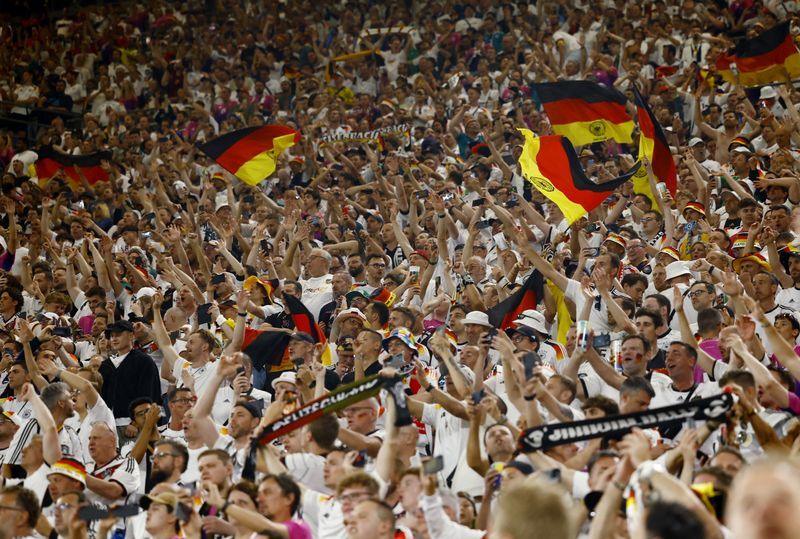
German law enforcement launched a sweeping investigation into potential criminal misconduct surrounding Euro 2024, with authorities executing searches at the headquarters of the Deutscher Fußball-Bund (DFB) and multiple locations nationwide on Wednesday. The raids represent a significant development in a probe that has uncovered what investigators suspect to be systematic irregularities in how premium tickets and hospitality packages were distributed during the continental football tournament that Germany hosted across a decade of its cities earlier this year.
According to the Bild newspaper, the investigation centres on allegations that thousands of match tickets and hotel invitations were illegally channelled to preferred recipients rather than being properly allocated through official channels. Prosecutors based in Bochum, working alongside the criminal investigation office for North Rhine-Westphalia state, confirmed that coordinated searches were underway at several German locations, though authorities stopped short of publicly identifying the DFB offices as a specific focus. The deliberate circumvention of standard ticketing procedures during a major international sporting event raises questions about governance and control mechanisms within German football's governing body during one of its most significant domestic hosting responsibilities in recent years.
The investigation has identified at least two individuals as persons of interest: a German national employed as a municipal official in Gelsenkirchen, one of the ten host cities, and a French national. According to reporting by Bild, the German municipal employee is suspected of receiving benefits worth approximately €2,400 (approximately RM11,000) in the form of match tickets, travel arrangements, and hotel accommodation. The scope of such impropriety extends beyond isolated instances, as prosecutors indicated their enquiries encompass broader patterns of what they have characterised as unauthorised advantages, with particular emphasis on the provision of international football match access to individuals who may not have qualified for such privileges through standard allocation mechanisms.
The selection of Gelsenkirchen as a host city for Euro 2024 proved significant given that the city's municipal infrastructure was utilised to facilitate ticket distribution. That a local government employee in this city became embroiled in the scandal points to a potential crossover between official municipal responsibilities and the ticketing apparatus operated for the championship. This intersection suggests that the investigation may extend beyond individual opportunism to examine whether institutional processes at both municipal and national football association levels contained sufficient safeguards against misallocation of premium access.
Euro 2024 represented a landmark event for German football and the nation's hosting capacity, with matches spread across diverse venues from Munich in the south to Hamburg in the north. The tournament's scale and complexity created multiple points where administrative oversight could potentially break down, and investigators appear to be examining whether lax controls or deliberate circumvention characterised the ticketing distribution process. The concentration of searches across multiple German jurisdictions suggests that authorities believe the suspected violations were not confined to a single city or venue but reflected a more widespread pattern requiring coordinated investigation across state boundaries.
The involvement of a French national in the inquiry introduces an international dimension to what might otherwise be viewed as a purely domestic German administrative matter. This detail hints that the suspected ticket and hospitality irregularities may have extended to foreign nationals receiving improper access, potentially raising questions about whether the allocation process was designed to benefit specific individuals regardless of their residency or connection to Germany. Such cross-border implications could complicate the investigation and potentially trigger coordination with French authorities depending on the nature of the suspected violations.
Neither the DFB nor UEFA, European football's governing body, offered immediate responses to inquiries about the investigation. The silence from these organisations is notable given that both bodies would ordinarily be expected to issue statements clarifying their positions when their integrity or administrative procedures come under official scrutiny. The lack of rapid communication suggests either that the organisations are awaiting fuller information from investigators before responding, or that the sensitivity of the allegations has prompted more cautious public positioning. For the DFB in particular, any finding of systematic misallocation would carry reputational consequences at a time when German football seeks to rebuild international standing following recent competitive disappointments.
The investigation represents a potential embarrassment for the DFB's leadership during a period when the association was expected to have demonstrated exemplary organisational standards in hosting Europe's premier football competition. Questions will inevitably arise about what oversight mechanisms existed for ticket distribution and whether internal audit or compliance functions adequately monitored the allocation process. The prosecutors' decision to launch nationwide searches indicates that they possessed sufficient preliminary evidence to believe that criminal violations had occurred, rather than merely suspecting administrative irregularities that might have been addressed through internal review processes.
For Malaysian and Southeast Asian observers, this case illustrates how even major sporting organisations in developed European democracies can face misconduct allegations and the importance of robust institutional accountability. The investigation also underscores how international sporting events, despite their celebratory character, can become entangled with questions of procedural integrity and the proper stewardship of public and private resources. The outcome of the DFB investigation may inform discussions about transparency and oversight mechanisms required for future major tournaments across the Asian region, particularly as Southeast Asian nations pursue opportunities to host significant international football competitions and must establish credible frameworks to manage such events.
Prosecutors in Bochum have indicated they will provide further details as the investigation progresses, though they declined to elaborate beyond confirming that searches were underway. This measured approach suggests authorities are treating the matter with appropriate seriousness while avoiding premature disclosure that might compromise investigative outcomes. The coming weeks will prove crucial in determining whether the inquiry uncovers isolated instances of misconduct or reveals systematic failures in how the DFB managed one of football's most prestigious tournaments.

