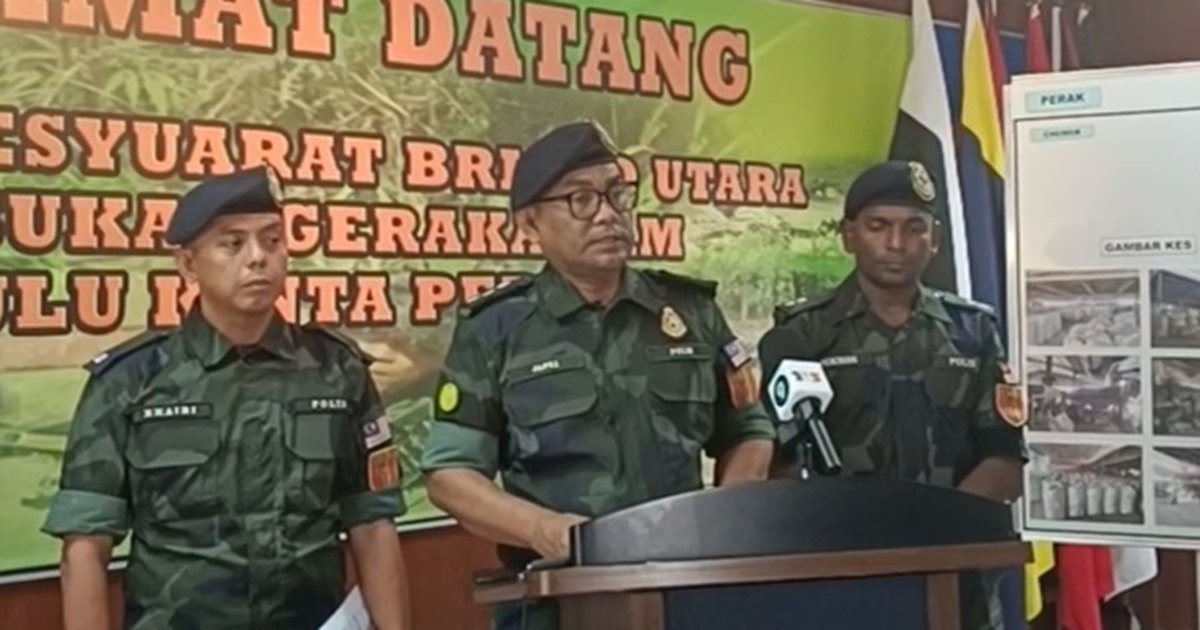
The General Operations Force Northern Brigade has intensified its campaign against unlawful extraction and processing of minerals, announcing a significant enforcement success that has resulted in the seizure of assets worth approximately RM31.7 million and the detention of 30 suspects across two northern states. The operation, conducted in both Perak and Kedah, represents a substantial blow to organised illegal mining networks that have been operating in the region's mineral-rich areas.
Illegal mining has emerged as one of the most persistent law enforcement challenges in Malaysia's northern corridor, where the abundance of tin, limestone, and other valuable minerals creates strong incentives for criminal exploitation. These unregulated extraction operations not only represent significant economic losses to the state—minerals that could otherwise contribute to legitimate revenue streams—but also pose serious environmental and public safety risks. The scale of assets recovered in this operation underscores the substantial financial investment these networks have made in their unlawful enterprises, suggesting a level of sophistication and coordination that extends beyond simple opportunistic mining.
The machinery and mineral stocks seized during the crackdown indicate that these operations were functioning at an industrial scale rather than as small-scale cottage industries. Such processing equipment typically requires substantial capital outlay and technical knowledge to operate effectively, pointing to the involvement of organised criminal syndicates with access to both financial resources and expertise. The diversity of assets confiscated suggests these networks were engaged in multiple stages of the value chain, from extraction through to primary processing, thereby maximising profits at each level.
Perak and Kedah represent particularly vulnerable jurisdictions for illegal mining activity due to their geographic characteristics and existing mineral deposits. Both states contain extensive reserves of economically valuable minerals, and their terrain provides natural concealment opportunities for clandestine operations. Additionally, the cross-border proximity between these states and into Thailand creates complex enforcement challenges, as illegal operators may shift operations across jurisdictional lines to evade detection. The dual-state nature of this operation demonstrates the need for coordinated enforcement responses that transcend traditional administrative boundaries.
The detention of 30 individuals provides law enforcement with opportunities to disrupt operational networks at multiple levels. Beyond the immediate suspects, investigations often lead authorities to identify suppliers, distributors, financial facilitators, and other intermediaries who enable these criminal ecosystems to function. Intelligence gathered from detainees can illuminate the hierarchical structures of these organisations, their methods of evading detection, bribery mechanisms, and connections to broader criminal networks that may extend beyond mining operations into trafficking and money laundering.
Environmental degradation represents another critical dimension of this enforcement action. Unregulated mining creates severe ecological damage including habitat destruction, water pollution from processing chemicals, and disruption of agricultural land. The environmental rehabilitation of sites compromised by illegal mining requires significant public expenditure and extends across many years, representing a hidden cost borne by communities and the state rather than the operators themselves. This operation therefore protects not only economic interests but also environmental assets that are fundamental to regional sustainability.
The RM31.7 million valuation of seized assets likely encompasses both raw minerals and specialised processing equipment, both of which represent considerable sunk costs for the criminal networks involved. The confiscation creates immediate financial losses and removes the operational capacity necessary for these groups to continue functioning, at least in the short term. However, the true measure of enforcement success extends beyond asset seizure to whether these operations remain permanently disrupted or whether they merely relocate and reconstitute elsewhere in the region.
This operation reflects broader regional concerns about illicit resource extraction that affects multiple Southeast Asian nations. Countries throughout the region have grappled with similar challenges as criminal networks exploit natural resource endowments through unregulated mining. Cooperation frameworks and intelligence-sharing mechanisms between regional law enforcement agencies have become increasingly important, as mobile criminal enterprises operate across jurisdictions and exploit regulatory gaps. Malaysia's enforcement efforts contribute to regional security by disrupting networks that frequently intersect with other criminal activities including human trafficking, arms smuggling, and financial crime.
The GOF Northern Brigade's action also sends important signals regarding enforcement commitment and capacity. The scale of the operation and the comprehensive nature of asset recovery demonstrate operational sophistication and sustained investigative capability. Such visible enforcement actions can have deterrent effects on potential operators considering entering the illegal mining sector, though they must be accompanied by consistent follow-up enforcement to maintain credibility and effectiveness.
Looking forward, the sustainability of these enforcement gains depends on several factors beyond immediate operational success. The coordination between federal and state authorities, adequate resourcing of enforcement agencies, and integration of intelligence from multiple sources all contribute to long-term effectiveness. Additionally, addressing the underlying economic drivers that incentivise participation in illegal mining—such as limited legitimate economic opportunities in affected communities—requires complementary developmental and social policy interventions that extend beyond law enforcement capacity.
The detained individuals will now progress through investigative and judicial processes that may reveal additional operational details and networks. Prosecutions of individuals involved in illegal mining serve multiple functions: they provide accountability, establish legal precedent regarding penalties and enforcement priorities, and generate intelligence that informs future operations. The cases emerging from this crackdown will likely contribute to evolving jurisprudence in environmental crime and mineral regulation, establishing benchmarks for similar prosecutions across the country.

