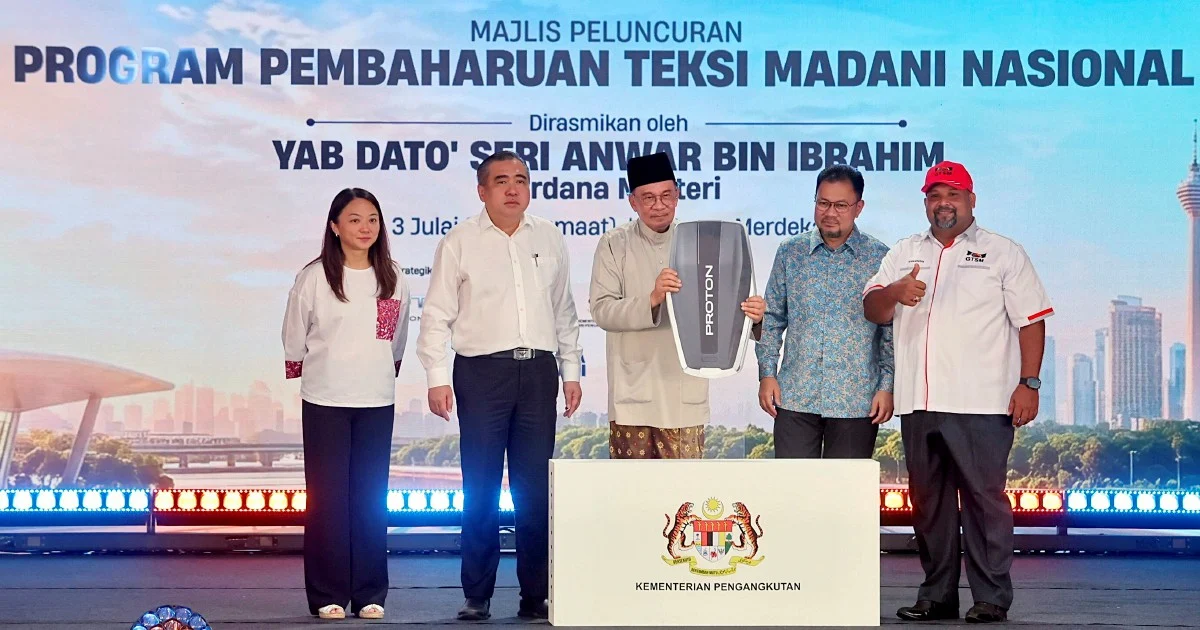
Prime Minister Datuk Seri Anwar Ibrahim has unveiled a substantial financial boost for the transportation sector, announcing the government's approval of RM10 million in fresh funding earmarked specifically for the matching grant programme aimed at assisting taxi operators in replacing their ageing fleets. The decision represents a meaningful government intervention at a critical juncture for Malaysia's taxi industry, which has faced mounting pressure from ride-hailing platforms and the accumulating costs associated with maintaining older vehicles.
The matching grant scheme operates on a co-investment model where government contributions are paired with contributions from participating taxi operators themselves, thereby distributing the financial burden between public resources and private stakeholders. This approach reflects a deliberate policy strategy to ensure that funds reach operators genuinely committed to modernisation while also preserving fiscal discipline in public spending. The mechanism encourages shared responsibility and creates accountability structures that incentivise participating drivers and fleet operators to maintain their commitments.
Taxi operators across Malaysia have been grappling with a confluence of operational challenges that have eroded their competitive positioning. Mounting maintenance costs for vehicles that have exceeded their typical service lifespans, coupled with stringent compliance requirements and emission standards, have created financial bottlenecks that prevent many from accessing capital for replacement vehicles. The additional funding allocation directly addresses these structural constraints by reducing the out-of-pocket capital requirements that individual operators must shoulder.
The scheme's timing carries particular significance given the broader transition underway in Malaysia's urban mobility landscape. Ride-sharing platforms have fundamentally altered customer expectations regarding convenience, cashless payment integration, and vehicle quality standards. By enabling taxi operators to refresh their fleets with modern, well-maintained vehicles, the government is essentially helping the traditional taxi sector remain competitive in an increasingly digital and convenience-driven transportation market. Newer vehicles typically come equipped with modern amenities and technological features that enhance passenger appeal.
The RM10 million injection also speaks to employment considerations within the transport sector. Beyond the direct employment of taxi drivers themselves, fleet modernisation generates secondary employment opportunities across vehicle maintenance centres, spare parts suppliers, and associated service industries. The initiative thereby extends economic benefits beyond individual operators to broader supply chains dependent on the taxi industry's health and vitality.
Regional context matters considerably for understanding this policy. Neighbouring jurisdictions across Southeast Asia have implemented various vehicle-scrapping and replacement schemes with mixed results, offering both cautionary lessons and successful models for programme design. Malaysia's matching grant approach appears to incorporate lessons from international experience, particularly regarding the importance of ensuring operator participation and commitment rather than relying entirely on subsidised programmes that can sometimes encourage free-riding behaviour.
The announcement also reflects government responsiveness to sustained advocacy by taxi operator associations and transportation unions that have repeatedly highlighted the sector's financial distress. These stakeholder groups have consistently argued that without targeted intervention, many smaller operators would face inevitable exit from the market, reducing competitive diversity and potentially creating service gaps in areas that ride-sharing platforms consider economically unviable.
Implementation mechanics will prove crucial to the scheme's effectiveness. The government must establish clear eligibility criteria, transparent application processes, and fair allocation mechanisms to ensure funds reach operators most in need while maintaining programme integrity. Coordination between federal transport authorities and state-level regulatory bodies will be essential, given Malaysia's federal structure and the varying regulatory approaches adopted across different states.
Vehicle procurement processes and standards will require careful management. The scheme should ideally encourage operators to select reliable, cost-effective vehicles suited to Malaysian driving conditions rather than perpetuating expensive foreign imports or allowing excessive price inflation by dealers anticipating government subsidies. Engagement with automotive industry stakeholders during implementation can help strike appropriate balance between supporting legitimate business interests and protecting public resources.
The RM10 million represents a measured allocation reflecting broader fiscal constraints, yet it carries outsize significance as a symbolic commitment to the taxi sector's preservation. For Malaysia's transportation policy framework, the allocation signals acknowledgement that public transport diversity benefits passengers, reduces congestion, and provides employment—outcomes that purely market-driven solutions might not automatically deliver.
This initiative fits within Malaysia's broader sustainable transport agenda. Replacing older vehicles with newer, more fuel-efficient models reduces emissions and environmental impact while potentially lowering operators' fuel costs. These efficiency gains translate into more sustainable urban mobility ecosystems aligned with both domestic environmental commitments and international climate obligations.
The scheme's success will ultimately depend on detailed implementation architecture and sustained government commitment over multiple years. Single-year funding allocations risk creating boom-bust cycles that undermine operator confidence and long-term planning. Establishing predictable, multi-year funding commitments would better enable operators to make informed decisions about fleet replacement timing and vehicle choices.

