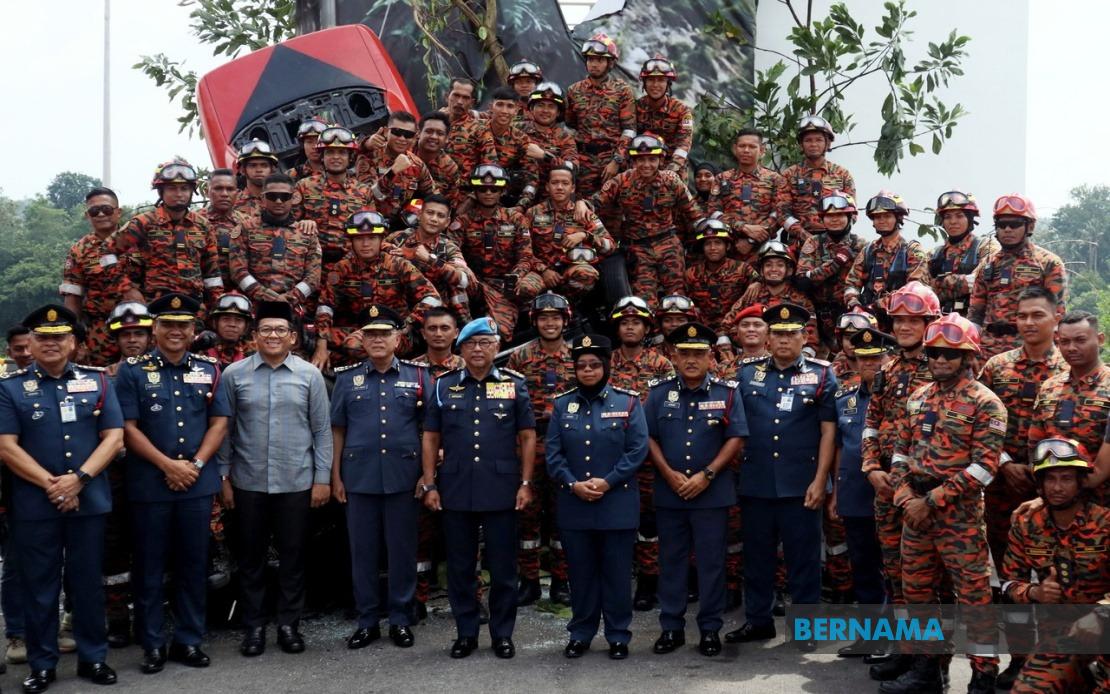
The Federal Government has approved RM278.9 million in annual development expenditure dedicated to the Malaysian Fire and Rescue Department, enabling the implementation of 86 projects across the nation during the first rolling plan phase of the 13th Malaysia Plan. The initiative, combining 27 newly launched initiatives with 59 existing undertakings, represents a substantial commitment to enhancing emergency response infrastructure at both urban and rural levels. This announcement came during the official opening of the Sungai Lembing Fire and Rescue Station in Pahang, an event that underscores the government's strategic focus on geographic expansion of emergency services.
Housing and Local Government deputy minister Datuk Aiman Athirah Sabu outlined the comprehensive scope of the allocation during the ceremony, highlighting that emergency preparedness remains a cornerstone of Malaysia's development agenda. The government's investment strategy reflects recognition that modern infrastructure and adequately resourced emergency services are prerequisites for sustainable economic growth and community wellbeing. The scale of the current allocation demonstrates escalating recognition within federal circles that fire and rescue capabilities must keep pace with urbanisation and industrial expansion across Malaysian regions.
Pahang state has emerged as a particular focus area for fire and rescue infrastructure development. Seven facility projects are currently advancing through construction or completion phases under both the previous 12th Malaysia Plan and the current rolling phase. These encompass the acquisition and rehabilitation of the Gohtong Jaya Fire and Rescue Station building alongside associated residential quarters, the establishment of new stations in Benta and Tioman complete with accommodation facilities, and comprehensive upgrading programmes targeting the Bentong and Kuantan stations. The roster of initiatives extends further to encompass the complete reconstruction of Triang station and preliminary groundwork for the forthcoming Tanjung Lumpur installation. This concentrated investment in Pahang infrastructure suggests deliberate policy prioritisation toward strengthening emergency response networks in the state.
The newly inaugurated Sungai Lembing facility represents the practical manifestation of this development framework. Constructed at a cost of RM6 million across a seven-acre parcel of land, it represents the 29th fire and rescue station established throughout Pahang. The facility commenced operational duties on February 15, positioning it to serve approximately 15,000 residents within Sungai Lembing township and surrounding communities. Beyond its primary firefighting and rescue mandate, the station has been conceptualised as a multifunctional facility capable of advancing public education on emergency preparedness and cultivating community capacity in emergency response protocols.
The broader developmental context surrounding the Sungai Lembing installation extends beyond conventional fire service provision. Deputy Economy Minister and Paya Besar Member of Parliament Datuk Mohd Shahar Abdullah characterised the fire and rescue station as an integral component of Sungai Lembing's comprehensive regeneration as a heritage destination. The township is undergoing simultaneous transformation through complementary initiatives including cinema restoration, ecotourism product development, digital museum establishment, tunnel infrastructure upgrading, and pursuit of UNESCO World Heritage designation. The coordination of emergency services expansion with cultural and tourism development reflects integrated planning methodologies increasingly common in Malaysian regional development.
The relationship between emergency services capacity and heritage town development carries particular significance for Malaysia's tourism and cultural preservation sectors. As Sungai Lembing transitions toward expanded visitor numbers through heritage tourism initiatives, the establishment of enhanced fire and rescue facilities becomes operationally essential. Modern emergency response infrastructure provides the safety assurance necessary for attracting domestic and international visitors while protecting cultural assets and historical structures that constitute the foundation of heritage tourism economics. The Sungai Lembing example illustrates how infrastructure spending can serve multiple policy objectives simultaneously.
Datuk Mohd Shahar's remarks emphasised that infrastructure development initiatives lack meaningful impact without corresponding attention to safety and emergency preparedness dimensions. The sequencing of the fire and rescue station development alongside heritage conservation efforts demonstrates governmental acknowledgment that economic development and public safety represent complementary rather than competing priorities. This integrated approach carries implications extending across Malaysia's broader development portfolio, suggesting that future regional development initiatives will increasingly incorporate emergency services infrastructure as a foundational component rather than an afterthought.
The RM278.9 million budget envelope for nationwide fire and rescue development projects must be contextualised within Malaysia's broader public capital allocation across multiple sectors. While representing significant investment in emergency services, the annual commitment requires careful management to ensure equitable geographic distribution and timely project completion. Regional variations in development priorities, population density, and industrial concentration create competing demands for allocation efficiency. The emphasis on Pahang projects within current announcements may reflect either deliberate regional prioritisation or simply the immediate focus of the announcement ceremony.
Stakeholder attendance at the Sungai Lembing inauguration ceremony, including the Sultan of Pahang, Pahang Menteri Besar Datuk Seri Wan Rosdy Wan Ismail, and State Legislative Assembly Speaker Datuk Seri Mohd Sharkar Shamsuddin, underscores the political significance attached to emergency services infrastructure development. Such high-level ceremonial participation reflects recognition that fire and rescue capabilities constitute core government service delivery with direct electoral implications. Citizens' perception of government effectiveness often hinges substantially on emergency response quality, making fire and rescue infrastructure investments politically salient across all Malaysian states.
The allocation mechanisms supporting the 86 projects under the 13th Malaysia Plan's first rolling phase require ongoing scrutiny to ensure expenditure translates into functional capacity enhancement. Budget approval represents a necessary but insufficient condition for infrastructure benefit realisation. Project implementation timelines, procurement efficiency, workforce training, equipment maintenance protocols, and inter-agency coordination mechanisms will ultimately determine whether the financial commitment generates proportionate improvements in fire and rescue service delivery. Performance measurement frameworks tracking station utilisation, response times, and community outcomes would provide evidence regarding allocation effectiveness.
Looking forward, the government's commitment to expanding fire and rescue infrastructure through the 13th Malaysia Plan establishes a platform for sustained sectoral development. Malaysia's ongoing urbanisation, industrial diversification, and climate-related environmental challenges will likely sustain elevated demand for emergency services capacity. The current allocation trajectory suggests governmental intention to maintain consistent investment levels across the rolling plan phases. However, competing fiscal pressures and evolving development priorities may constrain future increases, necessitating strategic prioritisation of capital deployment across remaining planned projects to maximise return on public investment.

