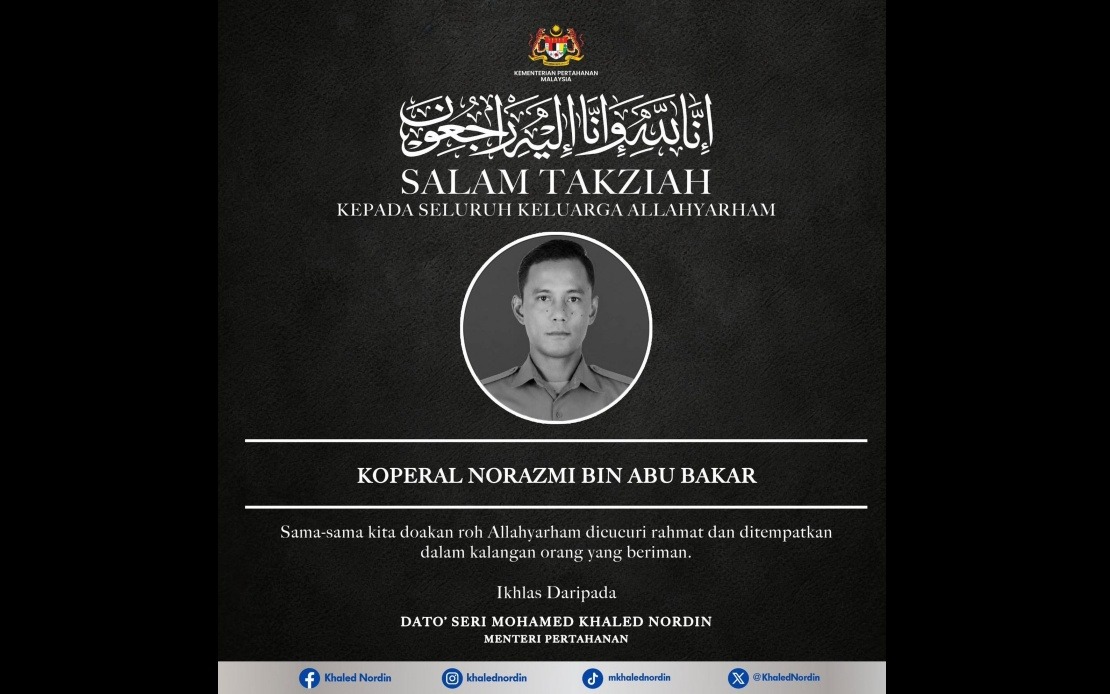
The Malaysian government and Defence Ministry have conveyed their heartfelt condolences to the families of Corporal Norazmi Abu Bakar and Private Siti Khadijah Sungip following their deaths in a blast that occurred during a grenade-throwing training exercise on 16 June. Both servicemembers sustained critical injuries in the incident at Hobart Camp firing range in Gurun, Kedah, and succumbed while being transported to medical facilities.
Defence Minister Datuk Seri Mohamed Khaled Nordin released a statement expressing profound grief over the loss of the two personnel. Corporal Norazmi served with the 6th Battalion, Royal Malay Regiment, while Private Siti Khadijah was attached to the 1st Squadron, Royal Army Engineers Regiment. The minister emphasised that the government and ministry stand with the bereaved families during this difficult period, calling for divine strength and resilience to sustain them through their grief.
In his condolence message shared on social media, Mohamed Khaled Nordin invoked Islamic prayers, requesting that Allah SWT show mercy upon the souls of both victims, forgive their transgressions, and grant them entry into paradise as faithful servants. The minister's words reflected the spiritual dimension of the loss felt across the Malaysian Armed Forces, acknowledging not only the personal tragedy but also the collective mourning within military ranks.
The incident occurred at 10.57 am during what was a routine training exercise at the firing range. The grenade-throwing exercise is a standard component of military training designed to build competency and confidence among personnel in handling explosive ordnance. However, the explosion during this session resulted in injuries severe enough to prove fatal before the two servicemembers could reach Sultan Abdul Halim Hospital in Sungai Petani, despite rapid evacuation efforts.
Army Chief General Tan Sri Azhan Md Othman has initiated a comprehensive investigation into the circumstances surrounding the blast. The inquiry aims to establish the precise cause of the explosion and identify any factors that may have contributed to the tragic outcome. Such investigations are crucial not only for understanding what went wrong but also for implementing preventive measures to safeguard personnel undertaking similar training exercises in future.
The deaths represent a sobering reminder of the inherent risks associated with military training, particularly exercises involving explosive devices and live ammunition. While safety protocols are in place at military training facilities across Malaysia, accidents can still occur despite stringent precautions. The loss of two trained personnel, one from the Royal Malay Regiment and another from the Royal Army Engineers Regiment, depletes the skilled workforce within these specialised units.
Private Siti Khadijah's death is particularly notable as it highlights the increasing role of women in Malaysia's armed forces. The Royal Army Engineers Regiment, like other units within the Malaysian Armed Forces, has progressively recruited female personnel into combat and combat-support roles. Her loss underscores both the commitment of women to national defence and the universal hazards they face alongside their male counterparts in military service.
The incident has drawn attention to safety standards at military training ranges across the country. Defence authorities will likely conduct reviews of procedures at Hobart Camp and potentially at other facilities to ensure that all safeguards are optimally implemented. Training exercises must balance the need for realistic, challenging conditions that prepare soldiers for operational demands with the paramount requirement to protect personnel from unnecessary risk.
For the families of Corporal Norazmi Abu Bakar and Private Siti Khadijah Sungip, the loss is irreplaceable. Beyond the immediate grief, they face the challenge of adjusting to the permanent absence of their loved ones. Government and military support mechanisms, including financial assistance and counselling services, typically extend to families of personnel killed in service-related incidents, though the emotional toll cannot be fully mitigated by institutional responses.
The Malaysian military community, comprised of approximately 110,000 active personnel across all three services, will likely pause to reflect on this tragedy. Such incidents reinforce the reality that military service, even during peacetime training, carries genuine risks. The comprehensive investigation ordered by the Army Chief will be closely watched to determine what lessons can be extracted and applied to prevent similar tragedies in the future.
As the investigation proceeds, the focus remains on supporting the grieving families and honouring the sacrifice and commitment of both servicemembers. Their deaths serve as a poignant reminder of the dedication of Malaysia's armed forces personnel and the price sometimes paid in pursuit of national security and defence readiness.