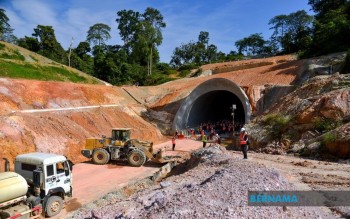
The Malaysian government has committed to a substantial economic revitalisation programme for the Pasir Puteh parliamentary constituency in Kelantan, with cabinet approval for 46 integrated development projects budgeted at RM207.2 million across 2026. The initiative represents a deliberate policy shift to harness the East Coast Rail Link as a regional economic engine, positioning Kelantan to capture freight and logistics opportunities that could reshape the state's economic trajectory.
Deputy Economy Minister Datuk Mohd Shahar Abdullah outlined the government's strategic rationale during parliamentary proceedings, emphasising that the portfolio extends beyond conventional infrastructure spending. The approved schemes encompass comprehensive land preparation and site development for the Pasir Puteh downstream industrial zone, designed to complement the emerging ECRL cargo facility and capitalise on the transportation corridor's commercial potential. This spatial planning approach reflects contemporary economic development doctrine, which recognises that transport infrastructure alone generates limited impact unless surrounded by complementary industrial and logistics facilities.
The positioning of Pasir Puteh as a dual-purpose transportation hub—serving both passenger and cargo operations—provides the constituency with geographical advantages that few other Kelantan localities possess. The government has explicitly identified synergies between rail accessibility and proximity to the Tok Bali Supply Base, creating what officials characterise as a natural logistics and downstream industrial cluster. This proximity argument carries weight, as transportation costs represent substantial operational burdens for manufacturers and logistics providers; a facility combining rail connectivity with established supply infrastructure theoretically reduces friction in the supply chain.
The development framework operates under the ECRL Integrated Land Use Master Plan, a formalised approach that attempts to coordinate sprawling infrastructure investments with land-use regulations and industrial zoning. This methodical planning structure distinguishes the initiative from ad-hoc development announcements that frequently characterise Malaysian regional projects. By subordinating individual projects to a coherent master plan, the government signals commitment to orderly, sequential development rather than piecemeal improvisation.
For Malaysian policymakers, the Pasir Puteh allocation embodies broader philosophical commitments outlined in the 13th Malaysia Plan. Datuk Mohd Shahar articulated an explicit principle that development spending should reflect each locality's comparative economic advantages—whether logistics, tourism, manufacturing, or agriculture. This targeting approach contrasts with historical patterns of dispersed, politically motivated allocation. The deputy minister's statement that the government prioritises projects aligned with regional strengths suggests a move toward evidence-based development planning, though implementation effectiveness remains contingent on institutional capacity and sustained political commitment.
The timeline for project execution extends from 2026 through 2030, representing a five-year implementation window under the broader 13MP framework. This extended horizon reflects realistic expectations about capital-intensive infrastructure development, though extended timelines also create risks of scope creep, budget overruns, and shifting political priorities. The government has established monitoring mechanisms through the MyRMK system, a digital tracking platform designed to enhance transparency and accountability in project delivery. Regular parliamentary reporting requirements theoretically subject performance to legislative scrutiny, though the effectiveness of such oversight depends on parliamentary committees' technical capacity and political willingness to demand rigorous accountability.
For the broader Southeast Asian context, Pasir Puteh's development holds implications for regional trade corridor dynamics. The ECRL represents a critical piece of China-led Belt and Road infrastructure extending through Malaysia, and enhanced cargo capacity along the route could redirect trade flows across the region. If Pasir Puteh successfully establishes itself as a competitive logistics hub, it may attract investment from companies seeking alternatives to congested southern ports, potentially stimulating competition that benefits regional shipping markets and supply chain resilience.
The emphasis on downstream industrial development warrants particular scrutiny. Downstream processing activities—value-addition sectors that transform raw materials into refined products—typically generate higher employment per unit of capital investment than primary or extraction industries. For a state like Kelantan, which has traditionally faced developmental challenges, downstream industrial clustering could catalyse human capital development, skills training, and technological spillovers that extend beyond the immediate ECRL corridor.
However, realising these aspirations depends on several contingencies beyond government planning. Private sector participation remains essential; industrial zones cannot thrive without anchor tenants and operational logistics service providers. The government's role extends to creating enabling conditions—reliable electricity, skilled labour availability, responsive regulatory processes—rather than directly generating economic activity. Investor confidence, particularly among international logistics operators, hinges on perceptions of Malaysia's business environment, currency stability, and geopolitical reliability.
The allocation also reflects recognition that regional inequality remains a persistent challenge in Malaysian federalism. Kelantan, historically among the lower-income states, has received targeted development attention from successive federal administrations. This RM207.2 million commitment acknowledges that spatial development disparities require deliberate corrective investment, though sceptics might question whether single-state allocations suffice to address structural gaps accumulated over decades.
Regarding implementation risks, Malaysian development projects frequently encounter delays attributable to land acquisition complications, environmental assessment processes, or coordination failures between federal and state authorities. Pasir Puteh's status as a federal-level initiative may provide political insulation from certain local bureaucratic obstacles, but the involvement of Kelantan state government in downstream operations creates potential friction points if state and federal administrations diverge on strategic priorities.
The government's commitment to monitoring and parliamentary accountability represents a partial shift toward results-based governance, though past experience suggests that tracking mechanisms often function as reporting exercises rather than genuine performance management tools. The success of the Pasir Puteh initiative will ultimately depend on whether the 46 projects materialise on schedule and within budget, whether they attract private sector participation, and crucially, whether they generate the anticipated employment and business opportunities for local constituencies. These outcomes will provide empirical evidence regarding the 13MP's capacity to translate planning frameworks and budget allocations into tangible economic transformation.

