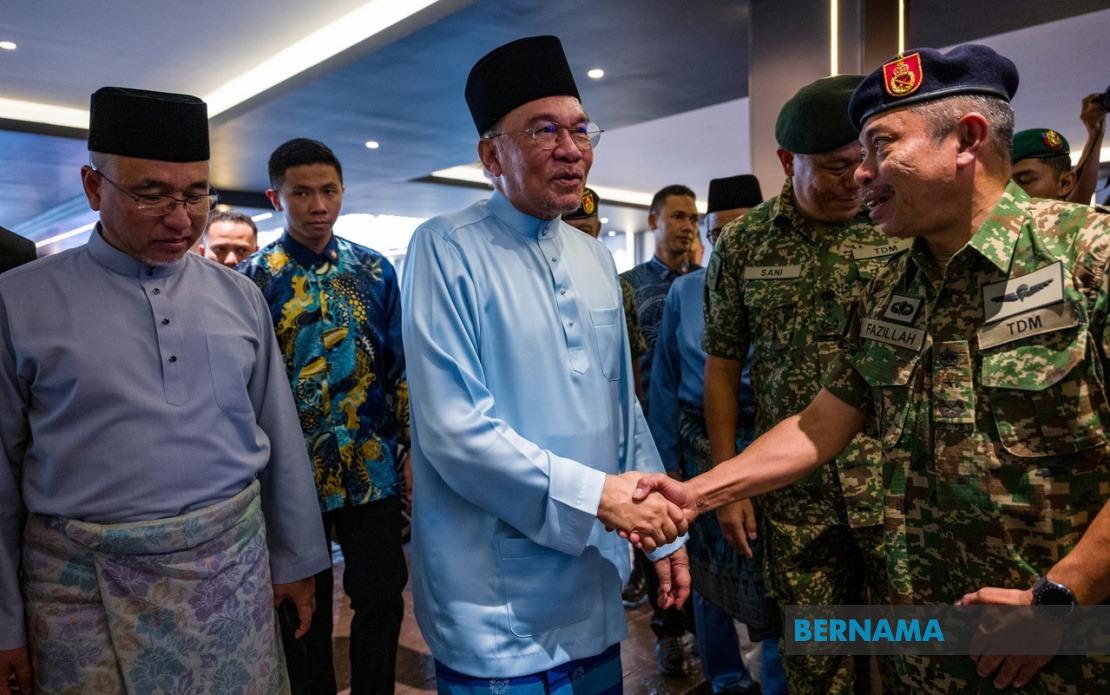
Prime Minister Datuk Seri Anwar Ibrahim's proposal to expand defence funding in the 2027 budget signals a decisive shift in government priorities towards revitalising the Malaysian Armed Forces at a time when regional security dynamics are increasingly complex. The commitment encompasses not only military hardware and equipment upgrades but also a comprehensive approach to personnel conditions, reflecting recognition that force capability depends equally on well-resourced infrastructure and motivated troops. This dual focus represents a strategic acknowledgement that modernisation requires both technological advancement and investment in human capital.
Chief of Defence Force General Tan Sri Malek Razak Sulaiman characterised the budget adjustment as validation of government support for the MAF's Future Force strategic development plan, a long-term modernisation framework designed to transform the military into a technologically capable and integrated deterrent. The general's public endorsement underscores military leadership's confidence in the proposed trajectory, though it also reflects the institutional pressures the defence establishment has faced in securing adequate funding amid competing budgetary demands across healthcare, education, and infrastructure sectors. The timing of this announcement, made during the Semarak Kenegaraan Programme at Terendak Camp in Melaka, provided symbolic reinforcement of civilian-military alignment on defence priorities.
The allocation will directly address asset and equipment modernisation initiatives that have languished due to previous budget constraints. Malaysia's defence inventory contains platforms and systems from varied procurement eras, creating logistical complexities and operational inefficiencies. Increased funding allows for systematic replacement and upgrading aligned with contemporary threats, including maritime security challenges in the Straits of Malacca, border security requirements in Sabah and Sarawak, and cyber defence capabilities. These investments have implications not only for national security but also for regional stability, as a more capable MAF contributes to freedom of navigation assurances and regional confidence in Malaysia's security arrangements.
Personnel welfare emerged as an equally significant component of the budgetary commitment, with specific mention of housing quarter improvements, hospital construction, and utility infrastructure maintenance. These improvements address chronic deficiencies that have affected recruitment and retention, particularly among junior ranks where housing shortages and inadequate medical facilities have created genuine hardship. The announcement recognises that military effectiveness depends on reducing welfare-related stress and demonstrating institutional care for service members and their families. In the Malaysian context, where military service remains a respected national vocation, improved conditions strengthen the social compact between the state and those bearing security responsibilities.
The housing initiative carries particular significance given long-standing complaints about overcrowding and deteriorating barracks conditions at various military establishments. Construction of dedicated healthcare facilities represents acknowledgement that military personnel require accessible, specialised medical services reflecting their occupation-specific health needs. Water supply maintenance, though seemingly routine, addresses fundamental quality-of-life issues that accumulate into morale concerns. These welfare measures, while sometimes overshadowed by equipment procurement discussions, represent the foundation upon which operational readiness ultimately rests.
Anwar's dual role as Prime Minister and Finance Minister positioned him uniquely to champion the defence budget increase within cabinet deliberations. His explicit advocacy reflects political will to prioritise security spending despite potential competing demands, suggesting confidence in the economic outlook and fiscal capacity to accommodate defence expansion. The announcement carries weight precisely because it comes from the minister controlling the purse strings rather than from defence advocates operating through institutional channels. This direct endorsement from the top fiscal authority signals that defence modernisation constitutes a government priority rather than a secondary consideration.
Additionally, the government has approved in principle a streamlined promotion process for military and police personnel, aligning career advancement timelines with public service standards. This bureaucratic reform addresses frustrations among officer corps regarding career progression velocity and parity with civilian service counterparts. The expedited promotion pathway represents recognition that talent retention in competitive regional environments requires competitive career structures. For Malaysia, competing with Singapore's highly professionalised military and increasingly well-resourced regional forces, efficient promotion mechanisms help retain institutional knowledge and experienced leadership.
The defence sector modernisation initiative must be understood within the broader Southeast Asian security context, where multiple nations are expanding military capabilities amid great power competition and traditional regional disputes. Malaysia's historical emphasis on constrained defence budgets has created capability gaps relative to some neighbouring states. The budget 2027 adjustment represents partial correction of this trajectory, though observers noting defence spending as a percentage of GDP will recognise that significant distance remains between Malaysian commitment levels and those of neighbouring Thailand or Vietnam. The modernisation programme therefore addresses relative capability decline that has accumulated over years of budgetary constraints.
Implementation timelines will prove crucial to the programme's success. Defence modernisation projects often experience delays due to procurement complexity, international supplier relationships, technology transfer negotiations, and domestic construction delays. The government's commitment to increase allocation must be sustained across multiple budget cycles to avoid the fragmentation that has previously plagued Malaysian defence projects. Establishing dedicated project management frameworks and maintaining budget continuity regardless of political cycles will determine whether this initiative represents transformational change or another episode of incremental progress interrupted by fiscal pressures.
For Malaysian readers, these developments signal government recognition that security infrastructure requires contemporary investment, with implications for regional stability, employment opportunities in defence industries, and long-term national resilience. The commitment reflects acknowledgement that security competition, whether traditional or emerging, necessitates continuous adaptation. The welfare focus particularly demonstrates understanding that military modernisation extends beyond hardware to encompass the personnel system that operates sophisticated equipment and executes strategic direction, making this a comprehensive rather than narrowly technical approach to defence sector revitalisation.

