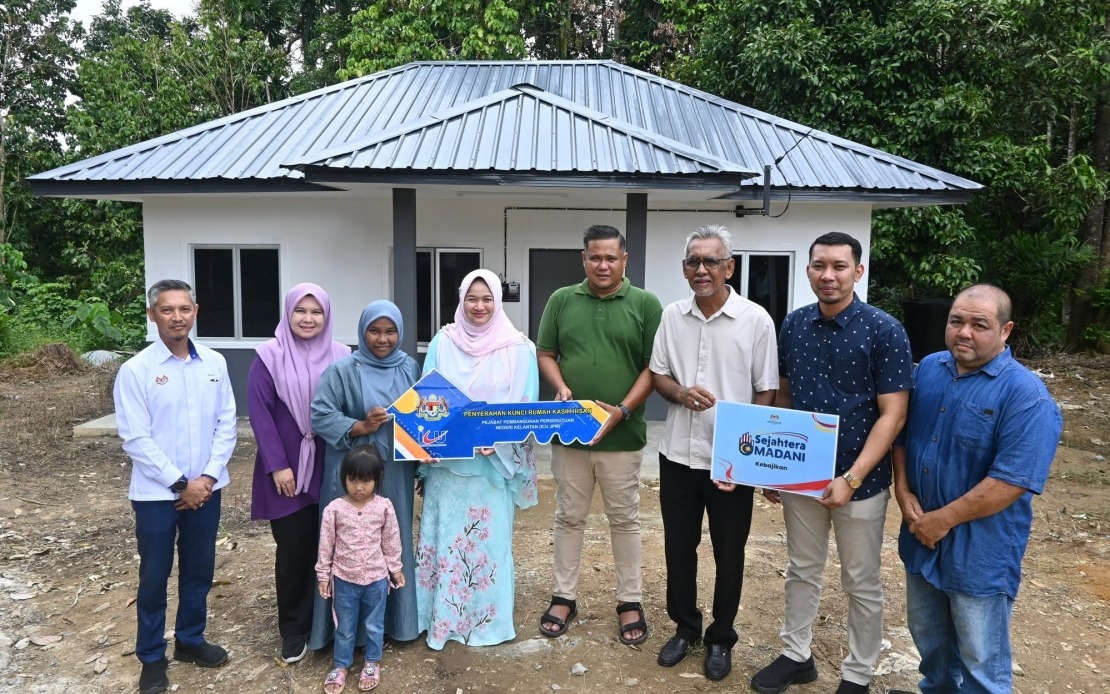
The Malaysian government has advanced its commitment to residential welfare by distributing Rumah Kasih Ihsan properties to qualifying households in Jeli, Kelantan, reinforcing a policy approach centred on providing dignified living conditions for vulnerable populations. Prime Minister Datuk Seri Anwar Ibrahim highlighted the milestone on August 19, positioning the initiative as evidence of the administration's dedication to elevating citizens' quality of life through targeted housing interventions. The handovers underscore a broader governmental philosophy that equates secure housing with foundational human development and long-term prosperity.
The Kelantan Implementation Coordination Unit (ICU), operating under the Prime Minister's Department (JPM), orchestrated the property distribution with systematic oversight. Dr Wan Nur Ibtisam Wan Ismail, serving as the ICU director, formally transferred ownership documents and possession to beneficiaries, demonstrating institutional commitment to transparent and dignified delivery of state benefits. This administrative structure reflects attempts by the federal apparatus to embed accountability within housing schemes and ensure direct, unmediated assistance reaches intended recipients without bureaucratic obstruction.
Two households emerged as primary beneficiaries in this phase of the programme. Yusof Mohamed Nawawi, residing in Kampung Renyut, received formal documentation confirming government-funded construction of a replacement dwelling to supersede his existing inadequate accommodation. Simultaneously, Shamsul Bahri Che Musa obtained full possession of a newly completed residence, transitioning from awaiting construction to immediate occupancy. The staggered approach—combining prospective housing projects with completed units—suggests programme administrators calibrate delivery timelines according to individual circumstances and construction progress.
Beyond structural provision, the government supplemented housing transfers with complementary welfare gestures. Recipients obtained food baskets, signalling holistic rather than narrowly sectoral support frameworks. Such accompaniments acknowledge that housing security, whilst foundational, operates within broader material deprivation contexts where nutritional stability and immediate sustenance equally merit policy attention. The symbolic dimension of gift-giving alongside property transfer also reinforces relational bonds between state and citizenry, cultivating perceptions of governmental solicitude beyond transactional service delivery.
The Kelantan ICU articulated an underlying philosophical framework distinguishing its approach from conventional infrastructure expansion. Officials contended that meaningful development transcends quantifiable physical metrics—buildings erected, roads constructed, projects inaugurated—to centre on tangible improvements in lived experience and human dignity. This interpretive shift reframes development discourse away from technocratic enumeration toward phenomenological assessment, questioning whether development outcomes genuinely manifest in beneficiary communities or remain confined to statistical abstracts.
Housing security, according to programme architects, constitutes an enabler of cascading benefits extending across psychological, economic, and social dimensions. Safe dwellings provide psychological stabilisation through reduced environmental stress, material security conferring dignity and autonomy, and spatial conditions facilitating family cohesion and children's educational concentration. By anchoring residents to stable residential addresses, such initiatives simultaneously enable access to municipal services, educational institutions, and employment opportunities previously obstructed by housing precarity.
For Malaysian policymakers and regional observers, the Jeli distribution exemplifies targeted poverty alleviation mechanisms attempting to operationalise equity-oriented governance within federal systems constrained by budgetary limitations and competing developmental priorities. Kelantan, historically among Malaysia's lower-income states with agricultural economies increasingly vulnerable to climate variability and market volatility, represents a demographic context where government housing assistance addresses acute vulnerabilities rather than marginal disadvantage. The initiative acknowledges spatial inequality dimensions embedded within Malaysia's uneven development geography.
The Rumah Kasih Ihsan framework also reflects evolving approaches to welfare provisioning distinguishing the current administration's tenure. Rather than purely cash-transfer mechanisms or conditional assistance programmes, the government privileges asset accumulation and homeownership pathways, recognising that property ownership generates collateral benefits including wealth accumulation, intergenerational asset transfer, and enhanced social standing. For beneficiary families, housing ownership represents transformative rather than ameliorative intervention, establishing platforms for sustainable livelihood diversification.
Implementation through the PMX Coordination Team suggests the Prime Minister's Office maintains operational control over housing distribution rather than delegating entirely to line ministries or state governments. This centralised coordination facilitates policy consistency and mitigates risks of regional elite capture whereby local power brokers redirect benefits toward connected constituencies. However, centralisation simultaneously risks disconnecting programme designers from ground-level recipient realities and local knowledge regarding genuine housing needs and beneficiary prioritisation.
The handover event's public documentation and Prime Minister endorsement indicate housing assistance occupies significant political salience within current governance messaging. Beyond material provision, publicising such initiatives generates demonstrable evidence of policy execution and tangible improvements in measurable beneficiary populations—politically valuable commodities for incumbent governments navigating electoral cycles and public accountability expectations. For residents of Jeli and comparable Kelantan communities, securing housing represents immediate material advancement; for administrators and political leaders, distributing homes constitutes demonstrable governance effectiveness.

