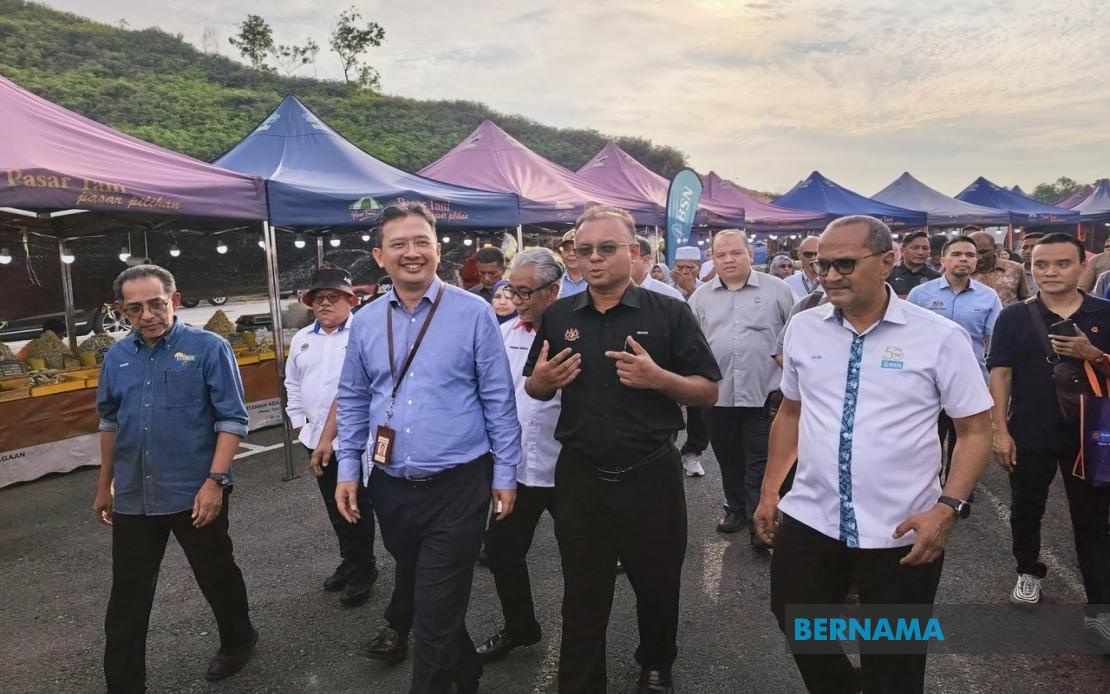
The Malaysian government is shifting into higher gear to ensure that small business owners and traders fully understand the breadth of micro-financing options available to them, with Treasury Secretary-General Tan Sri Johan Mahmood Merican acknowledging that current awareness levels remain inadequate despite the substantial pool of capital on offer. Speaking after a market engagement event in Putrajaya, Johan stressed that a coordinated approach involving all participating financial institutions would be necessary to reach entrepreneurs operating at the grassroots level, where information gaps remain most acute.
The scale of this initiative reflects the government's commitment to financial inclusion across the small and medium enterprise sector. Prime Minister Datuk Seri Anwar Ibrahim has committed over RM5 billion in micro-credit value to be distributed through a network of six key agencies: Agrobank, Bank Simpanan Nasional, Bank Rakyat, TEKUN Nasional, Amanah Ikhtiar Malaysia, and Majlis Amanah Rakyat. This multi-agency approach consolidates resources across both conventional and Islamic banking channels, significantly broadening the accessibility of capital for individuals who might otherwise struggle to secure traditional bank financing due to collateral requirements or formal documentation hurdles.
The field activation strategy unveiled by the Treasury involves deploying representatives from these institutions directly to hawker centres, farmers' markets, and street trader congregations where potential borrowers conduct their daily business. This on-the-ground presence serves a dual purpose: it demystifies application processes by providing face-to-face explanations of eligibility criteria and required documentation, while simultaneously gathering firsthand intelligence about the actual financial constraints facing micro-entrepreneurs. During the recent Putrajaya Pasar Tani visit programme, Treasury officials engaged with over 124 traders, many of whom had already benefited from these schemes but represented only a fraction of the potential borrower pool.
Feedback gathered during these visits paints an encouraging picture of the impact already achieved. Johan noted that a significant majority of traders interviewed had successfully accessed financing from at least one of the participating agencies, with several having accessed multiple loans across different cycles. This pattern suggests that those who do locate and navigate these programmes experience tangible business benefits, yet the broader challenge remains one of visibility and accessibility for traders who remain unaware such facilities exist or uncertain how to apply.
Agrobank's engagement series at farmers' markets provides concrete evidence of demand when barriers to information are lowered. Since launching these market outreach sessions, the agricultural lender has processed more than 160 applications totalling RM6.4 million in micro-credit approvals. These numbers underscore that demand for affordable financing substantially exceeds what current passive distribution channels capture. Agrobank's president and chief executive officer Datuk Tengku Ahmad Badli Shah Raja Hussin characterised the response as overwhelmingly positive, with traders responding enthusiastically to financing products that are more accessible, geographically convenient, and tailored to the seasonal and cyclical nature of hawking and small retail operations.
Beyond capital provision, the participating agencies are increasingly positioning themselves as comprehensive financial services platforms rather than mere lenders. Agrobank's market engagement model includes financial literacy workshops, business digitalisation support, takaful insurance protection, and one-on-one financial advisory consultations. This holistic approach recognises that capital alone is insufficient; traders require complementary services to deploy borrowed funds effectively and build business resilience in volatile environments. Tengku Ahmad Badli Shah emphasised that these ancillary services are designed to enhance long-term competitiveness, moving beyond short-term lending into genuine business partnership models.
The timing of this intensified awareness campaign aligns with broader inflationary pressures affecting small traders' operational costs and profitability margins. For hawkers and street vendors already contending with rising commodity prices and rental obligations, access to affordable working capital at below-market interest rates represents a tangible competitive advantage. The government's recognition that awareness gaps limit programme effectiveness suggests a degree of reflexivity within treasury and financial services leadership regarding the implementation challenges that plague well-intentioned but poorly publicised schemes.
Parallel efforts to monitor and stabilise agricultural commodity prices complement the micro-financing initiative, reflecting an integrated approach to supporting traders across the supply chain. The Agro-food Supply and Marketing Monitoring and Intervention portal operated by the Federal Agricultural Marketing Authority provides real-time price data to both traders and consumers, enabling early identification of price volatility that might necessitate supply augmentation. Ministry of Agriculture and Food Security Secretary-General Datuk Seri Isham Ishak highlighted that this information infrastructure allows government to intervene proactively rather than reactively, preventing sharp price spikes that would erode the profit margins of small traders despite access to financing.
For Malaysian entrepreneurs and regional observers, this campaign signals that policymakers are gradually transitioning from a reactive, crisis-driven approach to small business support toward systematic, preventive interventions embedded within market infrastructure. The multi-month deployment of agency representatives to persistent market locations should generate substantially more loan approvals than annual headline awareness campaigns alone. However, scaling these efforts across all 14 states and hundreds of informal trading clusters remains a logistical challenge that will require sustained commitment beyond initial pilot phases in Putrajaya and other federal territories.
The success of this initiative will ultimately be measured not merely by aggregate loan approvals but by the proportion of eligible traders who understand programme eligibility criteria, complete applications successfully, and deploy capital productively. The feedback loops between field teams and agency head offices will be crucial for identifying bureaucratic bottlenecks, documentation requirements that deter otherwise viable borrowers, and product features that diverge from actual trader needs. As Malaysia navigates moderate economic growth and labour market pressures, enabling informal sector participants to access capital more efficiently could have meaningful multiplier effects across consumption, employment, and household stability.
Looking forward, the government's willingness to invest Treasury resources in ongoing field engagement suggests recognition that passive channels—websites, application centres, bank branches—systematically underreach the traders most in need of support. Whether this campaign translates into sustainable institutional change or remains a temporary initiative may depend on whether participating agencies incorporate market-based lending and advisory services into their permanent operational models, rather than treating ground engagement as an episodic exercise punctuating longer periods of traditional banking operations.

