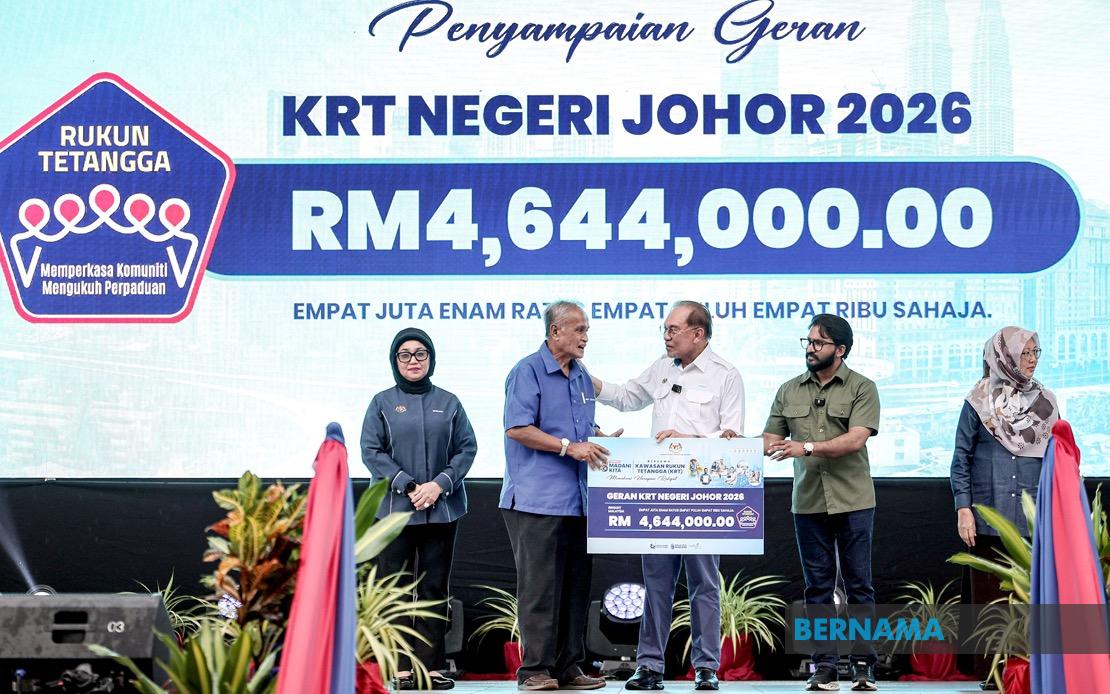
Prime Minister Datuk Seri Anwar Ibrahim has greenlit a substantial boost to funding for Neighbourhood Watch Areas (KRT) nationwide, raising the annual grant from RM6,000 to RM10,000 effective January 1, 2027. The announcement, delivered at the MADANI KITA Programme in Segamat on June 24, marks the first increase in the community policing subsidy over ten years, acknowledging the grassroots network's growing importance to national security and social cohesion.
The freeze on KRT allocations at RM6,000 throughout the past decade prompted the government to reassess the funding structure, recognising that inflation and operational costs have significantly eroded the purchasing power of local safety committees. Anwar emphasised that the rate stagnation was inconsistent with the institution's pivotal contributions to addressing diverse community challenges, from crime prevention to neighbourhood development initiatives. The Prime Minister framed the increase as validation of KRT members' voluntary service and their role in strengthening democratic participation and social harmony at the village and street level.
Anwar highlighted that Malaysia's defining characteristic since independence has been its capacity to nurture coexistence among ethnically, culturally, and religiously diverse populations. He underscored that such differences should not become vectors for discord, but rather constitute a source of national resilience and pride. This framing positions KRT funding enhancement within a broader government philosophy of inclusive governance and community-driven stability, particularly vital as Malaysia navigates complex identity questions and potential social tensions.
The KRT system, which organises residents into structured watch groups responsible for reporting security incidents and coordinating preventive measures, has long operated with minimal financial resources. The increased allocation represents recognition that effective community policing cannot rely solely on volunteer enthusiasm without adequate material support. Deputy Minister of National Unity R. Yuneswaran and Deputy Minister of Domestic Trade and Cost of Living Datuk Dr Fuziah Salleh attended the Segamat event, signalling whole-of-government backing for the initiative.
Beyond the KRT boost, the Prime Minister announced a RM3.205 million immediate allocation for upgrading basic infrastructure at Islamic educational institutions across Johor. The funding targets sixteen repair and upgrade projects at religious schools, madrasahs, study centres, and tahfiz institutions in districts including Batu Pahat, Muar, and Segamat. This investment reflects government prioritisation of creating conducive learning environments at faith-based educational facilities, recognising their role in social reproduction and youth development.
The Islamic education infrastructure initiative demonstrates the government's commitment to supporting religious institutions that serve substantial portions of Malaysia's Muslim population and immigrant communities. Such facilities often operate with constrained budgets and deferred maintenance backlogs, making targeted government support essential for maintaining educational quality and institutional sustainability. By bundling religious education funding alongside community safety enhancements, Anwar's announcements signal integrated attention to pillars of local governance and social welfare.
Simultaneously, Anwar authorised RM1.0 million in immediate funds for critical and urgent repairs to Royal Malaysian Police (PDRM) quarters throughout Johor. This allocation underscores the government's stated commitment to improving personnel welfare as integral to maintaining service capability and morale. Housing conditions directly affect officer retention, job satisfaction, and ultimately operational effectiveness in state security operations.
The sequencing and bundling of these three announcements—KRT grants, Islamic education infrastructure, and police facilities—reflects a strategic narrative linking community safety, religious institution development, and security personnel welfare into a unified framework of grassroots governance strengthening. Each component addresses distinct constituencies: KRT funding appeals to neighbourhood organisers and grassroots volunteers; Islamic education investment addresses Muslim communities and religious leaders; police facility improvements target security forces and their families.
For Malaysian readers, the KRT grant increase carries practical implications for neighbourhood security programmes, which historically have struggled with limited budgets for signage, training materials, communication systems, and community events. The 67% increase to RM10,000 provides meaningful, though not lavish, additional resources for groups managing dozens of residential streets. In Southeast Asia's competitive governance environment, Malaysia's institutionalisation of community-level security partnerships through KRT systems distinguishes its approach to safety from purely top-down policing models.
The timing of disbursement in January 2027 allows government budget cycles sufficient time for processing and allocation mechanisms. For KRT groups nationwide, the prospect of substantially increased annual funding may catalyse renewed engagement, improved record-keeping, and expanded programming. However, effective utilisation of enhanced grants will depend on clear guidance regarding permissible expenditures and capacity building support for local administrators frequently drawn from ordinary residents with limited financial management training.
The announcement also reflects broader government positioning ahead of budget cycles and electoral considerations. Datuk Seri Anwar's emphasis on consultation, consensus-building, and multi-community inclusion aligns these spending decisions with MADANI Government branding that emphasises inclusivity and grassroots engagement. The Segamat location itself—a Johor town within the UMNO-led coalition's stronghold—provided strategic geography for highlighting development allocations and community-focused initiatives.
Looking forward, stakeholders in other community safety frameworks across Southeast Asia may scrutinise Malaysia's KRT model and funding approach as potential templates. The combination of decentralised crime prevention networks with meaningful financial resourcing and political recognition differs from models relying heavily on private security or state-centric approaches. Whether the RM10,000 allocation proves sufficient to catalyse measurable improvements in community safety outcomes and neighbourhood cohesion will provide valuable evidence regarding fiscal investment in grassroots governance mechanisms.

