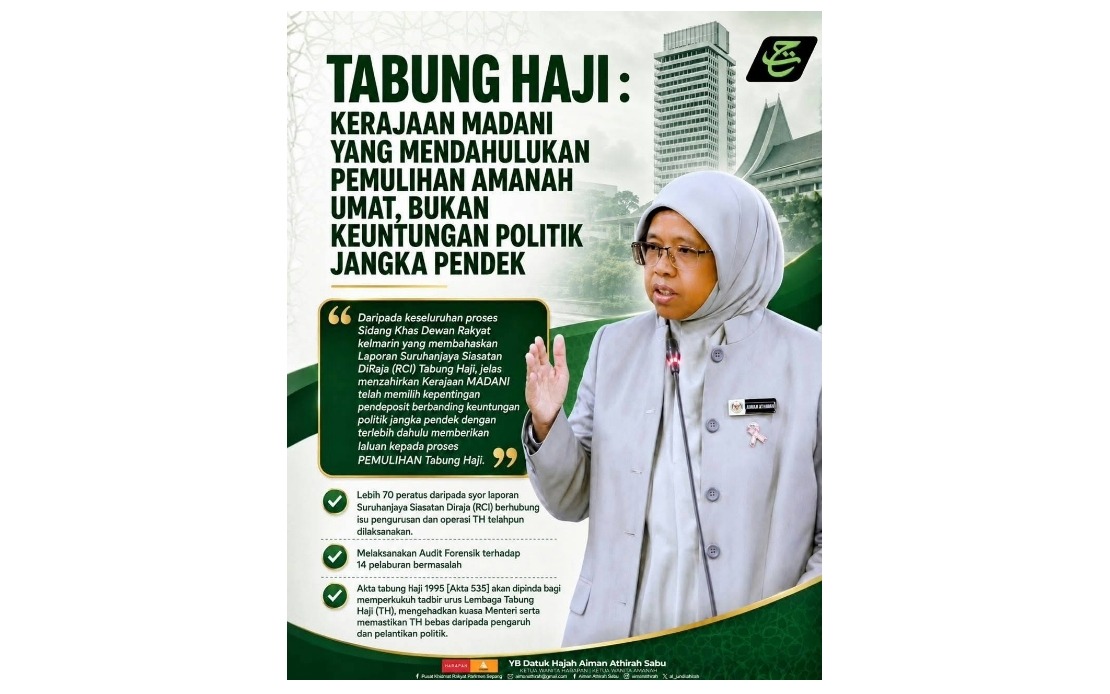
The Malaysian government is placing the financial security of more than 10 million Tabung Haji depositors at the centre of its decision-making on the Royal Commission of Inquiry report, rather than pursuing immediate political advantage, according to Datuk Aiman Athirah Sabu, Deputy Minister of Housing and Local Government. Her statement comes as the institution faces intense scrutiny following revelations that troubled investments have cost the pilgrimage fund nearly RM13 billion, with seven of those investments recording complete losses.
The deliberate, measured approach to releasing the RCI findings reflects a conscious choice to shield the financial institution from the kind of destabilising shocks it experienced in 2018, when rumours and governance concerns triggered withdrawals exceeding RM6 billion. That episode demonstrated the vulnerability of Tabung Haji to public confidence fluctuations and the potential cascading effects of rushed disclosures. By proceeding with caution, the government seeks to avoid repeating a scenario where panic-driven decisions by depositors could undermine the institution's recovery efforts and damage the savings of Malaysia's Muslim population at a particularly delicate juncture.
Tabung Haji occupies a uniquely sensitive position within Malaysia's financial and social landscape. Unlike conventional savings vehicles, the institution manages not merely money but the aspirations of Muslims throughout the country to fulfil the fifth pillar of Islam through the pilgrimage to Mecca. This dual responsibility—financial stewardship combined with spiritual significance—means that decisions affecting Tabung Haji carry weight far beyond ordinary commercial considerations. The institution's stability therefore becomes a matter of national religious importance, particularly in a pluralistic democracy where maintaining confidence in Islamic institutions serves broader social cohesion objectives.
The Deputy Minister's remarks also represent a direct response to opposition figures, particularly from Parti Islam Se-Malaysia (PAS) and Parti Wawasan Negara (Wawasan), who have questioned the government's timing in disclosing the RCI report. These parties have suggested that delayed publication reflects political calculation rather than institutional prudence. However, the government's framing suggests that those criticisms conflate legitimate governance concerns with political point-scoring, and that responsible stewardship of a major financial institution requires exactly the kind of methodical approach being adopted. The Sultan's own statement that the matter involved serious governance shortcomings—not merely routine management issues—has provided royal endorsement for treating the situation with exceptional gravity.
Progress on implementing the RCI's recommendations offers some reassurance to depositors and stakeholders. According to Dr Zulkifli Hasan, Minister in the Prime Minister's Department (Religious Affairs), more than 70 per cent of the commission's recommendations relating to Tabung Haji's operations and management structure have already been executed. Forensic audits into the 14 troubled investments represent a particularly significant step, as they promise comprehensive answers about how losses accumulated and where accountability lies. Such detailed investigation is essential before public disclosure, as it allows the government to present a complete picture rather than releasing incomplete or contested findings that could invite further speculation.
The financial recovery trajectory provides concrete evidence that Tabung Haji's situation, while serious, remains fundamentally recoverable. Investment income reached a record RM4.64 billion in 2025, a substantial improvement from previous years and indicating that the institution's core investment operations are functioning effectively. More tangibly for depositors, profit distribution has climbed from 1.25 per cent in 2018 to 3.5 per cent in 2025, directly boosting returns on accumulated savings. These improvements suggest that management changes and operational reforms are yielding measurable results, which should provide some comfort to Muslims planning their pilgrimage obligations.
Maintaining the hajj package price at RM33,000 for three consecutive seasons despite rising international costs demonstrates the government's commitment to ensuring that the spiritual obligation remains affordable for ordinary Malaysians. This pricing stability, achieved even as management and operational expenses have increased, reflects a deliberate policy choice to shield hajj participants from volatility. For many Malaysian Muslims working in modest circumstances, the stability of this cost is essential to financial planning. By absorbing cost pressures rather than passing them to pilgrims, Tabung Haji continues to fulfil its core social mission even amid financial difficulties.
The proposed amendments to the Tabung Haji Act 1995 address structural vulnerabilities that allowed the governance failures leading to the massive investment losses. These legislative changes aim to insulate the institution from political interference, limit ministerial discretion, and establish stronger professional management safeguards. Such governance reforms represent the kind of systemic correction that should prevent recurrence of the weaknesses that produced the troubled investments in the first place. For Malaysian depositors, these institutional safeguards offer greater assurance that future management will operate according to professional standards rather than political convenience.
The government's decision to address opposition criticism through substantive policy explanations rather than political counter-attacks reflects a particular approach to democratic governance. By releasing detailed information about recovery progress, implementation of recommendations, and financial improvements, officials are attempting to build a factual case for their management approach. This contrasts with the walkout staged by some opposition lawmakers during the special Dewan Rakyat sitting, which the Deputy Minister characterised as irresponsible avoidance of substantive engagement. Whether this information-based strategy proves sufficient to satisfy opposition concerns remains uncertain, but it signals an attempt to elevate the discussion beyond partisan positioning.
The scale of losses—RM10.2 billion borne by government through the Urusharta Jamaah rescue in 2018, plus RM2.6 billion in impairment losses between 2018 and 2025—underscores why the government's caution around disclosure merits consideration. These figures represent hundreds of millions of ringgit in taxpayer exposure and billions in depositor assets at risk. Handling such a situation requires careful sequencing: ensuring institutional stability first, implementing reforms second, and then allowing transparency. Any alternative approach risks triggering the very panic and loss of confidence that would compound the financial damage already incurred.
The broader Southeast Asian context adds another dimension to Malaysia's approach. Across the region, Islamic financial institutions and depositor protection schemes face similar governance challenges and public trust questions. Malaysia's handling of the Tabung Haji situation—attempting to balance transparency with stability, pursuing systemic reform, and publicly defending institutional independence—may serve as a regional reference point for how governments manage sensitive financial institution crises. For other Muslim-majority nations in Southeast Asia, the Malaysian model of combining forensic investigation, governance amendment, and measured disclosure offers both lessons and cautionary notes about the institutional and political complexities of stewarding religiously significant financial bodies.

