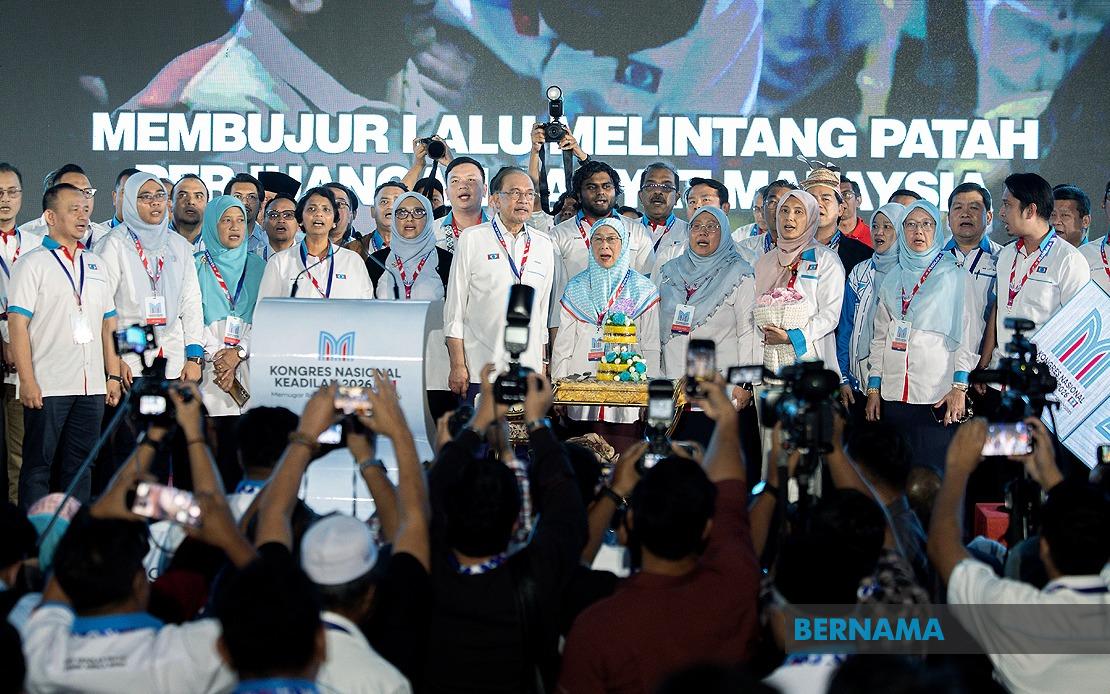
Prime Minister Datuk Seri Anwar Ibrahim has pledged that his administration will move forward with legislative amendments to the Tabung Haji Act 1995 in a bid to reinforce institutional integrity and protect the confidence that Malaysia's Muslim community has placed in the sacred savings institution. The commitment, made during remarks following the conclusion of the 2026 Parti Keadilan Rakyat National Congress, underscores the MADANI Government's stated determination to systematically address governance deficiencies across the public sector.
As both Prime Minister and Finance Minister, Anwar framed the planned amendment within a larger governance narrative centred on institutional cleaning and accountability. He emphasised that strengthening governance structures, removing systemic weaknesses, and repairing institutional frameworks must remain core priorities for his administration as it seeks to rebuild public trust in the machinery of state. The pledge to reform Tabung Haji legislation reflects recognition that the pilgrimage savings scheme, which manages the savings of millions of Malaysian Muslims preparing for the hajj pilgrimage, requires legislative updates to align with modern standards of transparency and fiduciary responsibility.
The Tabung Haji institution holds profound significance in Malaysian Muslim society, functioning as both a financial vehicle and a custodian of religious obligation. The institution's reputation and operational integrity directly impact the financial security of ordinary Malaysians who entrust substantial savings to prepare for one of Islam's five pillars. Any erosion of confidence in Tabung Haji's management has cascading social implications, potentially affecting the hajj aspirations of hundreds of thousands of Malaysian Muslims and their families.
Beyond Tabung Haji, Anwar used the occasion to signal his government's willingness to pursue other contentious institutional reforms. Most prominently, he called for the complete repeal of the Universities and University Colleges Act 1971 without replacement by alternative legislation that would similarly constrain student activism and democratic participation. The move would represent a dramatic reversal in educational policy, restoring to university students freedoms that have been restricted for five decades under the existing act.
The commitment to institutional reform carries broader political implications for the MADANI coalition. By publicly pledging to address structural weaknesses and governance lapses, Anwar is positioning his government as fundamentally different from the previous administration, which faced extensive scrutiny over institutional capture, political patronage, and conflicts of interest. These legislative initiatives serve as tangible markers of reform intent, offering concrete benchmarks by which the MADANI Government's anti-corruption agenda can be measured.
Anwar stressed that the government's economic agenda must ultimately translate into tangible improvements in citizens' quality of life and standards of living. This framing links institutional governance reforms to household prosperity, arguing that cleaning up institutions and removing inefficiency and corruption creates conditions for genuine economic progress that benefits ordinary Malaysians. The implicit message is that reform is not merely a matter of principle but of practical economic benefit.
A notable dimension of Anwar's statement involves his explicit commitment to serving all Malaysians regardless of their political affiliation or state of residence. He specifically acknowledged that citizens living in opposition-controlled states deserve equivalent government attention and investment as those in coalition-governed territories. This stance signals a shift away from the partisan distribution of state resources that characterised previous administrations, positioning the government as serving the nation rather than narrowly serving its own political base.
As PKR president, Anwar articulated the party's self-conception as a multi-ethnic, multi-religious movement committed to justice and reform principles that transcend sectarian or regional boundaries. He characterised the party's recent congress as an affirmation of principled leadership untethered to power consolidation or personal enrichment. This ideological framing attempts to position PKR and the wider coalition as distinct from politics centred on patronage networks, factional enrichment, or dynastic advancement.
The emphasis on clean leadership, organised effort, and streamlined party function suggests internal consolidation efforts within PKR itself. By invoking ideals of justice, human dignity, and people-centred governance, Anwar appears to be resetting party narratives and disciplining internal factions around common reform objectives. The call to "close ranks and streamline efforts" implies awareness of internal cohesion challenges within the coalition that require constant management and realignment.
For the broader Southeast Asian context, Malaysia's institutional reform trajectory holds regional significance. As the region's largest Muslim-majority democracy, Malaysia's approach to balancing religious institution governance with secular institutional standards creates precedent and context for other Southeast Asian nations navigating similar questions. The Tabung Haji amendment, while domestically focused, occurs within broader conversations across ASEAN about institutional accountability and religious institution oversight.
The timing of these announcements during the PKR congress also reflects political calendar management. By launching these reform initiatives at a party gathering, Anwar simultaneously signals to the broader electorate the government's reform commitments while reinforcing party messaging to PKR members about institutional renewal and principled governance. The dual audience suggests awareness that political support in Malaysia increasingly depends on demonstrable institutional performance rather than partisan loyalty alone.
Moving forward, the specific legislative language and implementation timeline for the Tabung Haji amendment will prove crucial in determining whether these commitments translate into substantive institutional change or remain rhetorical positioning. Malaysian observers and Muslim community leaders will scrutinise the proposed amendments' provisions regarding governance structures, transparency mechanisms, and stakeholder protections. The success of these reforms in actually restoring public confidence will depend on detailed policy design and rigorous implementation oversight.

