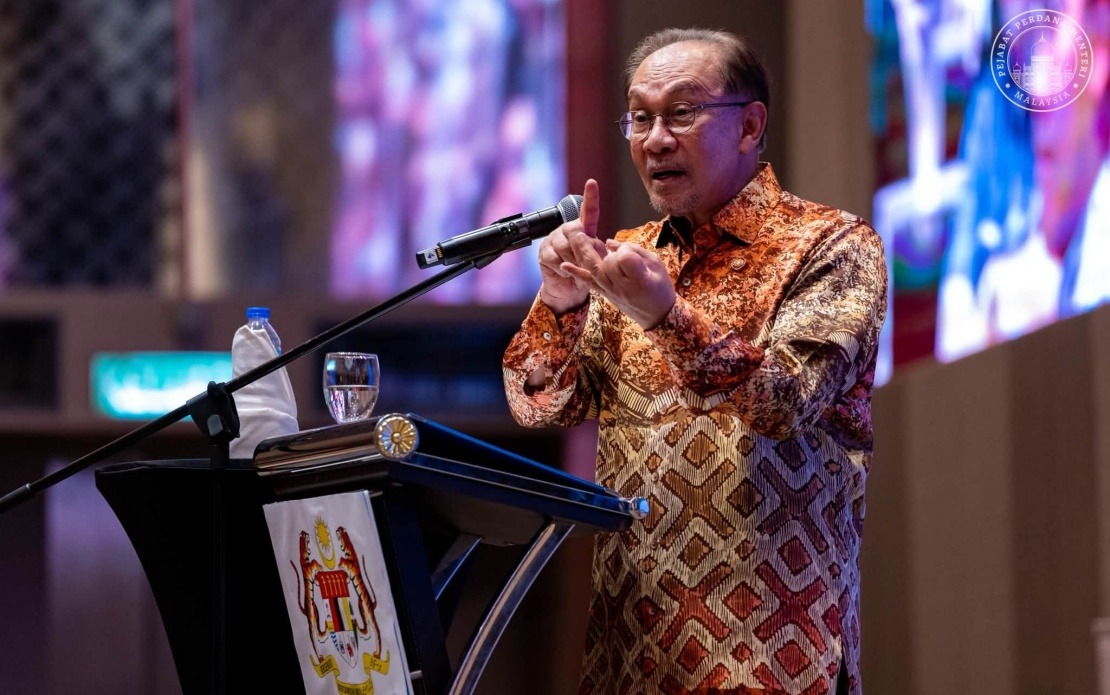
Prime Minister Datuk Seri Anwar Ibrahim has reaffirmed the government's determination to leverage all available resources in addressing the multifaceted challenges confronting Malaysia's younger generation. Speaking after attending the "Temu Anwar" session and the Opening Ceremony of the 2026 International Youth Assembly (HAMKA) in Klang, Selangor, the Prime Minister underscored that while the scope of government intervention remains bounded by practical constraints, the political will to assist young Malaysians remains unequivocal.
The engagement with youth representatives provided Anwar with direct exposure to the concerns and recommendations of younger Malaysians across various domains. Rather than issuing broad policy pronouncements, the Prime Minister framed the government's approach as one rooted in attentive listening—a subtle signal that youth-centered policymaking would be informed by grassroots perspectives rather than top-down diktat. This methodological commitment to consultation represents an important shift in how government engages with Malaysia's demographic dividend.
Central to Anwar's remarks was an observation about the contemporary environment confronting young people. He acknowledged that today's youth inhabit a world marked by ideological plurality and intellectual discord, where competing viewpoints and conceptual frameworks naturally clash. This characterization reflects a realistic assessment of the Malaysian information landscape, where social media amplification, generational value shifts, and global ideological currents create friction points for young citizens attempting to forge their own intellectual pathways.
Yet the Prime Minister did not frame this pluralism as inherently problematic. Instead, he articulated a vision in which disagreement becomes productive when mediated through rigorous intellectual engagement. Anwar emphasized that divergence of opinion should be channeled through knowledge-based discourse, reasoned argumentation, and civil comportment—rather than yielding to emotional impulses, antagonism, or sectional interests. This normative framework implicitly critiques the current tenor of Malaysian youth discourse, where online forums and social networks frequently become vectors for divisive sentiment rather than substantive debate.
The Prime Minister's invocation of HAMKA—the 2026 International Youth Assembly—carries symbolic weight extending beyond the immediate event. By referencing the assembly's nomenclature, Anwar drew a conceptual bridge to Abdul Malik Karim Amrullah, the twentieth-century Islamic scholar, intellectual, and literary figure who embodied what the Prime Minister characterized as a synthesis of rigorous thought, rhetorical eloquence, and pen-based activism. This historical reference serves multiple rhetorical purposes: it grounds contemporary youth engagement in intellectual tradition, it elevates the register of youth discourse beyond mere complaint to encompassing ideational labor, and it implicitly encourages young Malaysians to view themselves as potential architects of cultural and intellectual change.
Amrullah's legacy, as Anwar presented it, rested on three pillars: the cultivation and transmission of knowledge, the moral courage to articulate one's convictions publicly, and an epistemological openness toward idea generation. These characteristics remain conspicuously relevant for contemporary youth navigating an environment saturated with information yet marked by declining institutional trust. For Malaysian young people confronting questions of economic opportunity, social positioning, and national identity, a model emphasizing knowledge accumulation combined with intellectual courage offers a corrective to both passive consumption of ideas and hermetic ideological closure.
The government's commitment, while carefully hedged with acknowledgment of resource constraints, suggests several potential policy directions. Youth employment programming, educational curricular reform emphasizing critical thinking and civil discourse, and platforms for structured youth-government dialogue emerge as implicit priorities. The emphasis on listening—repeated throughout Anwar's statement—indicates that the government recognizes its own epistemic limitations regarding youth experience and is positioning itself as responsive rather than prescriptive.
For Malaysia's regional standing, this approach carries significance. Southeast Asia's youth populations increasingly grapple with shared challenges: climate anxiety, digital disruption, economic precarity, and questions about governance legitimacy. A Malaysian government demonstrating capacity to engage youth substantively, rather than dismissing or repressing youthful dissent, potentially models a more resilient political approach. Conversely, if the government's listening proves superficial and policy responses remain absent, the credibility gap between political rhetoric and material outcome could further alienate younger voters.
The distinction Anwar drew between emotion-based and knowledge-based discourse merits examination in the Malaysian context specifically. Recent years have witnessed youth mobilization around economic grievances, environmental concerns, and questions of meritocracy. In several instances, this activism has been characterized by mainstream political figures as driven by sentiment rather than substance. By positioning knowledge, argumentation, and mannered discourse as the appropriate registers for youth engagement, Anwar neither dismisses youth concerns nor validates the dismissive characterizations offered by political opponents. Instead, he creates space for youth voices while establishing normative standards for acceptable form of expression.
The gathering in Klang also reflects the government's recognition that youth engagement cannot occur solely through established institutional channels. The "Temu Anwar" format—literally "Meeting with Anwar"—suggests direct accessibility to executive authority, a departure from youth engagement mediated exclusively through bureaucratic layers. Such accessibility, whether substantive or largely symbolic, addresses a persistent complaint among young Malaysians regarding democratic participation: that conventional channels for youth input remain marginal to actual policymaking.
Moving forward, the government's commitment will be measured not merely by rhetorical affirmation but by tangible policy outputs addressing youth priorities. Malaysian young people confront particular challenges: navigating a job market offering limited high-wage opportunities, acquiring housing amid escalating property valuations, and constructing identity within a multicultural polity experiencing periodic communal tensions. Whether the government can translate its listening posture into programs addressing these material concerns remains an open question that will substantially determine the political trajectory of Malaysia's youth cohort over the coming years.

