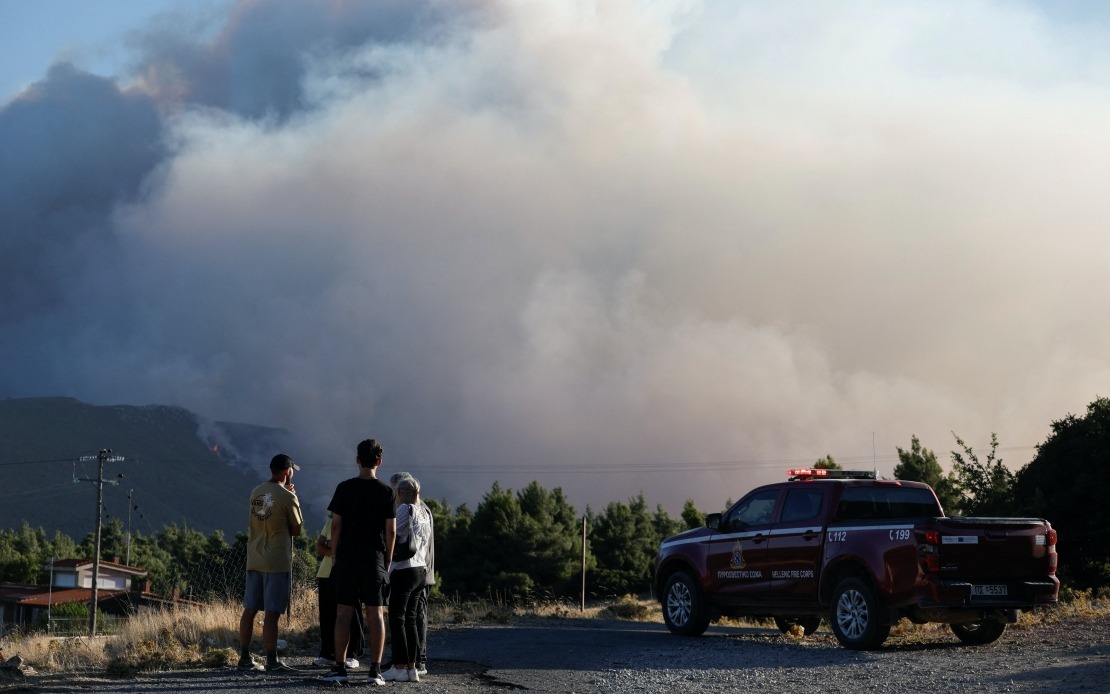
A significant wildfire raged across the Kithairon Mountains region west of Athens on Sunday, prompting one of Greece's largest emergency responses as hundreds of firefighting personnel worked around the clock to contain the advancing flames. The scale of the operation underscored the severity of the situation, with international assistance mobilised alongside domestic resources to combat a fire that threatened populated areas near the Greek capital.
The emergency operation deployed approximately 500 firefighters to the scene, a figure that included specialised crews dispatched from Romania and France to bolster Greece's firefighting capacity. Ground teams remained engaged throughout the night in the Kithairon Mountains, supported by military vehicles and heavy machinery brought in to establish firebreaks and protect vulnerable locations. As dawn broke, the aerial component of the response intensified, with state broadcaster ERT confirming that firefighting planes and helicopters resumed bombing runs to douse flames from above—a critical tactic when ground conditions become untenable.
Meteorological conditions complicated containment efforts considerably. Strong winds whipped across the affected terrain, causing the flames to spread with unpredictable velocity and changing direction. The communities of Veniza and Psatha experienced the most intense fire activity, with residents facing evacuation orders and property threatened by the advancing wall of fire. The danger became acute as the flames moved steadily eastward, steadily approaching Megara, a city located roughly 50 kilometres west of Athens and home to thousands of residents who watched the smoke plume grow larger throughout the day.
The proximity of the wildfire to a major population centre raised alarm across the wider region. As the flames crept closer to Megara, authorities intensified precautionary measures, preparing evacuation procedures and establishing emergency shelters should residents need to flee their homes. This scenario—where an uncontrolled wildfire threatens to engulf a significant city—represents one of the most dangerous situations Greek emergency services face, requiring perfect coordination between multiple agencies and real-time decision-making under extreme pressure.
Investigations into the fire's origins revealed a troubling pattern of human negligence. Authorities announced that 13 people had been arrested nationwide on charges related to negligent arson, suggesting that careless actions rather than natural causes had triggered the blaze. This finding reflects a broader challenge across Mediterranean nations, where the combination of summer heat, dry vegetation, and occasional human recklessness creates conditions for rapid fire propagation that can overwhelm even well-resourced emergency services.
The wildfire crisis extended beyond the Athens region. The island of Cephalonia, situated in the Ionian Sea west of mainland Greece, was simultaneously battling a major fire of its own, though state media reported that populated towns remained outside the immediate danger zone at that moment. The simultaneous eruption of major fires across different regions stretched Greek resources further, forcing difficult triage decisions about where to concentrate personnel and equipment.
On the island of Crete, firefighters had achieved greater success in controlling blazes, with local media reporting that most wildfires there had been substantially extinguished. However, the cost of this victory had been steep: several towns in Crete had been ordered to evacuate their residents, and unconfirmed reports circulated that as many as 200 homes had been destroyed in the fires. The lack of official confirmation of casualty figures reflected the ongoing chaos and incomplete information typical during active disaster response operations.
The scale of environmental destruction was staggering. A meteorologist quoted by news portal Protothema estimated that approximately 10,000 hectares of land had been consumed by flames across the northwestern and western areas surrounding Athens. To contextualise this figure for regional comparison: 10,000 hectares represents an area equivalent to roughly 14,000 football pitches, representing not merely an environmental loss but also the destruction of ecosystems, agricultural land, and wildlife habitats that would require years to regenerate.
For Malaysian observers, the Greek wildfire crisis offers sobering lessons about climate vulnerability and disaster management. Southeast Asia faces similar seasonal wildfire threats, particularly during El Niño years when drought conditions intensify across Indonesia, Malaysia, and neighbouring nations. The Greek experience demonstrates the importance of international cooperation in disaster response—the deployment of Romanian and French crews illustrated how regional mutual aid agreements can supplement domestic capacity when disasters exceed national resources. Additionally, the involvement of military assets and the scale of aerial firefighting operations highlight infrastructure investments that Southeast Asian nations might consider prioritising as climate change intensifies weather extremes and lengthens fire seasons across the region.

