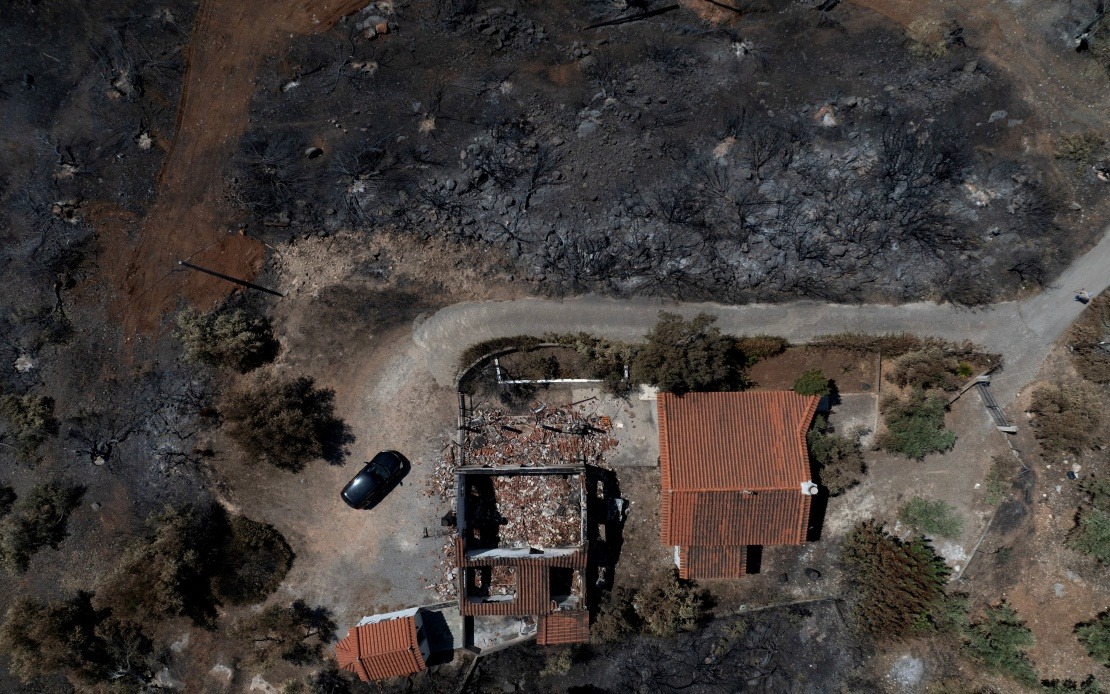
Greece has escalated its wildfire preparedness to the maximum alert level, with authorities declaring a "red alert" for three critical regions including the capital Athens and its surroundings as temperatures and dry conditions create extraordinarily dangerous circumstances for fire spread. The General Secretariat for Civil Protection, operating under the Climate Crisis and Civil Protection Ministry, raised the wildfire risk assessment to Category 4 for August 6 across Attica, Viotia, and Evia, reflecting conditions that pose severe threats to populated and vulnerable areas. This alert status triggers the activation of the National Civil Protection Mechanism at full operational capacity, signalling the seriousness with which Greek authorities are treating the immediate threat to one of Europe's most densely populated regions.
The red alert classification brings with it a comprehensive mobilization of the nation's emergency response infrastructure. Fire service units, police forces, and military personnel have been positioned to conduct continuous ground and aerial patrols across affected territories, ensuring rapid detection and response capabilities. Beyond deployment of personnel, the alert framework establishes restrictions on civilian activity in forests and ecologically sensitive zones, with particular controls placed on vehicle access and visitor movements to areas at heightened risk. Such measures represent an attempt to minimize human-caused ignition sources during the critical window when natural conditions would allow fires to spread with dangerous speed and intensity.
Public safety messaging has emphasized the critical importance of residents avoiding any activities that could potentially ignite fires during this high-risk period. The warnings reflect lessons learned from recent disasters, where accidental human actions—from discarded cigarettes to unattended campfires—have triggered catastrophic blazes. With weather patterns favoring rapid fire propagation, the margin for error has narrowed considerably, placing responsibility on both individuals and authorities to maintain heightened vigilance and swift reaction capabilities.
The alert was triggered partly in response to an active wildfire situation already consuming significant territory in the region. Firefighting crews successfully contained a separate blaze that erupted near Koropi, located southeast of Athens, on Wednesday afternoon. The fire, which ignited in low vegetation within the Driggia area around 1:45 pm local time, drew an intensive response involving 52 firefighters including specialized forest commando units and 14 ground vehicles. The operational response extended to aerial assets, with four helicopters and two water-dropping aircraft coordinating efforts to suppress the flames while ground teams managed the perimeter and prevented lateral spread.
The Koropi incident exemplified the multi-layered response approach now standard in Greek wildfire operations. Thermal imaging and optical drone surveillance provided real-time monitoring from the operations centre, allowing commanders to track fire behaviour and adjust resource allocation dynamically. Local municipal authorities contributed water tanker support, demonstrating the integrated command structure that coordinates resources across multiple administrative jurisdictions. An arson investigation team was subsequently deployed to examine the fire's origin, reflecting protocols that gather intelligence about causation patterns—critical data for prevention strategies and potential prosecution of those responsible for intentional fires.
Paralleling the Koropi situation, Greek firefighters continued intensive operations against a major active wildfire that originated in Viotia province the previous week and subsequently expanded into western Attica. According to satellite monitoring data from the European Union's Copernicus system, this larger blaze has consumed approximately 14,424 hectares, an area equivalent to roughly 35,642 acres. The scale of this fire underscores the challenges facing authorities in Greece, where summer conditions routinely produce large-scale blazes, but recent years have witnessed increasingly severe intensity and expansion rates that stress available resources.
The wildfire campaign has exacted a tragic human cost as well. On Sunday, during aerial operations against the major Viotia-Attica fire, two firefighting helicopters collided mid-air, resulting in the deaths of a Danish pilot and a Greek aerial coordinator. The incident represents a sobering reminder of the hazards inherent in helicopter-based firefighting operations, where aircraft operate in challenging conditions with limited visibility, intense heat, and high operational tempo. Such losses, while devastating to the aviation and firefighting communities, often motivate additional safety protocols and training enhancements across international aerial firefighting partnerships.
For Malaysia and Southeast Asian readers, the Greek wildfire situation carries particular relevance given the region's own experiences with catastrophic fires and transboundary smoke. Southeast Asia has repeatedly confronted massive wildfire events, particularly during El Niño-influenced dry periods, which generate smoke affecting millions across multiple countries. The Greek response model—with its emphasis on pre-positioned resources, multi-agency coordination, and public restrictions during high-risk periods—offers instructive examples that regional governments continue evaluating for adaptation to local contexts. The use of satellite monitoring systems like Copernicus parallels efforts by regional fire management agencies to employ advanced technology for early detection and real-time tracking of active fires.
The establishment of alert categories and associated restrictions also reflects evolving international standards for wildfire risk communication and public safety management. Greece's Category 4 alert system provides clear, easily understood messaging that enables citizens and businesses to adjust behaviour accordingly. In Southeast Asia, where wildfire preparedness remains uneven across nations and seasonal variations create distinct risk windows, such standardized alert frameworks could enhance cross-border coordination during periods when smoke and fire activity span multiple jurisdictions. The Greek experience demonstrates that effective wildfire management requires not merely reactive firefighting capacity but proactive restriction of activities and pre-positioned response capabilities calibrated to predictable high-risk periods.
As summer temperatures persist across the Mediterranean and climate change patterns continue shifting seasonal fire risk windows and intensity profiles, Greece's intensified alert status reflects the growing recognition that extreme wildfire conditions have become regular rather than exceptional occurrences. The mobilization of full emergency capacity for three regions represents a significant allocation of national resources that, if sustained across extended periods, raises questions about resource sustainability and the long-term fiscal implications of climate-driven fire management escalation. This challenge mirrors concerns within Southeast Asian nations grappling with similar resource constraints while confronting expanding fire seasons and larger burned areas.

