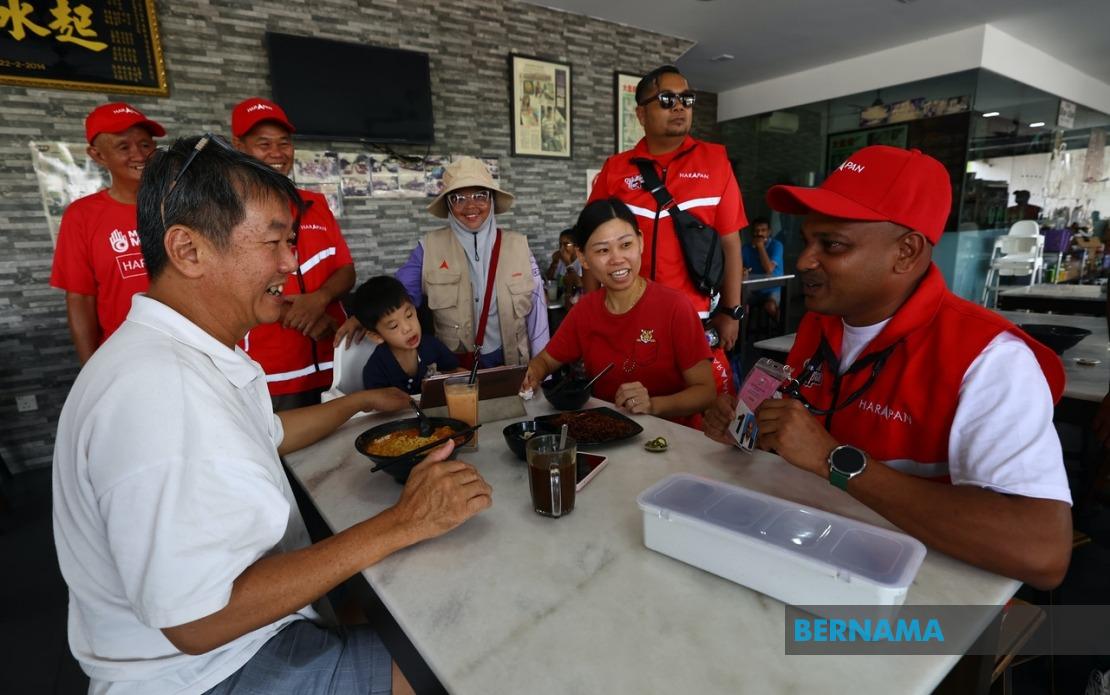
With the Johor state election set for July 11, Pakatan Harapan candidate Guna Balakrishnan has announced an aggressive final sprint to reach the remaining fifth of voters in the Layang-Layang constituency, signalling the competition in this three-way contest is entering its decisive phase. The candidate disclosed that his campaign machinery has traversed nearly four-fifths of the electoral division and now intends to maximise efforts to ensure comprehensive voter contact before polling day arrives.
Speaking at the PH operations centre in Kluang, Guna framed the concluding campaign period as demanding extraordinary effort, declaring his intention to elevate his commitment beyond standard intensity. His rhetoric of moving from complete dedication to doubled effort underscores the conventional wisdom of Malaysian electoral contests, where the final week typically determines which swing voters will ultimately be persuaded. The Layang-Layang seat encompasses 25,181 registered voters, placing it among mid-sized constituencies within the Johor statehouse, and securing a plurality requires aggressive ground organisation during this stretch.
Guna's central campaign message focuses on achieving governance transformation, positioning Pakatan Harapan's historical participation in federal administration from 2018 to 2022 as evidence of the coalition's capacity to deliver meaningful reform. This argument carries particular resonance in Johor, where Barisan Nasional has dominated state politics for decades, making incumbent-change messaging strategically important for any challenger. The candidate is essentially asking voters to assess PH's track record against the status quo represented by the governing arrangements in the state.
The candidate unveiled a comprehensive local manifesto addressing infrastructure deficiencies that resonate with rural and semi-urban constituencies throughout Malaysia's peripheries. Flood mitigation emerges as the cornerstone commitment, reflecting the harsh reality that water-related disasters affect multiple neighbourhoods within Layang-Layang during monsoon seasons. Complementing this are pledges to enhance road networks and install improved street lighting—modest but tangible improvements that directly influence quality of life. Recognising the digital divide that separates urban from rural Malaysia, Guna has made internet connectivity expansion a specific manifesto plank, acknowledging how inadequate broadband access constrains educational and commercial opportunities for residents in less-developed areas.
Beyond infrastructure, Guna's manifesto encompasses human capital development through three specific initiatives. Support for women's entrepreneurship programmes reflects Malaysia's ongoing efforts to enhance female labour force participation and business ownership rates. Technical and Vocational Education and Training expansion for young people addresses the persistent skills gap that leaves many school-leavers unprepared for employment in the modern economy. The proposed establishment of a senior citizen activity centre, termed PAWE, signals attention to demographic ageing—a challenge intensifying across Malaysia as life expectancy improves and birth rates decline.
Local trader Tan Ah Kiat, aged 55, endorsed Guna's candidacy by highlighting the practical relevance of the manifesto to community concerns. Tan specifically cited flood mitigation and infrastructure improvements, issues that directly affect daily livelihood and safety in constituencies vulnerable to water damage. The trader's observation that internet connectivity deficiencies hamper both education and business in rural areas captures an often-overlooked development challenge; without reliable broadband, entrepreneurs and students in Layang-Layang face structural disadvantages compared to counterparts in urban centres like Kuala Lumpur or Johor Bahru.
R. Kalaiselvan, 48, articulated appreciation for Guna's emphasis on youth development through TVET and female entrepreneurship support, reflecting how younger and middle-aged voters increasingly assess candidates on their capacity to create economic pathways rather than merely redistribute existing resources. Kalaiselvan's particular approval of senior citizen welfare initiatives through the proposed PAWE suggests that Guna's inclusive approach to age-group representation appeals to working-age voters who recognise their own eventual vulnerability and value candidates demonstrating concern for elderly citizens. The construction of a narrative encompassing youth opportunity, women's economic participation, and senior welfare demonstrates political awareness of Layang-Layang's demographic composition.
The three-cornered contest involving Guna, Barisan Nasional's Chua Jian Boon, and incumbent Abd Mutalip Abd Rahim representing Perikatan Nasional reflects the fragmentation that increasingly characterises Malaysian electoral competition. Where Johor historically witnessed binary contests between BN and PH, the emergence of PN as a significant force has splintered opposition and government support, creating scenarios where disciplined voter mobilisation becomes paramount. Guna's acknowledgment of the final five days' criticality reflects this calculus; with voters potentially divided three ways, reaching persuadable segments efficiently determines electoral outcomes.
Early voting scheduled for Tuesday, July 7 introduces a strategic element to the final campaign push. Candidates must now target both early voters and those casting ballots on election day itself, requiring simultaneous campaigns across voter cohorts. The compressed timeframe between early voting and election day means that momentum generated during the final week could influence late-deciding voters, making Guna's acceleration tactically sound. Malaysian electoral history demonstrates that campaigns often shift in the final seventy-two hours as undecided voters crystallise their choices.
For Pakatan Harapan statewide, the Layang-Layang contest represents one among forty state seats, and aggregate performance across constituencies determines government formation. While individual candidate efforts matter considerably, national coalition messaging and regional campaign coordination equally influence outcomes. Guna's localised focus on Layang-Layang-specific challenges must cohere with broader PH narratives concerning governance and reform to maximise persuasive impact among the approximately five thousand voters who remain genuinely undecided entering the final week.

