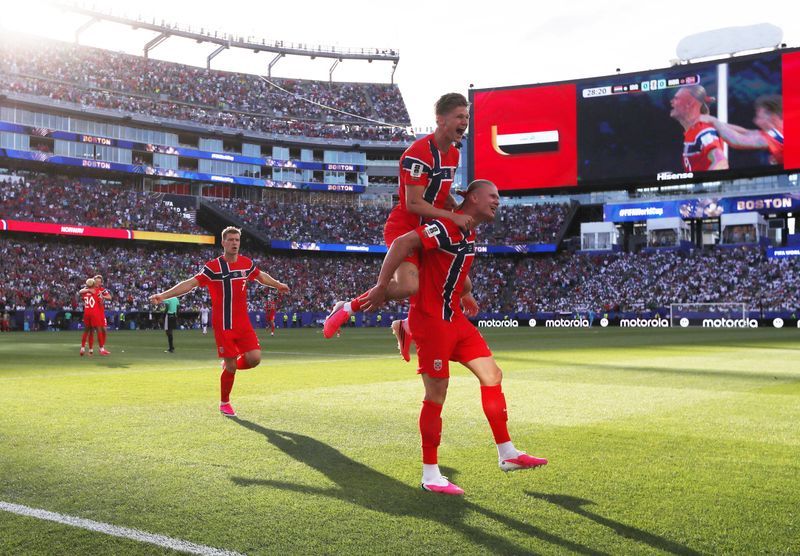
Erling Haaland wasted no time announcing himself on football's grandest stage, scoring twice in the opening half as Norway delivered a comprehensive 4-1 defeat of Iraq in their World Cup curtain-raiser. The 23-year-old striker's emphatic double underscored his remarkable pedigree, adding the World Cup finals to an already stellar résumé of competitions in which he has found the net on his first appearance, following earlier debuts in the German Bundesliga, English Premier League and Champions League.
Haaland's arrival at the tournament carried the weight of Norwegian expectations, a nation returning to the World Cup finals for the first time since 1998. Rather than succumbing to such pressure, the prolific attacker thrived under it, producing a masterclass in predatory finishing that left Iraq's defence thoroughly discomfited throughout the opening exchanges. His first-half performance established him as the match's dominant force and suggested that despite Norway's 28-year absence from the competition, they possessed a generational talent capable of delivering on the global stage.
The nature of both goals reflected Haaland's instinctive intelligence in the penalty area. His opening strike came through a clinical poacher's finish after David Moller Wolfe delivered the ball across the box, a simple yet incisive combination that demonstrated the coordination between supply and execution. His second goal showcased different qualities—an aggressive closing of Iraqi defenders that forced a careless backpass before he blocked the goalkeeper's desperate clearance attempt, redirecting it into the net with ruthless efficiency.
While Haaland's personal brilliance captivated observers, Norway's overall performance revealed significant vulnerabilities that coach Stale Solbakken will need to address. The team struggled to impose consistent control, committing numerous passes astray and occasionally appearing disjointed in their attacking play. Captain and midfield orchestrator Martin Odegaard produced a surprisingly subdued display, failing to impose the creative influence expected of a player of his calibre, while defensive lapses allowed Iraq to briefly equalise through Aymen Hussein, a moment that briefly unsettled the Norwegian unit.
The philosophy underpinning Norway's approach became apparent in the strategic framework employed throughout the encounter. Norwegian Prime Minister Jonas Gahr Stoere had articulated this concept during the pre-match buildup, emphasising that whilst individuals score the goals that turn matches, ultimately teams emerge victorious through collective endeavour. In practical terms, this translated into a tactical design where supporting players prioritised creating opportunities for Haaland to exploit, effectively building the entire attacking structure around his lethal finishing ability. When this coordination functioned smoothly, as it did during his opening goal, Norway appeared formidable; when execution faltered, as evidenced by Odegaard's ineffective midfield contributions, the team's attacking potency diminished noticeably.
Norway's three-point haul positioned them atop their group on goal difference ahead of France, who earlier that day defeated Senegal 3-1. Yet Haaland recognised that such early positional advantage offered little comfort given the demanding fixtures ahead and the inconsistent nature of Norway's performance. His goal-scoring magnificence had masked a broader team display that, whilst ultimately successful, contained enough rough edges to warrant serious tactical refinement before subsequent group matches.
For Norwegian supporters, the result represented a triumphant homecoming following more than a quarter-century of World Cup absence. The psychological significance of qualifying and, more importantly, winning convincingly against a Middle Eastern opponent provided substantial morale-boosting value beyond the mere three points accumulated. Haaland's personal contribution elevated the occasion further, offering supporters a genuine superstar around whom they could construct genuine tournament aspirations.
The striker himself acknowledged both the achievement and the continuing challenges lying ahead. In characteristically understated fashion, Haaland noted that success had come despite expectations placed upon the squad, whilst expressing genuine satisfaction that Norwegian supporters back home could celebrate the successful return. His comment about the likely festive atmosphere in Norway reflected the emotional release that such a result afforded a nation rediscovering its presence at the world's premier footballing competition after enduring a lengthy absence.
Haaland's performance assumes additional significance within the Southeast Asian context, where the striker has become a global icon following his dominance in the English Premier League. Malaysian football enthusiasts and analysts recognise in his World Cup emergence the tangible arrival of one of sport's most exciting contemporary talents at the international level. His ability to deliver consistently across different leagues and now the World Cup platform suggests that this tournament could potentially showcase some of the finest finishing football will witness in coming years, provided Norway can build adequate platform for their principal attacking asset to flourish throughout the group stage and potentially beyond.