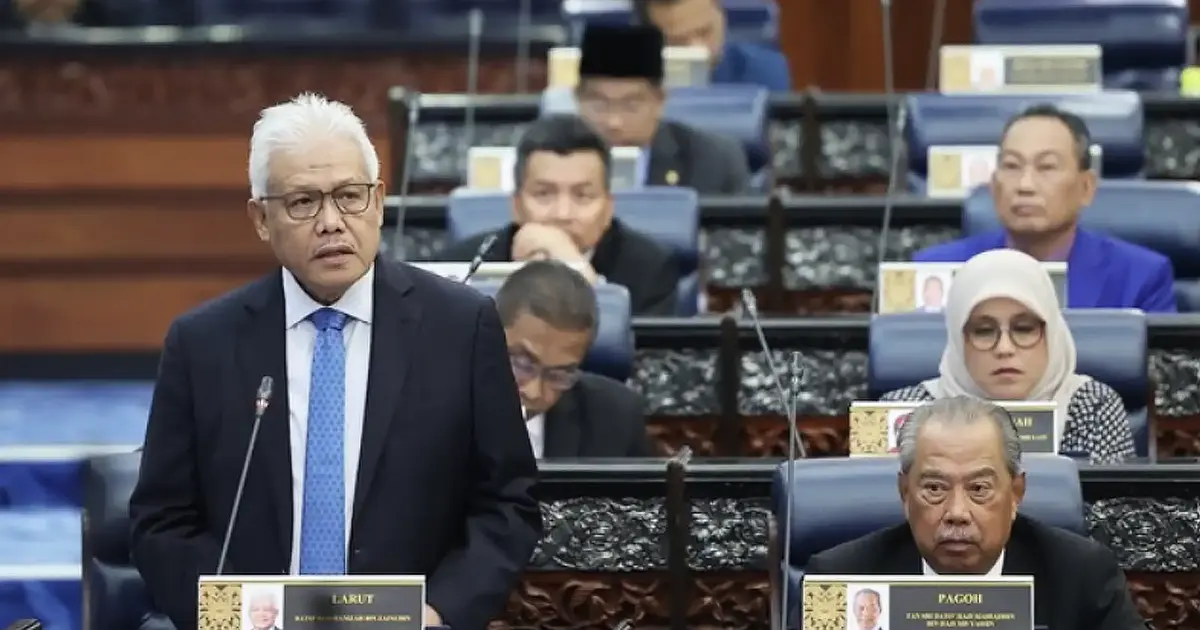
Hamzah Zainudin has reclaimed the front-row parliamentary seat traditionally reserved for the leader of the opposition, marking a significant shift in Dewan Rakyat seating arrangements that reflects broader changes within Malaysia's political landscape. The repositioning sees Bersatu president Muhyiddin Yassin, who previously occupied the prominent seat immediately adjacent to the opposition leader, now placed eight positions further down along the front row of the lower house.
The reassignment carries considerable symbolic weight in Malaysian parliamentary politics, where physical proximity to the government front bench is understood as a tangible measure of political influence and status. Hamzah's return to the principal opposition leader's station represents a consolidation of his authority within the opposition coalition, while Muhyiddin's relocation signals a diminished formal standing within parliamentary proceedings despite his continued role as Bersatu president. This rearrangement suggests evolving power dynamics within the anti-government bloc and underscores the fluidity of coalition politics in post-2022 Malaysia.
The shift becomes more comprehensible when examined against the backdrop of Malaysia's fractious opposition landscape, where multiple parties vie for influence and resources. The opposition bloc has undergone considerable restructuring since the 2022 general election, with Pakatan Harapan and Perikatan Nasional previously maintaining separate parliamentary groupings before recent coordination efforts. Hamzah, heading the PKR faction and retaining substantial parliamentary representation, has consolidated authority as the de facto face of parliamentary opposition, justifying his command of the principal opposition front bench position.
Muhyiddin's previous proximity to the opposition leader's seat reflected Bersatu's earlier positioning within the anti-government coalition architecture, a configuration that has since evolved considerably. While the party remains significant in terms of seats and parliamentary representation, the repositioning acknowledges shifting hierarchies within opposition structures. This recalibration may also reflect broader negotiations about opposition unity and coordination mechanisms, with Hamzah's reinforced status serving to strengthen centralised opposition leadership during parliamentary sittings.
For Malaysian observers of parliamentary procedure, seating arrangements are far from mere protocol formalities. They communicate legislative negotiating power, coalition stability, and the relative bargaining strength of individual leaders heading opposition factions. Media commentators and political analysts routinely interpret such shifts as indicators of incoming parliamentary strategy and coalition robustness. The change therefore provides early signals about how the opposition intends to prosecute its campaign during the current parliamentary term.
The implications extend beyond symbolic considerations. The opposition leader's front-row position carries practical advantages during parliamentary debates, enabling greater visibility during televised proceedings and positioning the occupant for more frequent interventions during ministerial question time and legislative exchanges. Hamzah's repositioning thus enhances his capacity to shape parliamentary narratives and consolidate public perception of opposition leadership coherence. This enhanced platform proves particularly valuable for an opposition that must work harder to capture media attention compared to government-aligned parties.
Bersatu's repositioning within the parliamentary seating arrangement does not necessarily indicate weakening party strength or Muhyiddin's declining relevance. Rather, it reflects a recalibration of opposition structures that assigns clearer hierarchy to leadership positions. Bersatu remains a significant parliamentary force, particularly in states such as Perak and Terengganu, and Muhyiddin retains considerable sway over party direction and policy positions. The rearrangement simply clarifies that Hamzah holds primary responsibility for directing opposition parliamentary strategy.
The broader context involves sustained tension between Bersatu's dual-track political positioning and its formal opposition credentials. The party has maintained a complex relationship with governmental structures and has occasionally undertaken bilateral negotiations that complicate straightforward opposition classifications. Muhyiddin's repositioned seating may therefore reflect broader concerns about maintaining clear opposition branding and coordination, with concentration of opposition leadership in Hamzah's hands strengthening operational unity.
From a Southeast Asian perspective, Malaysia's parliamentary seating dynamics illustrate the region's enduring commitment to Westminster-style legislative procedure, even where political cultures have evolved substantially since independence. Indonesia and Thailand exhibit comparable ritualistic attachments to parliamentary symbolism and formal hierarchies, suggesting shared regional political traditions. The Malaysian rearrangement thus participates in broader regional patterns whereby physical arrangement communicates political relationships.
Looking forward, the repositioning establishes clearer opposition operational structures heading into critical parliamentary periods. Government legislative agendas require careful opposition scrutiny, particularly on matters involving constitutional amendments or significant policy realignments. Centralising opposition leadership clarity through Hamzah's elevated positioning enhances parliamentary coordination capacity during complex legislative negotiations. This proves especially relevant given Malaysia's multi-party parliamentary complexity and the prevalence of closely divided votes on significant measures.
The rearrangement also carries implications for opposition coalition electoral planning. Clearer delineation of leadership roles within parliamentary structures facilitates better coordination for the next general election cycle, whenever that occurs. Hamzah's reinforced positioning signals to party members and voters alike that the opposition operates according to coherent leadership structures and decision-making hierarchies, potentially strengthening electoral messaging about alternative governance capacity.
Ultimately, the seating shift reflects Malaysian politics' characteristic blend of formal institutional respect and substantive power contestation. While parliamentary procedure maintains dignified adherence to established protocols, underlying shifts in seat assignments communicate real changes in negotiating positions and coalition priorities. Hamzah's reclamation of the opposition leader's parliamentary seat thus merits attention not as trivial procedural detail but as tangible expression of reformed opposition arrangements seeking to project greater coherence and operational capability within Malaysia's increasingly complex legislative environment.

