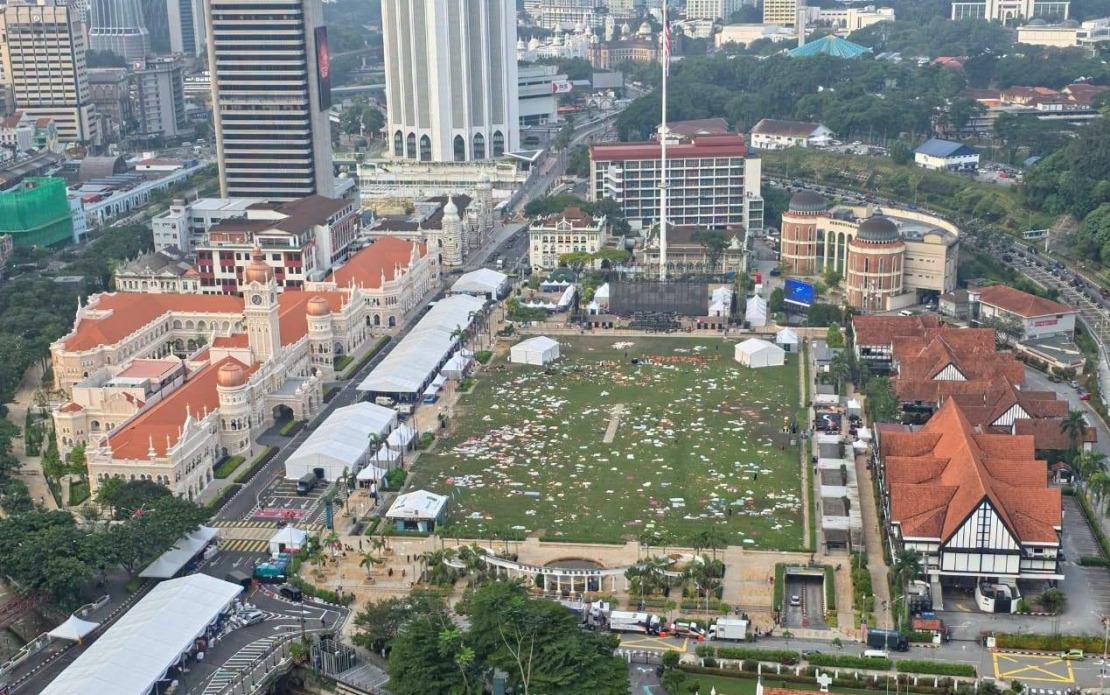
Hannah Yeoh, the Minister in the Prime Minister's Department overseeing Federal Territories, has publicly commended the dedicated efforts of Kuala Lumpur City Hall workers who swiftly restored Dataran Merdeka to order after it became littered with refuse during a public broadcast of the 2026 FIFA World Cup final. The cleanup operation highlighted both the commitment of municipal staff and a broader conversation about how Malaysians engage with their shared urban environment. Yeoh's remarks, delivered through Facebook, struck a balance between acknowledging institutional performance and challenging the public's own conduct in maintaining communal spaces.
The aftermath of the World Cup screening event presented city authorities with a substantial task. Thousands of spectators who gathered at the historic venue left behind considerable amounts of waste, requiring DBKL workers to undertake intensive cleanup operations. Rather than merely accepting this as an inevitable consequence of large public gatherings, Yeoh seized the moment to frame the incident as a teaching opportunity about collective responsibility. She recognised the professionalism displayed by municipal workers while simultaneously questioning why citizens should expect public employees to bear the entire burden of maintaining cleanliness in spaces that belong to everyone.
Central to Yeoh's message was a redefinition of what taxpayer entitlements should encompass. While Malaysians legitimately expect government agencies to deliver core public services—including sanitation and maintenance of common areas—the minister drew a crucial distinction between government obligation and individual conduct. Disposing of waste properly, she argued, represents a fundamental civic duty that should originate from personal choice rather than reliance on public workers to remedy carelessness. This perspective challenges a commonly observed pattern in urban Malaysia where some members of the public treat shared spaces less carefully than they would their own homes or private establishments.
Yeoh also elevated Dataran Merdeka beyond its practical function as an event venue, emphasising its profound historical and symbolic significance. As Malaysia's independence monument and heart of national commemoration, the space carries weight that transcends its role in hosting entertainment or sporting events. This framing suggests that littering or neglecting such a location amounts to disrespecting not merely a municipal asset but a repository of national memory and identity. By connecting environmental conduct to patriotic sentiment, the minister drew a direct line between how citizens treat public spaces and broader questions about national dignity and shared identity.
The minister's invocation of Malaysia MADANI, the government's development framework under Prime Minister Datuk Seri Anwar Ibrahim, positioned civic cleanliness as integral to the nation's aspirational vision. MADANI emphasises holistic progress that extends beyond economic growth or infrastructure development to encompass the values, character, and mutual respect that define a harmonious society. Under this conceptual framework, a clean and well-maintained public realm reflects not merely efficient municipal management but the collective maturity and civic consciousness of the population. Conversely, widespread littering signals a disconnect between aspirations for national development and the everyday choices that citizens make.
Yeoh's reference to Prime Minister Anwar Ibrahim's philosophy regarding national progress underscored an administration-wide perspective that development cannot be measured solely through physical infrastructure, though such investments remain important. Rather, true advancement requires that citizens internalise values of respect, care, and responsibility toward shared resources. This philosophical stance represents an attempt to reshape public discourse around what constitutes a developed nation—shifting focus from monuments and megaprojects to the character of public behaviour and mutual respect for communal spaces. It suggests that Malaysia's transformation depends not solely on government action but fundamentally on how individual citizens conduct themselves daily.
The cleaning operation itself demonstrated DBKL's operational capacity and responsiveness. Municipal workers mobilised efficiently to restore the space, preventing any lasting damage to the venue or disruption to its symbolic importance. Yet Yeoh's comments implied that continually placing the burden of remediation on such workers amounts to taking their labour and commitment for granted. Public sector employees, she suggested, deserve better than to function primarily as cleaners after carelessness by others. This perspective advocates for a rebalancing of responsibility that would reduce the preventable work created by public negligence and allow municipal staff to focus on broader maintenance and improvement initiatives.
The incident also raises questions about the design and management of large public gatherings. While Yeoh focused primarily on individual responsibility, the scale of littering after the World Cup screening suggests that event organisers might consider implementing enhanced waste management infrastructure, clearer signage about disposal expectations, or incentives for tidiness during mass gatherings. The fact that thousands of people congregated in one location simultaneously creates logistical challenges distinct from everyday public space management. Nevertheless, Yeoh's emphasis on personal agency remains valid—better infrastructure cannot substitute for citizens who deliberately choose to dispose of waste responsibly.
For Malaysian readers, particularly those in Kuala Lumpur, Yeoh's message carries particular resonance given ongoing debates about urban cleanliness and public behaviour. Cities across Southeast Asia grapple with balancing rapid development, growing populations, and environmental management. Malaysia's ambition to position itself as a developed nation depends partly on such intangible factors as public civility and environmental stewardship. The Dataran Merdeka incident, captured in the minister's commentary, serves as a microcosm of broader challenges facing urban Malaysia as it pursues development while cultivating the civic culture necessary to sustain it.
Yeoh's closing statement—that Kuala Lumpur is shared home requiring collective care rather than external intervention—encapsulates the heart of her argument. This framing treats urban cleanliness not as a service delivered to passive consumers but as a responsibility shared among active citizens who recognise mutual benefit in maintaining their environment. It represents an invitation for Malaysians to embrace a more mature civic identity, one where individual choices reflect respect for collective spaces and acknowledgment that public institutions function better when supported by responsible citizenry. Whether this appeal gains traction may ultimately determine whether similar incidents diminish or recur at future public gatherings across the capital.

