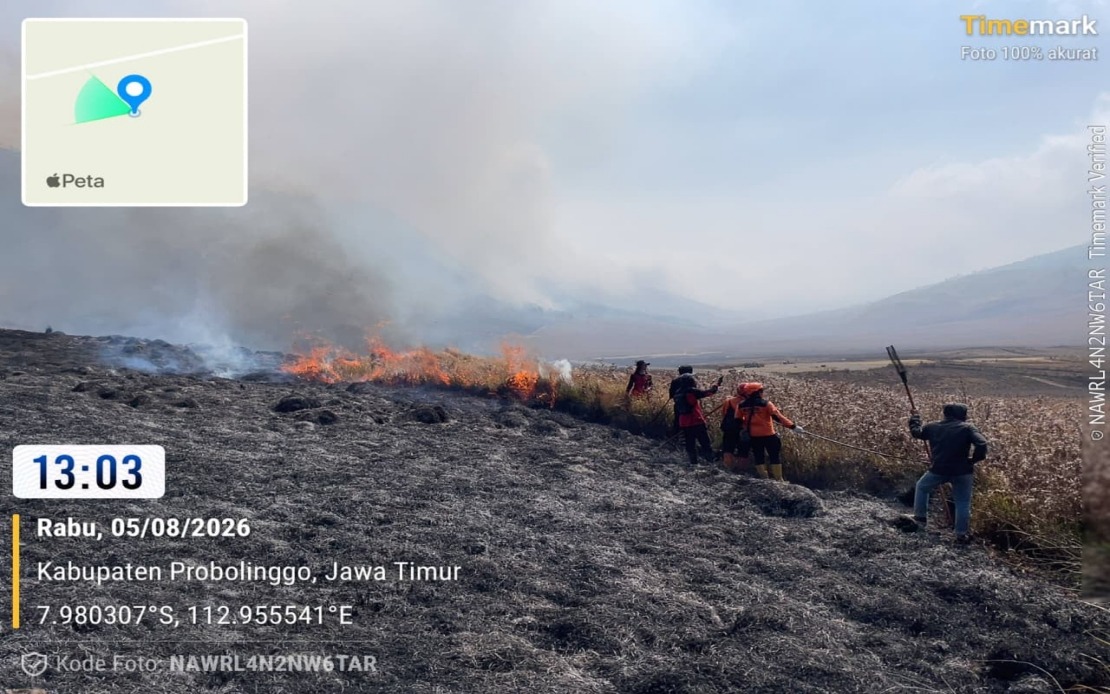
Indonesia's disaster management authorities have escalated their response to a major wildfire at Mount Bromo by bringing in aerial firefighting assets, signalling the intensity of the blaze that has already consumed about 60 hectares of forest across two East Java regencies. The National Disaster Management Agency (BNPB) has deployed two water-bombing helicopters to tackle hotspots in terrain too steep and treacherous for ground crews to navigate safely, marking a significant shift in containment strategy for the fire that ignited on Monday.
According to Abdul Muhari, head of BNPB's Disaster Data, Information and Communication Centre, the affected area spans approximately 10 hectares in Probolinggo Regency and a substantially larger 50-hectare zone within the Bromo Tengger Semeru National Park situated in neighbouring Malang Regency. The geographic distribution of the fire across multiple jurisdictions has compounded response coordination challenges, requiring the mobilisation of resources across provincial boundaries. The vast majority of the 50-hectare section lies within the national park, a designation that carries particular significance for environmental preservation and tourist infrastructure in one of East Java's most economically important regions.
Authorities achieved substantial progress in containing the initial spread by Wednesday afternoon, when ground-based firefighting operations managed to bring most active flames under control. However, the mountainous topography of Mount Bromo has proven problematic for comprehensive suppression efforts, with numerous embers remaining smouldering in steep gullies and high-altitude zones where traditional fire crews face severe access limitations. The challenging terrain has necessitated the helicopter deployment, as conventional ground-based approaches cannot effectively reach all burning areas, particularly those on near-vertical slopes characteristic of volcanic mountain environments.
The decision to employ aerial water-bombing represents a measured escalation in response intensity, though local authorities have also announced preparations for a Weather Modification Operation that would seed clouds to induce rainfall over the affected region. Abdul Muhari indicated that this experimental approach remains contingent upon favourable atmospheric conditions and would serve as a complementary tool supporting the ongoing work of joint emergency response teams across multiple agencies. Such operations, whilst technically feasible, depend on meteorological circumstances that may or may not materialise, creating uncertainty around their ultimate effectiveness.
The Bromo Tengger Semeru National Park Authority has implemented temporary closure measures for affected sections of the Mount Bromo tourist area, a necessary precaution that protects both visitors and emergency personnel concentrating on suppression activities. The closure also removes potential sources of new ignition in an environment where evacuation routes may become compromised during active firefighting. Tourism represents a critical revenue stream for East Java and surrounding communities, making the temporary restrictions economically significant beyond their immediate public safety function.
Investigators have preliminarily attributed the fire's origin to a campfire abandoned by hikers, though the formal investigation remains ongoing and alternative causes have not been definitively ruled out. The hypothesis that human negligence sparked the blaze raises broader questions about visitor management protocols at the national park and the sufficiency of education campaigns regarding fire safety in ecologically sensitive mountain environments. Mount Bromo's popularity as a trekking destination means that thousands of hikers traverse the region annually, and each represents a potential ignition risk during dry seasons when vegetation moisture content drops dramatically.
The timing of this wildfire carries particular relevance for Southeast Asian environmental observers, as large-scale forest fires across the region remain an ongoing concern with transboundary air quality implications. Indonesia has invested substantially in disaster management infrastructure following catastrophic fire seasons in preceding years, yet incidents like the Mount Bromo blaze demonstrate that improved response capacity remains essential. The deployment of helicopters reflects investment in advanced firefighting technology, though such assets remain limited and must be prioritised across multiple active incidents whenever simultaneous emergencies occur.
For Malaysian observers, the Mount Bromo situation underscores the regional challenge of managing fire risk in mountainous terrain during dry periods, a concern equally relevant to Malaysian national parks and protected forest reserves. The rapid escalation from ground-based efforts to aerial support illustrates how quickly initially manageable situations can expand into major disasters requiring specialised resources. The cross-jurisdictional coordination challenges evident in Indonesia's response, spanning multiple regencies and national park administration, mirror complexities that Malaysian authorities also navigate during forest fire emergencies affecting areas under different administrative purview.
The broader implications extend to tourism management across Southeast Asia, where protecting popular hiking destinations from both environmental degradation and visitor safety hazards requires careful balance. Temporary closures prevent immediate revenue generation but preserve infrastructure and prevent catastrophic accidents that would cause far greater long-term economic damage. National park authorities across the region grapple with similar decisions balancing conservation imperatives, visitor access, and emergency response requirements, making the Mount Bromo incident instructive for regional disaster management practitioners.

