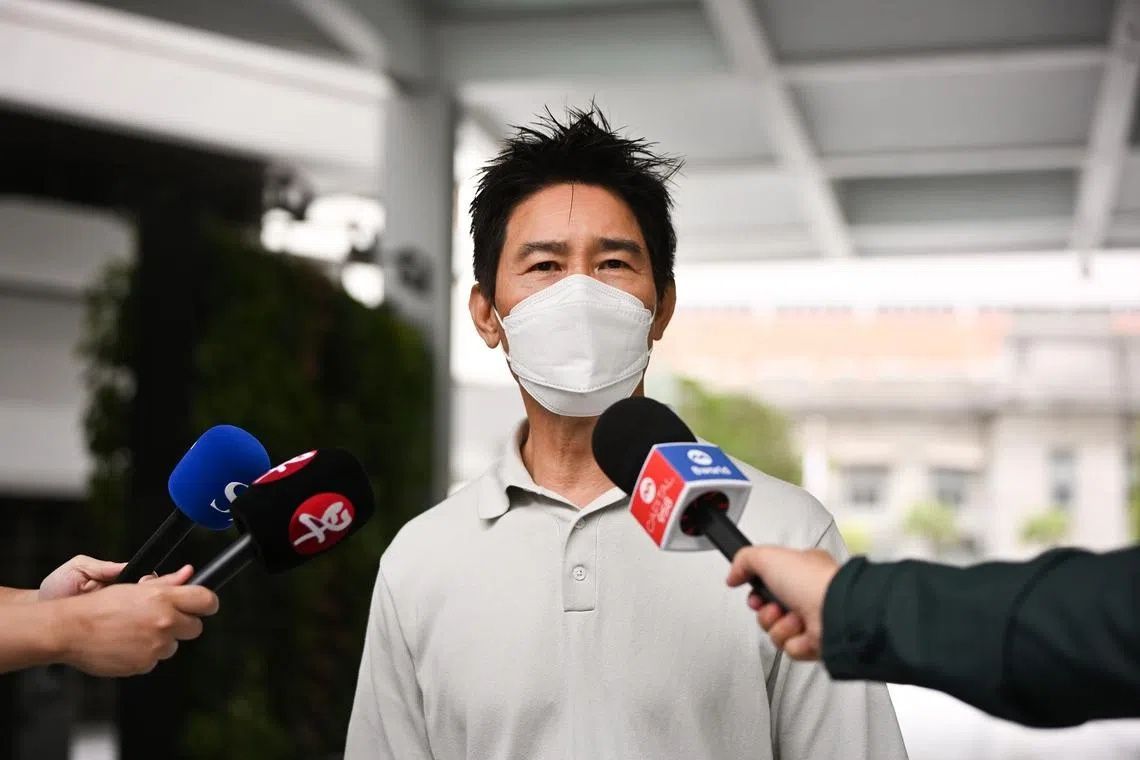
Edmund Chen, the 64-year-old former television actor whose legal name is Tan Kai Yuan, has secured a significant reduction in his custodial sentence following a successful appeal heard in Singapore's High Court on Monday, July 20. The actor's five-day jail term, originally imposed in January for causing grievous hurt in a traffic collision, has been trimmed to just one day, though he will remain subject to a five-year driving ban and a fine component as determined by the appellate bench. The case highlights the ongoing tension in Singapore's justice system between holding drivers accountable for reckless behaviour and ensuring that punishment remains proportionate to the harm caused.
The accident in question occurred on March 4, 2025, at noon along the Ayer Rajah Expressway heading towards the Central Expressway. Chen, who was operating his private vehicle in the fourth lane, had slowed his car substantially and began filtering across the third lane without being positioned in the correct lane for a road split ahead. His manoeuvre was designed to access the Central Expressway or Seletar Link, but the execution proved problematic. A 21-year-old motorcyclist approaching from behind attempted to avoid the vehicle by swerving but collided with Chen's car nonetheless, resulting in multiple fractures to the rider's wrists that required surgical intervention at Singapore General Hospital.
Justice Hri Kumar Nair, delivering the appellate judgment, determined that while the original five-day custodial sentence was manifestly excessive, the district judge's decision to cross the custodial threshold was not necessarily wrong in principle. This nuanced ruling suggests the appeal succeeded primarily on the basis of sentencing severity rather than the fundamental appropriateness of imprisonment. The court's reasoning acknowledged that the circumstances of the incident warranted serious consideration but that the severity imposed in the lower court had overreached. This distinction carries implications for future traffic cases involving injury, as it establishes boundaries on how far sentencing judges can venture into custodial punishment for non-grievous traffic offences.
Chen's legal team, led by newly engaged Senior Counsel Abraham Vergis from Providence Law Asia, mounted a compelling argument centred on proportionality and the nature of the injuries sustained. Vergis emphasized that the motorcyclist's fractures, while serious enough to warrant hospitalisation and surgery, remained localised to the extremities and were treated under local rather than general anaesthesia. The victim spent two days in hospital and received 99 days of hospitalisation leave but suffered no permanent disability. These facts, Vergis contended, positioned the case at the lower end of the grievous hurt spectrum and did not justify incarceration. The lawyer further noted that maximum financial penalties of up to S$5,000, combined with the driving disqualification, would suffice to serve the interests of justice and public safety.
Dashcam footage presented during the proceedings provided critical context for understanding the accident's mechanics. The recording showed that Chen had activated his indicator lights before changing lanes, satisfying at least one element of procedural road safety. However, the footage also revealed that a passing vehicle had obstructed the motorcyclist's view due to the road's curvature, complicating the motorcyclist's ability to anticipate Chen's manoeuvre. Vergis highlighted this obstruction as evidence that Chen's actions, while undeniably careless, occurred within a context of partially compromised visibility conditions. Additionally, the footage demonstrated that Chen had crossed white chevron markings during the incident, an infraction that had weighed heavily in the district judge's original sentencing decision.
The prosecution's position, represented by Deputy Public Prosecutor Ben Tan, maintained that the original sentence reflected appropriate judicial discretion within sentencing guidelines. The prosecutor pointed to the fact that drivers of two separate vehicles had sounded their horns to warn Chen of the danger posed by his manoeuvre, yet he persisted regardless. This detail suggested a degree of inattentiveness or disregard for warnings that elevated the culpability beyond mere careless driving. The prosecution argued that while the district judge's sentence landed toward the higher end of the permissible range, it did not constitute an error serious enough to warrant appellate intervention. However, the High Court ultimately disagreed with this assessment, determining that the one-day reduction was necessary to achieve proportionality.
Chen's personal circumstances appear to have influenced both his legal strategy and courtroom presentation. Before the appeal hearing, he spoke to reporters about his anxiety regarding the proceeding, revealing that he had brought five days' worth of medication and that neither he nor his family had slept the previous night. These admissions painted a picture of significant psychological distress, which his defence team used to support arguments that he had been sufficiently traumatised by the incident and would be unlikely to engage in reckless driving behaviour in future. This emotional dimension, while not formally determinative in sentencing law, may have contributed to the appellate bench's willingness to view the original punishment as excessive.
Chen's career trajectory adds another layer to public interest in this case. He was once a household name in Singapore's entertainment industry, having appeared in multiple popular television drama series including Star Maiden and Patrol during his active performing years. He stepped away from show business in 2000 when his daughter was born, though he subsequently accepted occasional acting assignments, most notably in the 2017 television drama Life Less Ordinary. His marriage to veteran actress Xiang Yun, celebrated for roles in classic local productions such as The Awakening, Double Happiness and The Little Nyonya, further connects him to Singapore's cultural landscape. This background means that the case has received considerable public attention beyond its legal merits, intersecting celebrity, traffic safety and judicial discretion.
The changing composition of Chen's legal representation throughout the proceedings merits attention for what it reveals about strategy evolution. Initially represented by Invictus Law's Josephus Tan and Cory Wong following the sentencing in January, Chen subsequently engaged Kelvin Ong and Dickson Chew from Contigo Law before ultimately retaining the prominent Senior Counsel Abraham Vergis for the appellate stage. This sequence suggests that Chen's family recognised the necessity of increasingly sophisticated legal firepower as the case progressed through appellate channels, a pattern common among defendants with financial resources to pursue multiple layers of judicial review.
The appellate outcome carries broader implications for traffic accident jurisprudence in Singapore and potentially across Southeast Asia, where jurisdictions often grapple with balancing road safety enforcement against punishment proportionality. The High Court's reduction of Chen's sentence to one day effectively signals that custodial punishment for traffic accidents should be reserved for cases involving either more severe injuries, evidence of egregious recklessness, or circumstances involving repeat offending or dangerous driving patterns. For ordinary motorists whose carelessness results in injury but without deliberate or grossly negligent conduct, the ruling suggests that financial penalties and driving disqualifications may constitute adequate legal consequences. This clarification provides useful guidance for sentencing judges facing similar cases and establishes clearer parameters for what conduct truly warrants incarceration.
Regional observers should note that this case exemplifies how common law jurisdictions like Singapore approach traffic offences with increasing sophistication. Rather than applying formulaic sentencing matrices, the courts are developing nuanced jurisprudence that considers injury severity, driver conduct patterns, visibility conditions, and the broader context of road safety. For Malaysia and other ASEAN nations with comparable legal systems, the Chen case offers instructive precedent on how appellate courts can intervene in sentencing decisions without dismantling trial judges' discretionary authority. The five-day-to-one-day reduction demonstrates that appellate review remains a meaningful check on lower court sentencing decisions, particularly when proportionality appears compromised. As road traffic accidents continue generating serious injury and fatality across the region, this refined approach to balancing accountability with fairness becomes increasingly important for maintaining public confidence in the justice system.

