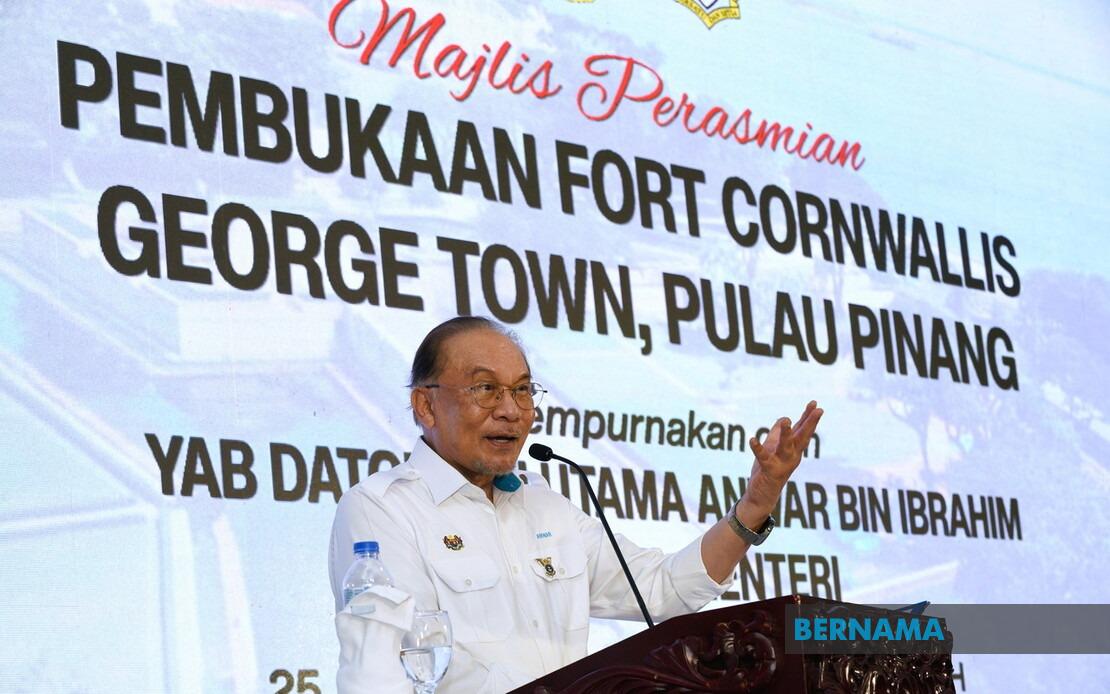
Prime Minister Datuk Seri Anwar Ibrahim has urged the nation to reimagine its approach to historical preservation, arguing that iconic sites like Fort Cornwallis in George Town should serve primarily as classrooms where citizens learn lessons rather than as scenic backdrops for photographs. Speaking at the opening ceremony of the restored fort on July 25, Anwar emphasised that educational value must accompany physical preservation if Malaysia is to ensure younger generations grasp the true significance of the nation's past.
The Prime Minister articulated a vision where visits to heritage sites become structured learning experiences focused on imparting substantive historical knowledge. Rather than allowing visitors to absorb only aesthetic impressures of colonial-era architecture and landscapes, Anwar advocated for comprehensive interpretive frameworks that contextualize each location within the broader narrative of Malaysia's struggle for independence and nation-building. This approach reflects growing recognition across Southeast Asia that tourism dollars should not come at the expense of historical literacy among local populations.
Anwar stressed that the narrative surrounding such sites must be fundamentally reframed. Instead of accepting the perspective embedded in these colonial structures by their original builders, Malaysia should reclaim ownership of these histories by presenting them through the lens of those who lived under colonialism. The suffering, sacrifice and resilience of ordinary Malaysians during the colonial period represent the true story deserving prominence, not the architectural achievements or administrative efficiency of foreign powers. This represents a conscious decolonization of how the nation remembers its past.
The restoration of Fort Cornwallis, the Prime Minister clarified, was never intended to glorify the machinery of colonial control. Rather, the conservation project represents an opportunity to confront uncomfortable historical realities and extract meaningful lessons applicable to contemporary governance and national cohesion. By maintaining these sites in good condition, Malaysia creates accessible spaces where citizens can directly encounter the physical remnants of their subordination and draw strength from how their ancestors ultimately triumphed over foreign domination.
For younger Malaysians, Anwar suggested, exposure to such sites carries particular importance in an era where national identity faces constant pressure from globalization and digital fragmentation. When young people understand viscerally what independence cost their nation—the lives lost, the freedoms denied, the resources extracted—they develop deeper appreciation for the constitutional protections and democratic structures their parents built. This emotional and intellectual connection to history functions as a bulwark against complacency and apathy toward civic responsibilities.
The Prime Minister highlighted a crucial political lesson embedded in Malaysia's colonial experience: the dangers of disunity when facing external pressure. When a nation lacks internal cohesion and shared purpose, Anwar noted, it becomes vulnerable to manipulation by foreign interests pursuing their own strategic agendas regardless of local consequences. This insight carries immediate relevance for contemporary Malaysia, where religious, ethnic and partisan divisions occasionally threaten the fragile consensus that underpins the social contract. Historical sites become venues for reinforcing why transcending such divisions remains essential for national survival.
Anwar's remarks reflect broader intellectual currents within Southeast Asian leadership circles regarding how post-colonial nations should engage with their historical inheritance. Unlike Western nations that often treat heritage conservation as primarily an aesthetic or cultural enterprise, Southeast Asian governments increasingly view such sites as strategic assets for nation-building and national resilience. The Prime Minister's framework positions historical education as inseparable from efforts to strengthen racial harmony, deepen patriotic commitment, and build immunity against external interference.
The practical implications of Anwar's vision extend to how Malaysia manages heritage tourism moving forward. Government agencies and private operators managing historical sites would need to invest significantly in curatorial expertise, interpretive materials, and educational programming. Guides at Fort Cornwallis and similar locations would require training not merely in historical facts but in how to communicate the emotional and political dimensions of colonial exploitation. Schools could structure field trips around learning objectives rather than treating visits as recreational breaks from classroom routine.
This approach also acknowledges that Malaysia's younger generation, increasingly mobile and globally connected, may have limited familiarity with national history taught through textbooks alone. Experiential learning at preserved historical sites offers pedagogical advantages that traditional instruction cannot replicate. Walking through Fort Cornwallis while learning about the lives disrupted by its construction, the resources extracted through colonial commerce, and the determination that ultimately forced the British departure creates layered understanding that transcends classroom instruction.
The Prime Minister's emphasis on reconstructing history from Malaysian perspectives rather than colonial ones signals recognition that official narratives still carry colonial imprints despite decades of independence. British historians and administrators shaped how Fort Cornwallis was understood and recorded; Malaysian historians and educators must now undertake the work of reinterpretation, centering voices and experiences that colonial archives systematically marginalized or ignored. This process of rewriting national history represents ongoing decolonization essential to genuine independence.
For Malaysia's regional standing, Anwar's remarks position the nation as intellectually engaged with post-colonial theory and development challenges shared across Southeast Asia. Other nations grappling with similar questions about heritage preservation and historical education may look to Malaysia's evolving approach as a model. The challenge will be translating these aspirational statements into concrete policy changes and funding allocations that genuinely transform how historical sites function within the educational ecosystem.

